Digital Competences in European Basic Education Curricula: A Document Analysis
 Emily Ellen Lima de Souza
  Instituto de Educaçao da Universidade de Lisboa, PortugalElisabete Cruz Instituto de Educaçao da Universidade de Lisboa, PortugalFernando Albuquerque Costa Instituto de Educaçao da Universidade de Lisboa, Portugal
How to cite: De Sousa, E. E., Cruz, E. y Costa, F. (2026). Digital competences in european basic education curricula: a document analysis. Revista Electrónica de Investigación Educativa, 28, e02, 1–17. https://doi.org/10.24320/redie.2026.28.e02.6574

Abstract
This study aims to analyze and understand the integration of digital competences into official curricula in Europe during the early years of basic education. The research utilized document analysis, systematically and carefully examining curriculum documents from six European countries (Estonia, Latvia, Wales, Scotland, Iceland, and Northern Ireland). While the results reveal the existence of different approaches to the integration of digital competences into the curriculum, a cross-cutting approach is most prevalent, with a strong focus on competences associated with online research and communication. Three countries establish progression levels for digital competences, but only one provides detailed guidance for their assessment. The findings of this study are relevant for educators, researchers, and educational policymakers. They provide a fundamental basis for informed and strategically oriented curricular decisions to enhance consistent and intentional teaching of digital competences, especially in the early years of basic education.
Keywords: digital skills, basic education, curriculum research
I. Introduction
Digital technologies are an integral part of 21st-century daily life. Directly or indirectly, they have revolutionized how we interact with each other, create content, and access information. Indeed, technology has become embedded in the way younger generations make sense of the world, especially Generation Alpha, born from 2010 onward (McCrindle et al., 2014).
Contrary to the notion that this generation is composed of “digital natives” (Prensky, 2001), research has demonstrated that exposure alone to digital technologies does not necessarily equip individuals to use them effectively and safely (Kennedy et al., 2010; ECDL, 2015; Iglesias et al., 2023). A study by Iglesias et al. (2023) illustrates this, showing that a significant number of students in Spanish basic education continue to exhibit insufficient digital proficiency, with minor differences between students of different genders or between public and private schools. Similarly, research by Garcia-Valcarcel et al. (2019) lends further weight to the need to support knowledge, skills, and attitudes in the digital realm, finding that young people still do not use the internet in a healthy and safe manner, despite spending considerable time online.
The imperative of preparing young people to deal with new technologies and the challenges they pose has led to deeper reflections in recent years, in various European Union countries, on how to integrate digital technologies into the school curriculum in a cross-cutting and meaningful way. For instance, the Digital Education Action Plan 2021-2027 (European Commission, 2020) aims to involve Member States in providing students with exposure to a wide range of digital technologies while also “[equipping] all learners with digital competences (knowledge, skills and attitudes) to live, work, learn and thrive in a world increasingly mediated by digital technologies” (European Commission, 2020, p. 2). This calls for curriculum renewal to address both which digital competences are taught and how they are supported.
In this context, there is an urgent need to understand how to integrate this new knowledge into the curriculum. However, as noted by Williamson (2013), despite a growing focus on the relationship between media and learning in educational research, limited attention has been given to the implications of this digital era for the curriculum. This paucity of scholarly work is even more pronounced in the case of younger students, with even fewer studies and curriculum documents specifically dedicated to developing and evaluating digital competences in younger learners (Martínez-Piñeiro et al., 2019; Sousa, 2023; Sousa et al., 2022).
In basic education, a scarcity of resources and tools to support assessment of these competences has been observed, as well as difficulty in measuring learning in the digital domain among younger learners (Baeza-González et al., 2022; Godaert et al., 2022), despite assessment being essential for better learning. In addition, teachers believe that more digital training programs and initiatives are needed to enable them to feel better prepared to develop their students' digital competences (Directorate-General for Education, Youth, Sport and Culture, 2020). This reinforces the importance of clear and useful curriculum documents to enhance and support consistent and intentional teaching of digital competences.
In light of the above, this study aims to analyze and understand how digital competences are addressed in official curricula during the first stage of basic education. Specifically, the goal is to identify patterns and trends in curricular approaches to digital competences in the early years of schooling by analyzing similarities and differences in the curriculum documents of various European countries. The study seeks to answer the following research questions:
Q1. How are digital competences positioned and integrated into curriculum documents in European countries?
Q2. Which domains of digital competences are prioritized in these curriculum documents?
Q3. How are the progression or proficiency levels of targeted digital competences defined?
Q4. How do these curriculum documents approach the assessment of digital competences?
The following section presents the methodological approach adopted to analyze the curricula, explaining and justifying the methods used for data collection and processing. Subsequently, we provide a detailed description of the study results in relation to the research questions. Finally, we conclude with a brief discussion and reflection on trends in curricular approaches to digital competences in the early years of schooling. We also identify some limitations of this study, which may serve as starting points for further research on this topic.
II. Method
Document analysis techniques and procedures were chosen for this study. This method, widely recognized for its value in educational research, facilitates the triangulation of data from different sources but also has the potential to reveal nuances and novel aspects of a particular topic or problem (Bowen, 2009). This technique does not merely define a set of documents to be scrutinized but also involves the selection, evaluation, and synthesis of data contained in the documents.
To ensure objectivity and rigor in the process, we established inclusion and exclusion criteria for the corpus of documents and also defined specific objectives to guide the analysis (Table 1).
| Specific objectives | Identify the status attributed to digital competence in the documents; Map the domains of digital competences covered by the documents; Identify progression or proficiency levels and descriptors to compare the progression/development of digital competences; Understand how the documents address the assessment of students’ digital competences in primary education. | |
| Inclusion criteria | Curriculum documents that explicitly mention learning outcomes and criteria for assessing digital competences in primary education, mentioned in the Eurydice report (European Commission: European Education and Culture Executive Agency [EACEA], 2019). | |
| Exclusion criteria | Curriculum documents that do not address students' digital competences; Curriculum documents not published on official government websites of the corresponding country; Curriculum documents not available online. | |
| Nota: ** la correlación de Spearman es significativa en el nivel 0.01 (bilateral). | ||
As indicated in Table 1, one of the inclusion criteria was that the document must be referenced in the Eurydice report Digital Education at School in Europe (European Commission/EACEA, 2019) as a curriculum document that not only outlines learning outcomes but also criteria and/or standards for assessing digital competence in primary education. The report lists eight countries with curriculum documents that meet these criteria: Estonia, Latvia, Wales, Scotland, Iceland, Northern Ireland, the Republic of Ireland, and Montenegro. However, the Republic of Ireland and Montenegro were excluded from the study because their curriculum documents were not openly available online or published on the official websites of their respective governments, so only six of these eight countries were examined in this research: Estonia, Latvia, Wales, Scotland, Iceland, and Northern Ireland. Below, Table 2 offers a brief characterization of the curriculum documents selected for inclusion in the corpus.
| Country | Institution | Document (Title) | Level of education | Additional notes |
|---|---|---|---|---|
| Estonia | Haridus ja noorteamet (Educational and Youth Council) | Digipädevusmudelid (Student Digital Competence Model).1 | Compulsory education | The analysis examined the digital competences and assessment criteria defined for “I Kooliaste” (6-8 years) and “II Kooliaste” (9-11 years). |
| Latvia | Ministru kabineta (Council of Ministers) | Noteikumi par valsts pamatizglītības standartu un pamatizglītības programmu paraugiem (Regulation on National Standards for Primary Education and Examples of Primary Education Programs).2 | Primary Education | The analysis examined the competences and learning outcomes defined for the first six years of compulsory education (6-11 years), as available in the annexes of this document. |
| Wales | Welsh Government | Curriculum for Wales.3 | Compulsory education | The analysis examined the part of the document dedicated to cross-cutting competences, precisely the “Digital Competence Framework,” competences defined for students at the first level and second level (5-11 years).4 |
| Scotland | Education Scotland | Education Scotland: Guidance on using Benchmarks for Assessment – Technologies.5 | Compulsory education | The analysis examined the section on students' digital competences at the first level (P2-P4, 5 to 8 years) and second level (P5-P7, 8 to 11 years). |
| Iceland | Ministry of Education, Science and Culture | The Icelandic National Curriculum Guide for Compulsory Schools - with Subjects Areas [sic].6 | Compulsory education | The analysis examined the section “Information and Communication Technology.” |
| Northern Ireland | Council for the Curriculum, Examinations & Assessment |
The Northern Ireland Curriculum - Primary7; Guide to Assessment8; Levels of Progression in Using ICT Across the Curriculum: Primary (Levels 1–5).9 |
Primary Education | The analysis examined the section “Using Information and Communication Technologies Across the Curriculum.” Two complementary documents indicated in the national curriculum were also analyzed: “Guide to Assessment” (with a focus on the ICT Use section) and “Levels of Progression in Using ICT Across the Curriculum: Primary.” |
After all corpus documents were collected, a database was created using Microsoft 365 Excel to systematize the initial set of information extracted from the documents: country, issuing institution, target audience, document location, and additional notes. All six documents were then read in full, with the aid of Google Translate for those not available in English.
Next, given the nature of the data, the content analysis technique, commonly combined with document analysis (Bowen, 2009), was selected as the most suitable approach for systematizing and interpreting the information extracted from the documents. Iterative triangulation among the researchers supported the inductive development of a categorization system consisting of four main categories and 17 subcategories, as summarized in Figure 1.

This system was established progressively through a process of deliberation among the three researchers until consensus was reached. Each document was then analyzed and coded based on the defined categories. The first author coded the documents, recording all decisions in an Excel document, including uncertainties and issues requiring clarification. Subsequently, cross-validation was carried out between the other two researchers, who took on the role of supervisors and did not participate in the initial coding process. This final check was essential to ensure impartiality and consistency in the predefined categories.
Following analysis and interpretation of the categorized excerpts, descriptive summaries were developed for each case to highlight the key findings, with examples for each of the categories.
III. Results
This section presents the findings from a corpus of curriculum documents from six countries: Estonia, Latvia, Wales, Scotland, Iceland, and Northern Ireland. The results are presented based on the analytical categories used in the document analysis: 1. Status of Digital Competence; 2. Digital Competence Domains; 3. Levels of Progression/Proficiency; and 4. Assessment of Digital Competence.
3.1 Status of Digital Competence
Digital competence takes on various roles across curricula. It may take the form of cross-cutting knowledge integrated into different curriculum areas, while in other cases it is presented as a standalone discipline. Of the six documents analyzed, four describe digital competence as cross-disciplinary, consistent with the Curriculum Guidelines for ICT in Primary Education (1st Cycle) in Portugal, the context in which this research was conducted. Table 3 presents the status of digital competence in the various curriculum documents analyzed.
| Status of digital competence | National curriculum document | |||||
|---|---|---|---|---|---|---|
| Estonia | Latvia | Wales | Scotland | Iceland | Northern Ireland | |
| Cross-cutting competence | x | x | x | x | ||
| Standalone curricular area | x | |||||
| Content integrated into a curricular area | x | x | ||||
The Estonian curriculum includes a local digital competence model based on the European Digital Competence Framework (Carretero et al., 2017). This model is intended to guide cross-curricular development of digital competence for students and teachers. In recognition of the plurality of concepts and definitions, in the Estonian document the digital competence model is understood as a hierarchical, taxonomic or matrix-based construct that describes the components of digital competence (Haridus ja noorteamet, 2020).
Similarly, in the Welsh curriculum (Welsh Government, 2020), digital competence is mandatory and cross-cutting, with educators from different curriculum areas sharing responsibility for digital competence development and progression. This is similar to the perspective of the curriculum of Northern Ireland, where the use of information and communication technologies and the development of digital competences throughout the curriculum are advocated through activities that simulate real-life situations and information searching that is meaningful for learning (Council for the Curriculum, Examinations & Assessment, 2019).
In Latvia's curriculum framework, “digital literacy” skills are identified as cross-cutting competences within the values and core content specified for the nine years of education at this level. They are defined as the responsible and effective use of digital technologies to acquire knowledge, create new content, share and communicate content, and critically and constructively evaluate the role of technology and media in society (Ministru kabineta, 2018). In Latvia, “technology learning” is mandatory, and the curriculum also includes digital technology competences as an integral part of the broader subject area “Technologies.” Some digital competences are considered cross-curricular, while others are more specific and confined to a particular subject area.
Similarly, in the Scottish curriculum, digital competences are integrated into the “Technologies” area, specifically as part of “Digital Literacy,” which encompasses three competence domains: 1. Using digital products and services in a variety of contexts to achieve a purposeful outcome; 2. Searching, processing, and managing information responsibly; 3. Cyber resilience and internet safety.
Finally, in Iceland, although digital competence is established as a standalone subject area, the country's national curriculum also notes the cross-curricular nature of digital competences and the need to integrate them with other areas. This is because the intended digital learning outcomes are explicitly specified and can be integrated into most subjects. Additionally, the document includes a focus on “introducing pupils to technology and methods for acquiring, processing, creating and communicating information in relation with other studies” (Ministry of Education, Science and Culture, 2014, p. 238).
3.2 Digital Competence Domains
Next, the analysis sought to determine which digital competences were prioritized at this stage of compulsory education and how these competences were organized in each document. Table 4 summarizes the digital competence domains present in the analyzed documents.
| Knowledge, skills, and attitudes related to… | National curriculum document | |||||
|---|---|---|---|---|---|---|
| Estonia | Latvia | Wales | Scotland | Iceland | Northern Ireland | |
| Information searching, management, and validation | x | x | x | x | x | x |
| Online communication and collaboration | x | x | x | x | x | x |
| Creation of digital content | x | x | x | x | x | |
| Digital safety | x | x | x | x | ||
| Problem-solving | x | x | x | x | ||
| Self-assessment | x | x | x | |||
| Virtual etiquette awareness (“netiquette”) | x | x | x | x | x | |
| Technical use of digital devices and software | x | x | x | |||
| Programming | x | x | x | |||
| Health and well-being protection | x | x | x | |||
| Environmental protection | x | x | ||||
Table 4 shows that knowledge, skills, and attitudes related to searching for and managing information on the internet, as well as online communication and collaboration, were prioritized in all the analyzed curriculum documents. The second most commonly observed digital competences were those associated with digital content creation and procedures, as well as proper online etiquette. Learning about sustainable digital use, including understanding the environmental impact of digital technology, only appears in the curriculum documents of Estonia and Latvia, making it the least prevalent digital competence in the documents analyzed.
3.3 Levels of Progression/Proficiency
All the curriculum documents analyzed explicitly define which digital competences they consider essential for students aged six to ten. However, only three of the analyzed curricula (Wales, Scotland, Northern Ireland) establish levels of progression/proficiency for these competences. More commonly, the documents choose to establish progression levels only between cycles of compulsory education, and not between individual years of a given cycle.
In the Welsh curriculum, each of the 12 subdomains of digital competence is described in five ascending levels of progression. Figure 2 is taken from the Welsh curriculum document and illustrates the progression levels defined in the subdomain “Communication,” within the domain “Interacting and Collaborating.”
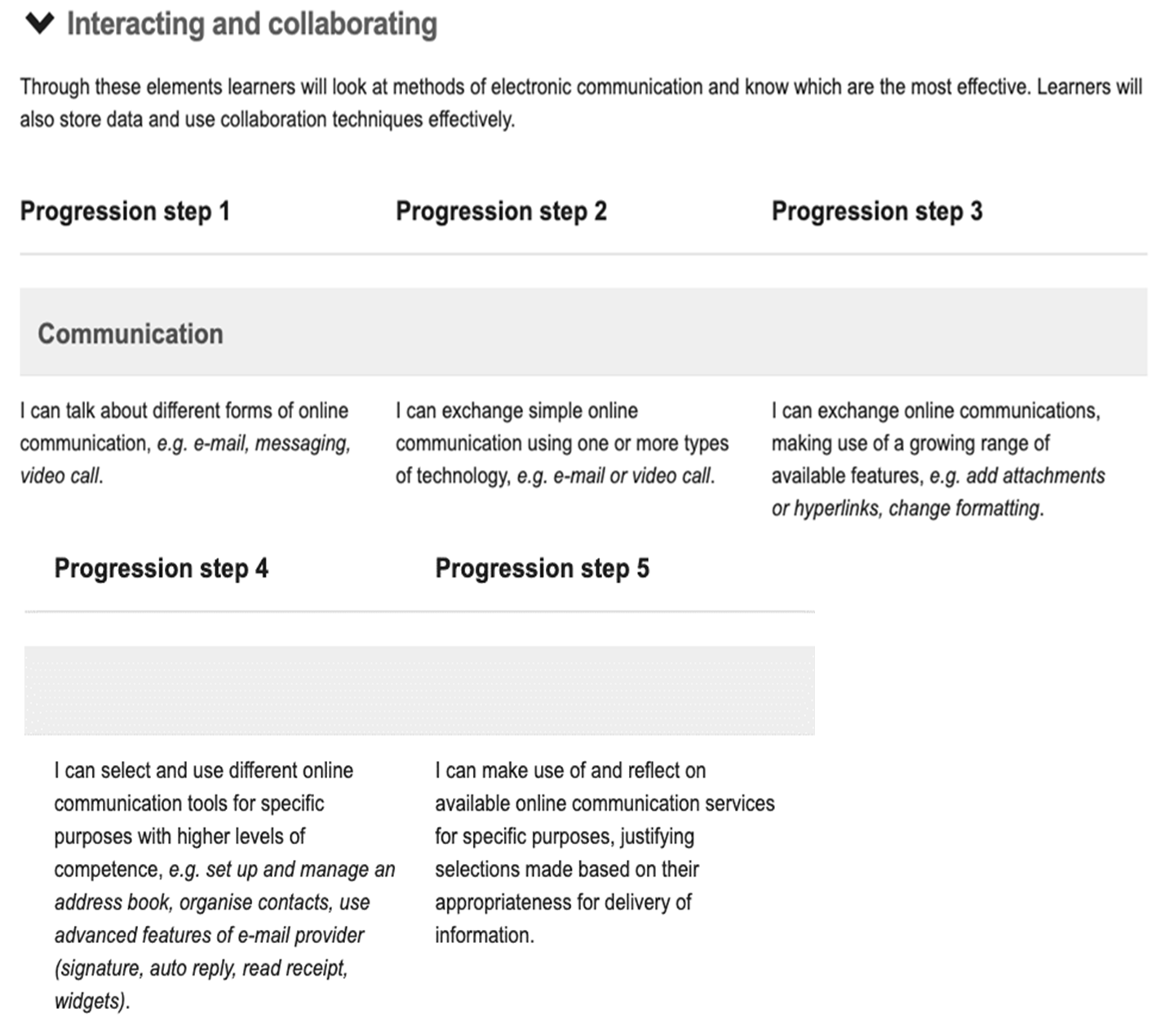
Each level of progression represented above corresponds to a specific age (5, 8, 11, 14, and 16 years, respectively). This approach is based on five principles of progression in learning, namely: i) increasing effectiveness as a learner; ii) expanding the breadth and depth of knowledge; iii) deepening the understanding of ideas/disciplines within the areas of learning and experience; iv) refining and increasing sophistication in the use and application of competences; and v) creating connections and transferring learning to new contexts (Welsh Government, 2020).
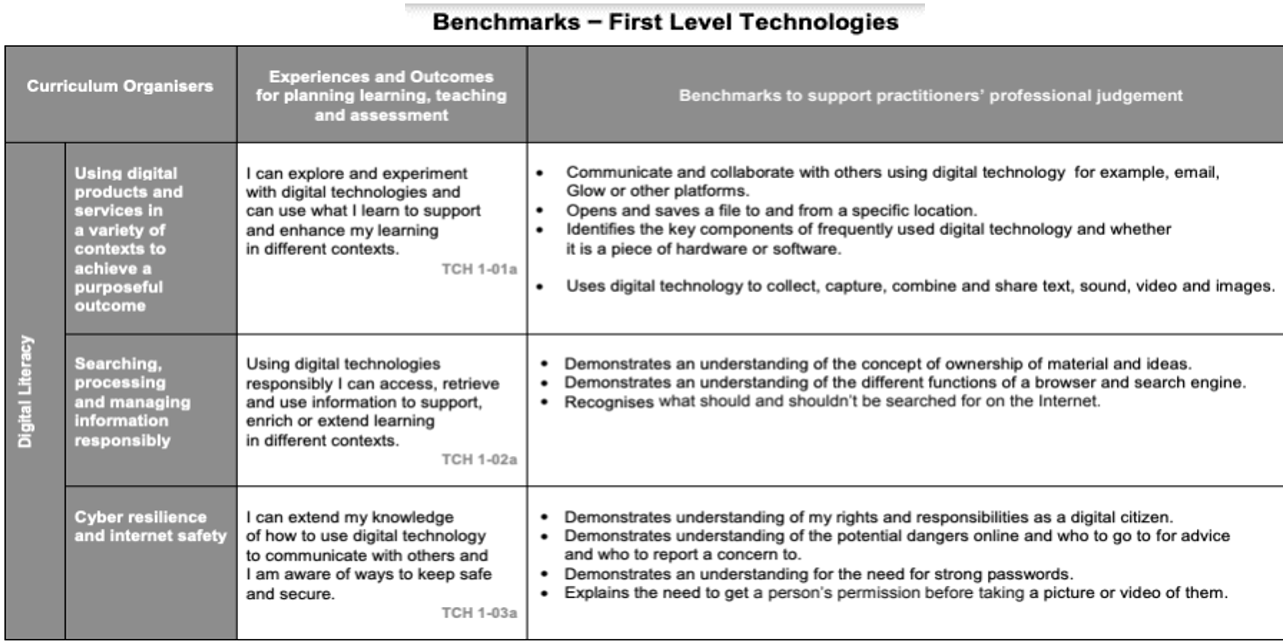
One curriculum with explicitly outlined progression levels in primary education is that of Scotland, where the development of students' abilities, knowledge, and attitudes is structured progressively across years. The second level of progression (“First Level”) is of particular interest as it covers students who are, on average, 5-8 years old, equivalent to the first cycle of primary education in Portugal. The third level of progression (“Second Level”) is also of interest as it includes students from P5 to P7, aged 8-11. The curriculum specifies which competences students should acquire at each level for each of the domains within the “Digital Literacy” area. Figure 3 and Figure 4 present the digital competences expected of students at the second level of progression (“First Level”) and the third level of progression (“Second Level”).

The third curriculum document to explicitly set out progression levels across primary education is that of Northern Ireland. The area titled “Using ICT” is divided into five domains, and the document outlines the skills that students are expected to demonstrate in each of these domains, across seven progression levels aligned with the school years. The focus of this research was Key Stage 1 (6-8 years), where competences are operationalized from Level 1 to 3. Students are expected to perform at least at Level 2 by the end of Key Stage 1.
Key Stage 2 (8-11 years) includes the three levels from Key Stage 1 and adds two more, resulting in a total of five levels (from 1 to 5). By the end of this stage, students are expected to be at least at Level 4. Figure 5 shows the five progression levels for Key Stage 2 (including the first three also covered in Key Stage 1) within the domain “Explore.”

None of the curriculum documents discussed above provide a reference framework with year-to-year progression levels, instead establishing learning outcomes to be achieved within a time frame. In some cases, this resulted in two distinct proficiency stages within the early years of basic education.
3.4 Assessment of Digital Competence
Four of the six documents highlight the need to assess digital competences in primary education. However, only the Northern Irish curriculum clearly presents the methods or tools with which they can be assessed, as summarized in Table 5.
| Assessment of digital competence | National curriculum document | |||||
|---|---|---|---|---|---|---|
| Estonia | Latvia | Wales | Scotland | Iceland | Northern Ireland | |
| Explanation of the need to assess digital competences in the early years of primary education | x | x | x | x | ||
| Definition of assessment methods and tools for digital competences in the early years of primary education | x | |||||
In the Estonian curriculum, the digital competence model is notable for describing each of the 21 digital competences in terms of corresponding skills, knowledge, and attitudes. For example, in Competence 1.2 (“Assessment of digital data, information, and content”) in Domain 1 (“Information and data literacy”), the curriculum states that in I kooliaste (automatically translated as “first grade”), the student should “identify the author of the source found” (1.2.2) and “understand that information on the web may not be reliable” (1.2.3). The document addresses all 21 competences for each cycle of education, intending that they serve as criteria to be used and adapted by each teacher to assess students' digital competence development, despite not specifically stating how this assessment should be undertaken.
The Welsh curriculum gives no details on how to assess digital competences. However, it emphasizes their integral role within the curriculum and their importance in promoting shared understanding (by learners, teachers, and parents) of a student's progress across various areas, including the digital domain.
In Scotland and Northern Ireland, the curriculum documents emphasize the importance of assessing digital competences from the early years of schooling. The Scottish curriculum, for example, stresses that assessment is an integral part of teaching and learning and is always an ongoing process, and that the accomplishment of a level of progression is directly related to teachers' judgments of their students' capabilities. However, these judgments should always be evidence-based. “Benchmarks” were developed to support teacher judgment but are not intended to be prescriptive.
In a supplementary volume of the curriculum of Northern Ireland, guidelines are presented to support schools (both teachers and top and middle leadership) in assessing cross-cutting competences throughout compulsory education, including in the area “Using ICT.” Details are given on supporting materials and teachers are also strongly encouraged to conduct assessment activities using computers (which may be complemented with other strategies) as they facilitate the compilation and reporting of results to school leadership and parents. Another important observation is the emphasis on the alignment between formative assessment at certain points during the school year and summative assessment at the end of a semester or academic year.
IV. Discussion and conclusions
Faced with a growing need to prepare younger students to be critical and proficient users of digital technologies (Council of the European Union, 2018; ECDL, 2015) and the ongoing difficulty, identified in previous research (Iglesias et al., 2023; García-Valcárcel et al., 2019), of developing digital competences among young people, this study focused on analyzing and understanding how digital competences are addressed in official curricula during the first stage of basic education in Europe. Specifically, the goal was to identify trends in curricular approaches to digital competences, observing similarities and differences across European countries.
The majority of examined curricula were found to treat digital competences as cross-curricular. While some documents present them as an independent curriculum area (Ministry of Education, Science and Culture, 2014) or integrate them within specific subjects (Ministru kabineta, 2018; Education Scotland, 2017), a cross-curricular approach to digital competences predominates, in the belief that promoting digital competences in conjunction with other areas of the curriculum will better support learning. This cross-curricular approach provides a more meaningful context for the development of digital competences, allowing them to be applied more holistically in response to the demands of a constantly evolving technological landscape (Departament d’Ensenyament, 2013). Additionally, this interconnection between the digital domain and various curriculum subjects expands students' understanding of the value and applicability of digital competences in their academic journey.
A consistent focus was observed on competences associated with “searching for, managing, and validating information” and “online communication and collaboration” in all examined documents. These findings align with other studies that analyzed international frameworks (Mattar et al., 2022); most documents included domains of digital competences related to “information and data,” “communication,” “collaboration,” and “technical skills.” In contrast, there was not a prominent focus on digital competences related to “programming,” “health and well-being,” and “environmental protection.” The limited focus on these domains of digital competences highlights a gap between the official curriculum and both the needs of the social context and major theoretical frameworks (Baeza-González et al., 2022), depriving students of the opportunity to develop competences in areas considered fundamental for a holistic understanding of technological changes, and for self-care and environmental awareness. In this sense, this observation also signals both an opportunity and a need for a more flexible and dynamic update of school curricula, to include emerging domains essential for students' comprehensive education.
This analysis showed that only half of the examined curriculum documents established progression levels across the years of primary education. However, none of these documents set specific digital competences to be achieved year by year. In some cases, the learning objectives in this domain were outlined over a broader time frame, with two specific proficiency stages in the digital domain. The absence of precise year-by-year expectations for digital competences reflects a highly flexible curricular approach in primary education, with the potential to accommodate variations in student learning paces in a holistic and integrated manner. However, this lack of explicit guidance could also impact consistency in teaching these competences, a challenge that was also identified by Mattar et al. (2022). Therefore, future research may wish to explore the possibility, tentatively suggested in the curricula examined here, of defining two digital proficiency stages across the years of primary education, making monitoring and assessment of individual progress less complex and challenging for teachers. A more in-depth analysis of this strategy could focus on evaluating its effectiveness in the intentional and progressive development of digital competences over the first four years of basic education, and explore its adaptability to individual variations in the learning process.
Finally, most documents highlight the need for digital competence assessment in primary education, a critical aspect identified by previous research (Amante et al., 2021, Godaert et al., 2022, Martínez-Piñeiro et al., 2019; Siarova et al., 2017). However, only one curriculum provides a clear definition of methods or tools for this assessment. Therefore, these findings suggest greater attention is needed to ensure that expected digital competence outcomes in primary education are clearly outlined in curriculum documents. Since specific indications for the operationalization and assessment of these competences in schools remain scarce, it is essential to develop more detailed guidelines so that all students in primary education can consistently and meaningfully develop socially relevant digital competences and their progress in this key learning domain can be monitored.
However, as with any study, this work is not without limitations. Due to time and human resource constraints, the corpus of documents was restricted to those mentioned in the Eurydice report “Digital Education at School in Europe” (European Commission/EACEA, 2019), which represents a sampling limitation. For future research, we recommend expanding the corpus by including more curriculum documents from other European countries and even incorporating those of non-European countries. This would contribute to a more comprehensive and diverse perspective on the topic. The temporal limitations are also relevant, as the analyzed documents may have been updated after the corpus was selected and compiled, and consequently, the corpus may not reflect the most recent educational and curricular policies or any changes introduced subsequently. Additionally, this methodological approach is strictly based on document analysis. While suitable and valuable for achieving the objectives outlined in this study, this method offers only a limited glimpse into curricular practices and is confined to official curriculum documents. For a more comprehensive and in-depth understanding of the interaction between curriculum policies and their practical implementation, future studies may favor a mixed-methods approach. Complementary techniques, such as interviews with teachers and analyses based on the observation of real learning dynamics, may capture not only the formal guidelines set out in official documents but also how they are interpreted, adapted, and applied in classrooms.
Despite the acknowledged limitations, this study makes a significant contribution to research on curricular practices to prepare students for the challenges of a constantly evolving digital world. This study is unique in that it expands available knowledge about the vision and strategies for developing digital competences in the early years of compulsory education, as they are set out in European policy and curriculum frameworks. The detailed approach taken here, based on the analysis of curriculum documents from various European countries, provides a comprehensive overview and highlights patterns and trends in relation to four core aspects: the positioning and integration of digital competences in curriculum documents, key domains of digital competence in the examined contexts, established levels of progression or proficiency, and the approaches taken to the assessment of digital competences. These findings are relevant not only for the educational community and researchers but also for policymakers, offering evidence that can inform adjustments to existing strategies with the aim of supporting intentional and consistent teaching of digital competences in the early years of basic education.
Writing review: Joshua Parker
Contribution of each author
Emily Ellen Lima de Souza: conceptualization, methodology (50%), data curation, formal analysis, writing – original draft.
Elisabete Cruz: supervision (60%), methodology (50%), validation (50%), writing – review and editing (50%).
Fernando Albuquerque Costa: supervision (50%), validation (50%), writing – review and editing (50%).
Declaration of no conflict of interest
The author declares no conflict of interest.
References
Amante, L., Bastos, G., & Oliveira, I. (2021). Empowering educators in digital assessment. INTED2021 Proceedings, 7729–7735. https://doi.org/10.21125/inted.2021.1554
Baeza-González, A., Lázaro-Cantabrana, J. L., & Sanromà-Giménez, M. (2022). Evaluación de la competencia digital del alumnado de ciclo superior de primaria en Cataluña [Assessment of primary education students’ digital competence in Catalonia]. Pixel-Bit. Revista de Medios y Educación, 64, 265-298. https://doi.org/10.12795/pixelbit.93927
Bowen, G. A. (2009). Document analysis as a qualitative research method. Qualitative Research Journal, 9(2), 27–40. https://doi.org/10.3316/QRJ0902027
Carretero, S., Vuorikari, R. & Punie, Y. (2017). DigComp 2.1: The digital competence framework for citizens with eight proficiency levels and examples of use. JRC Publications Repository. https://publications.jrc.ec.europa.eu/repository/handle/JRC106281
Council for the Curriculum, Examinations and Assessment. (2019). The Northern Ireland Curriculum: Primary. https://ccea.org.uk/downloads/docs/ccea-asset/Curriculum/The%20Northern%20Ireland%20Curriculum%20-%20Primary.pdf
Council of the European Union. (2018). Recomendação do Conselho sobre as Competências Essenciais para a Aprendizagem ao Longo da Vida [Council Recommendation on Key Competences for Lifelong Learning.]. https://eur-lex.europa.eu/legal-content/PT/TXT/PDF/?uri=CELEX:32018H0604(01)&from=GA
Departament d’Ensenyament. (2013). Competències bàsiques de l’àmbit digital. Identificació i desplegament a l’educació primària [Basic competences in the digital domain: Identification and implementation in primary education]. Generalitat de Catalunya. https://educacio.gencat.cat/ca/departament/publicacions/colleccions/competencies-basiques/primaria/ambit-digital/
Directorate-General for Education, Youth, Sport and Culture. (2020). Education and Training Monitor 2020. European Commission. https://www.acs.si/wp-content/uploads/2020/11/Education_and_training_monitor_2020.pdf
ECDL. (2015). The fallacy of the ‘digital native’: Why young people need to develop their digital skills. ECDL Foundation. https://ec.europa.eu/futurium/en/system/files/ged/the_fallacy_of_the_digitalnative_-_ecdl_foundation.pdf
Education Scotland. (2017). Education Scotland: Guidance on using Benchmarks for assessment–Technologies. https://dera.ioe.ac.uk/id/eprint/28596/1/TechnologiesBenchmarksPDF.pdf
European Commission: European Education and Culture Executive Agency. (2019). Digital education at school in Europe. Publications Office of the European Union. https://data.europa.eu/doi/10.2797/763
European Commission. (2020). Digital Education Action Plan 2021-2027. https://eur-lex.europa.eu/legal-content/EN/TXT/PDF/?uri=CELEX:52020DC0624
García-Valcárcel, A., Salvador, L., Casillas, S., & Basilotta, V. (2019). Evaluación de las competencias digitales sobre seguridad de los estudiantes de Educación Básica [Assessing the digital-safety competences of students in basic education]. Revista de Educación a Distancia (RED), 19(61). https://doi.org/10.6018/red/61/05
Godaert, E., Aesaert, K., Voogt, J., & van Braak, J. (2022). Assessment of students’ digital competences in primary school: A systematic review. Education and Information Technologies, 27, 9953–10011. https://doi.org/10.1007/s10639-022-11020-9
Haridus ja noorteamet. (2020). Digipädevusmudelid [Digital competence models]. https://digipadevus.ee
Iglesias, A., Martín, Y. y Hernández, A. (2023). Evaluación de la competencia digital del alumnado de Educación Primaria [An evaluation of the digital competence of primary school students]. Revista de Investigación Educativa, 41(1), 33–50. https://doi.org/10.6018/rie.520091
Kennedy, G., Judd, T., Dalgarno, B., & Waycott, J. (2010). Beyond natives and immigrants: exploring types of net generation students. Journal of Computer Assisted Learning, 26(5), 332–343. https://doi.org/10.1111/j.1365-2729.2010.00371.x
Martínez-Piñeiro, E., Gewerc, A., & Rodríguez-Groba, A. (2019). Nivel de competencia digital del alumnado de educación primaria en Galicia. La influencia sociofamiliar [Digital competence of primary school students in Galicia: Social and family influence]. Revista de Educación a Distancia (RED), 19(61). https://doi.org/10.6018/red/61/01
Mattar, J., Santos, C. & Cuque, L. (2022). Analysis and comparison of international digital competence frameworks for education. Education Sciences, 12(12), 932. https://doi.org/10.3390/educsci12120932
McCrindle, M., Wolfinger, E., & Salt, B. (2014). The ABC of XYZ: Understanding the global generations. University of New South Wales Press Ltd.
Ministru kabineta. (2018). Noteikumi par valsts pamatizglītības standartu un pamatizglītības programmu paraugiem [Regulations on the State Basic Education Standard and Model Basic Education Programmes]. https://www.vestnesis.lv/op/2018/249.5
Ministry of Education, Science and Culture. (2014). The Icelandic national curriculum guide for compulsory schools–with subjects’ areas. https://www.government.is/library/01-Ministries/Ministry-of-Education/Curriculum/adalnrsk_greinask_ens_2014.pdf
Prensky, M. (2001). Digital natives, digital immigrants. Part 1. On the Horizon, 9(5), 1–6. https://doi.org/10.1108/10748120110424816
Siarova, H., Sternadel, D., & Mašidlauskaitė, R. (2017). Assessment practices for 21st century learning: review of evidence. Analytical report. Publications Office of the European Union. https://data.europa.eu/doi/10.2766/71491
Sousa, E. E. (2023). Um dispositivo para o desenvolvimento0 e a avaliação de competências digitais de alunos do 1.º ciclo do ensino básico [A model for the development and assessment of primary school students’ digital competences] [Tese de mestrado, Instituto de Educação – Universidade de Lisboa]. Repositório da Universidade de Lisboa. http://hdl.handle.net/10451/57415
Sousa, E., Cruz, E., & Costa, F. (2022). Competências digitais dos alunos em contexto escolar: o que diz a investigação? [Students’ digital competences in schools: What does the research say?] In C. Cavaco, F. Costa, J. Marques, J. Viana, R. Marreiros, & A. R. Faria (Eds.), A educação e os desafios da sociedade contemporânea: contributos da investigação. Atas do XXIX Colóquio AFIRSE.
Welsh Government. (2020). Curriculum for Wales. https://hwb.gov.wales/curriculum-for-wales/
Williamson, B. (2013). The future of the curriculum: School knowledge in the digital age. The MIT Press. https://doi.org/10.7551/mitpress/9457.001.0001