Emotional Impact of COVID-19 on Teacher Training
 Irune Corres-Medrano
  Universidad del País Vasco, EspañaRakel Gamito Gomez Universidad del País Vasco, EspañaImanol Santamaría-Goicuria Universidad del País Vasco, España
How to cite: Corres-Medrano, I., Gamito, R., & Santamaría-Goicuria, I. (2025). Emotional impact of COVID-19 on teacher training. Revista Electrónica de Investigación Educativa, 27, e12, 1-18. https://doi.org/10.24320/redie.2025.27.e12.6262

Abstract
Today’s globalized society calls for university students able to meet the new demands of the labor market. This shift in pedagogical paradigms was accelerated by the unexpected closure of universities due to the COVID-19 pandemic. This longitudinal study explores the emotional impact of pandemic-induced changes in students’ education. A qualitative (biographical-narrative) approach was used to examine 55 autobiographical accounts by students from the School of Education and Sport of the University of the Basque Country (Spain). The results underscore the role played by ICT in closing the distance in relationships and enabling collaboration and cooperation between teachers and students. However, university students are still dependent on lectures, and the long-awaited return to in-person teaching also resulted in some emotional instability. In conclusion, although global crises of the kind recently experienced can provide opportunities to rethink teaching-learning models, no substantial methodological changes are observed in social and emotional relationships in the new normal.
Keywords: education, emotion, teacher-student relationship, university, teacher training
I. Introduction
Breaking away from a theoretical model based on the accumulation of knowledge, the university of the 21st century has embraced a new educational model that promotes quality and excellence in education with a focus on competency-based teaching and learning (Olivencia & Hernández, 2012). To achieve this, the university system undertook a process of updating its policies and curricula with the aim of forging more competitive college students able to adapt to new market demands (OECD, 2020).
In the context of this paradigm shift in education, the sudden outbreak of the global COVID-19 pandemic put society (Claessens, 2021; Dwivedi et al., 2020) and universities on alert. The first protective measure taken by universities was to suspend teaching activity immediately (Unesco, 2020), with in-person classes migrating to new online learning environments. This entailed changes – often called into question – in the teaching-learning process, both in teaching practice and in pedagogical methods and teaching and assessment techniques (Cabrera et al, 2022). Information and communication technology (ICT) played a key role in this rapid adaptation, making it possible to move education online in record time (de Vicenzi, 2020).
Despite this quick response by universities, relationships considered to be the cornerstone of the teaching-learning process were sidelined. Many studies from the early days of the pandemic described the emotional repercussions of lockdown both on schoolchildren and on teachers (Berasategi et al., 2020; González-Calvo et al., 2020; Holmes et al., 2020; UNICEF, 2020). These studies include work by Berastegi et al. (2020), who observed mixed feelings: for example, people feel joy at spending more time with loved ones, but also sadness due to social isolation, together with a fear of going out. González-Calvo et al. (2020) described feelings of insecurity, melancholy, and uncertainty in the face of new learning processes, while Holmes et al. (2020) highlighted anxiety and depression as some of the main effects. However, there has been little research to date on the social and emotional impacts that the changes in methodologies brought about by COVID-19 have had on students in universities. This research focuses on the emotional repercussions of these changes within the context of the university education of future early childhood educators.
1.1 Pandemic-driven changes in methodology and pedagogical relationships in university education
Authors like Biesta (2018) and Hernández (2012) maintain that true learning takes place as part of a social event that transforms the learner’s subjectivity. Thus, the teaching-learning process is founded on pedagogical relationships based on dialogue and interaction (González-Monteagudo & León-Sánchez, 2020; Hernández, 2021; Lay-Lisboa et al., 2018). From this perspective, the pre-COVID-19 university education model was already immersed in a transition process to replace learning strategies based on information retention with interactive and collaborative methodologies (Unesco, 2004).
One of the main consequences of the closure of universities due to the COVID-19 pandemic was an acceleration of this pedagogical paradigm shift. A model grounded in teaching, knowledge accumulation, and teacher authority suddenly gave way to one centered on learning and student autonomy (Navickiene et al., 2021). However, this change in education, imposed by the COVID-19 pandemic, laid bare the relational difficulties that already existed in university settings (Flores-Lueg & Turra-Díaz, 2019). In this sense, authors such as Giroux (2016), Krichesky and Murillo (2018), and López (2018) have criticized for years the direction being taken by relationships in society and, in particular, in universities. Specifically, they view academic relationships as becoming increasingly individualistic and competitive, and hence dehumanized and depersonalized.
As a result, research on the emotional dimension of education is gaining greater relevance (Fernández-Berrocal et al., 2017; Smith, 2019); although cognitive processes lie at the core of the teaching-learning process, performative, experiential, and/or affective processes are also indispensable (Hernández-Hernández & Sancho-Gil, 2019; Pozo, 2016). Ultimately, it is crucial to understand all processes in order to design appropriate, high-quality professional development experiences.
1.2 Objective
This work offers a reflection on the impact of the pandemic on the education of future early childhood educators, from its onset in March 2020 to December 2020. More specifically, we consider emotional aspects associated with the lockdown and the return to in-person instruction to explore the effect of students’ experiences on their perception of the quality of the education they received.
Therefore, the primary objective of this paper is to study the emotional repercussions that pandemic-induced relational and methodological changes are having on the university education of future early childhood educators, contrasting the emotional impact of the changes caused by lockdown with that of the changes that came with their return to in-person learning in college.
II. Method
2.1 Participants
A qualitative, longitudinal study was conducted over the 2019-2020 and 2020-2021 academic years with students of the bachelor’s degree in early childhood education, at the School of Education and Sport of the University of the Basque Country (Spain). Purposive and convenience sampling was used to select participants (Polkinghorne, 2005). The sample comprised 55 students, 20 male and 35 female, with a mean age of 19 years. Generally, the participants reported a medium level of knowledge about the use of new technologies, prior to the lockdown.
2.2 Design and tools
This research adopted a qualitative approach, employing a longitudinal case study grounded in the principles of narrative research (Chase, 2015). This methodology made it possible to document different points of view regarding the same event, providing insight into lived experiences and an understanding of how and why things happen (Clandinin, 2007; Simons, 2009). A biographical narrative approach allows participants to share meaningful experiences in their own voices. In this case, it also lent greater visibility to situations that had substantial emotional repercussions on educational practice (Morales et al., 2020). In particular, this study analyzes, compares, and brings to light the experiences, expectations, and fears of students of the bachelor’s degree in early childhood education during the lockdown and the return to in-person classes.
The data were collected through two instruments: an ad hoc questionnaire with 10 open-ended items (see Appendix 1) and autobiographical accounts by students, in which they recounted their perceptions of their experiences, both during lockdown and during the return to in-person learning.
2.3 Analysis of information
The information from the autobiographical accounts was analyzed using inductive and deductive categorization strategies, with the support of the qualitative data analysis software package NVivo-12. Thematic content analysis (Goodson, 2004) and the constant comparative method (González-Calvo et al., 2020) were employed, both grounded in a life-history approach.
The information and data were obtained, processed, and reduced by the researchers involved in this study, and the analyses were triangulated to adjust and finalize the resulting categories, listed in Table 1 (Denzin & Lincoln, 2017).
| Dimensions | Categories | Thematic indicators | |
|---|---|---|---|
| Emotional aspects | Emotional connection and developing awareness | Emotional adaptation | |
| Emotional repercussion | Concern, difficulties concentrating, fatigue, fear, anger, sadness, stress, and anxiety | ||
| Developing coping and awareness strategies | Coping | Establishing routines | |
| Sensitivity and awareness | Expressions of joy | ||
| Sense of freedom | |||
| Greater connection with oneself | |||
| Change in values | |||
| Pedagogical relationships | Student-student relationships | Positive aspects | More time available |
| Use of technology | |||
| Wearing facemasks for protection | |||
| Negative aspects | Lack of physical contact | ||
| Teachers have little technological training | |||
| Student-teacher relationships | Positive aspects | Willingness to help | |
| Negative aspects | Little communication | ||
| Poor knowledge of technology | |||
| Pedagogical and didactic changes | Changes in methodology | Lockdown | Lack of adaptation |
| Excessive workload | |||
| Return to in-person classes | Return to previous methodologies | ||
| Changes in the role of teachers | Lockdown | Sidelined | |
| Return to in-person classes | Greater presence | ||
Table 1 shows the system of categories obtained from the analysis of information, which contains three dimensions, each made up of categories and thematic indicators. To safeguard the anonymity of participants, a system of identifying codes was established and each individual was assigned a number from 1 to 55. We distinguished between the two data collection periods by identifying information gathered during the lockdown with the letter L, while information collected during the return to in-person school activities was labeled RS. Lastly, another set of codes was used to identify the source of information: Q for questionnaires and AA for the autobiographical accounts.
III. Results
The results are presented in three blocks, one for each of the main dimensions obtained as a result of the analysis. Each block is divided into subsections representing each category. The first block (Emotional aspects) is divided into two subsections: Emotional connection and developing awareness and Developing coping strategies for the new reality. The second block (Pedagogical relationships) is divided into two subsections: Student-student relationships and Student-teacher relationships. Lastly, the third block (Pedagogical and didactic changes) is also divided into two subsections: Changes in methodology and Changes in the role of teachers.
In presenting our results, we have gathered and combined data and information both from the questionnaires and from the students’ autobiographical accounts.
3.1 Emotional aspects
This first dimension describes the emotional state of participants during the lockdown and the return to normal life and is divided into two subsections: Emotional connection and developing awareness and Resignation and developing coping strategies for the new reality.
Emotional connection and developing awareness. The following responses by students illustrate the emotional process they experienced as a result of the changes brought about the lockdown and the subsequent return to in-person instruction (Figure 1).
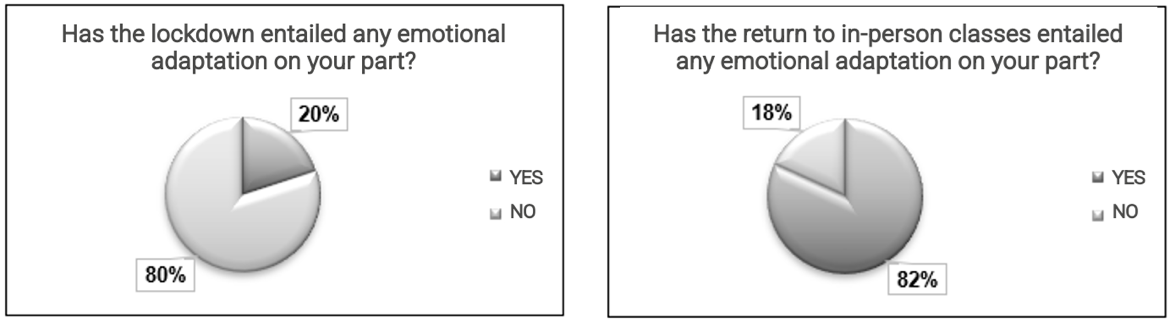
In all, 80% of students (n = 44) did not require any emotional adaptation process to deal with the lockdown. Most students recalled thinking, in the early days of the pandemic, that university closures would be short-lived: a brief break to rest, meet up with friends, and engage in leisure activities. In short, they saw it as a brief academic hiatus for their personal enjoyment.
In the early days, I was happy because I had more “me time,” to read, relax, think, and exercise. That was very positive for me. (L-6-Q).
However, students experienced the subsequent return to in-person classes differently. As the return to face-to-face instruction became imminent, students knew that the transition from online to in-person learning would be quicker and more direct, resulting in a certain degree of generalized stress. So it is that 82% of students (n = 45) reported feeling a need for emotional adaptation processes (Figure 1).
As soon as we learned we were returning to class, I thought, “Finally!” But I also felt quite overwhelmed because I suspected that we were suddenly going to have to do everything we hadn’t been doing online when we returned to normal classes. (RS-23-AA).
Thus, one aspect worth stressing is the emotional impact experienced by students during the lockdown and return to in-person classes. Students reported that this experience was one source of concern, as they were uncertain about what would happen with their education.
All this worried me a lot because, after all, they needed a major reason to close the university. At the beginning, I had trouble understanding and taking in the situation. (L-17-Q).
Similarly, students reported difficulties concentrating and fatigue as factors that influenced their academic performance:
I’ve noticed how my concentration, performance, and motivation levels have changed. It’s difficult to progress in your studies when you’re tired. Now I spend more time than normal reading a text and I find it a lot harder to do the exercises. (RS-10-Q).
Fear, anger, and sadness stand out as emotions brought out by the pandemic. Most participants shared that they had experienced these emotional states over a short period of time:
The weirdest part has been not being able to leave the house in 64 days. That has affected me emotionally. Initially, it wasn’t hard, but as the days go on, you go through every emotion: you get stressed, you get sad, you get angry… (L-1-AA).
The students attributed their anger primarily to a perceived lack of solidarity from other people who flouted the lockdown rules.
It made me angry to see many people not observing the lockdown. I can’t get my head around the fact that people are doing whatever they like, knowing that all these people are dying of the virus. (L- 33-Q).
Fear and sadness were the most prevalent emotions during the lockdown and the return to in-person classes, on account of the uncertainty and lack of control about what would happen in the near future:
Not knowing what will happen and when almost always causes concern and fear, so it hasn’t been easy to maintain a positive attitude in everyday life. (L-42-Q).
We still can’t kiss or hug one another and that’s very sad. Seeing everything we’ve lost scares me and makes me very sad. (RS-19-AA).
Stress and anxiety were also common responses to an inability to adjust to the lockdown:
As time went on, the situation got worse, and with the assignments I had to complete, I began to feel a lot of stress. (L-6-Q).
When students resumed in-person classes, just as with the introduction of the lockdown, stress and anxiety were common responses to the challenge of adjusting to the new reality:
When in-person classes were suspended, I had more time. Now that I’ve had to return to classes, I lose four hours in the commute, and we need a lot of time for the assignments – and that really weighs me down and stresses me out. (RS-22-Q).
Another prominent emotion, revealed by the sense of anger in the return to in-person classes, is displeasure. In the context of a pandemic and having been subject to such harsh measures, students cannot understand how, almost overnight, they can all be together again in class. They also expressed annoyance at being unable to continue the routines they had established during online learning:
We’re not allowed to be together in the classroom between lessons, yet during class there may be 40 people packed tightly together in the same classroom! Make it make sense! (RS-49-AA).
2nd phase. Developing coping and awareness strategies. Students reported employing various strategies to cope with their emotional instability. On the one hand, they stressed the importance of establishing work routines, which facilitated a change in mentality during the lockdown. At the same time, this emotional wellbeing has enabled them to reflect on the repercussions they have felt, thus creating a certain collective awareness in the community.
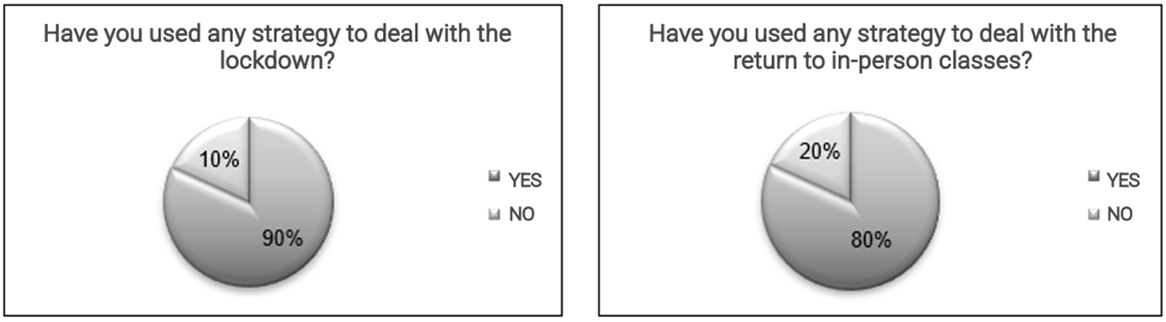
The students explained that despite the fatigue, concern, and emotional ups and downs of both the lockdown and the return to in-person instruction, as time went on, they continued the process of adapting to the new reality using different coping techniques (see Figure 2). In total, 90% of students (n = 50) indicated that they had made use of a coping strategy during the lockdown, while 80% (n = 44) did so during the return to in-person classes.
In general, they saw a need to take greater control of their everyday lives to cope with the uncertainty. The benefits of establishing routines that facilitated the transition to the reality of lockdown, and then to the new reality of the return to in-person classes, were mentioned by 90% of participants:
Right from the beginning I established routines that have helped me a lot, because I had a schedule and tried to carry out the same activities I did before this whole thing happened. (L-41-AA).
Going back to the classroom demanded an adaptation process on my part. Since returning to class, I’ve had one hour less to sleep and that meant I had to get myself organized on weekends. (RS-46-Q).
Students reported that, gradually, they began to experience a sense of wellbeing as more time became available to them. This was reflected in expressions of joy at having more free time. Similarly, they said that this situation helped to give them greater freedom and they began to feel greater satisfaction as they engaged in tasks autonomously:
This situation has taught me positive things; it hasn’t all been negative. I think I’ve learned to work more autonomously and better organize my time. (L-1-AA).
Some individuals also recounted that the experience enabled them to better connect with themselves and appreciate how emotional aspects relate to overall wellbeing:
Emotionally, I’ve learned a lot. I’ve realized the importance of simple stuff that wasn’t very important to me before, like a hug, a kiss, a chat with my friends, etc. (RS-14-AA).
Lastly, the participants in this research shared some reflections that demonstrated their sensitivity and awareness of the alarming global situation and its social repercussions:
It’s a difficult experience for everyone. It’s hard on young children because they don’t understand what’s going on and they miss going to school. On top of that, parents have to work from home while still attending to their children’s formal education. (L-32-AA).
Consequently, as shown by the following comments, all these experiences have resulted in a reordering of values, primarily with respect to relationships with family members and friends, but also in terms of time management, with greater emphasis placed on personal care:
This lockdown has made me appreciate my relationships with my family and the people I know; for example, before the pandemic, sometimes I couldn’t be bothered to go and visit my grandma, but lockdown has made me appreciate those times and others. (L-30-Q).
Returning to college made me realize that previously, I didn’t have any time for myself: to care for myself, to read… (RS-46-AA).
3.2 Pedagogical relationships
This second block presents information associated with the perceived changes in pedagogical relationships (student-student and teacher-student) that resulted from the lockdown and the return to in-person instruction. We also discuss some factors that, according to students, facilitated or hindered their pedagogical relationships.
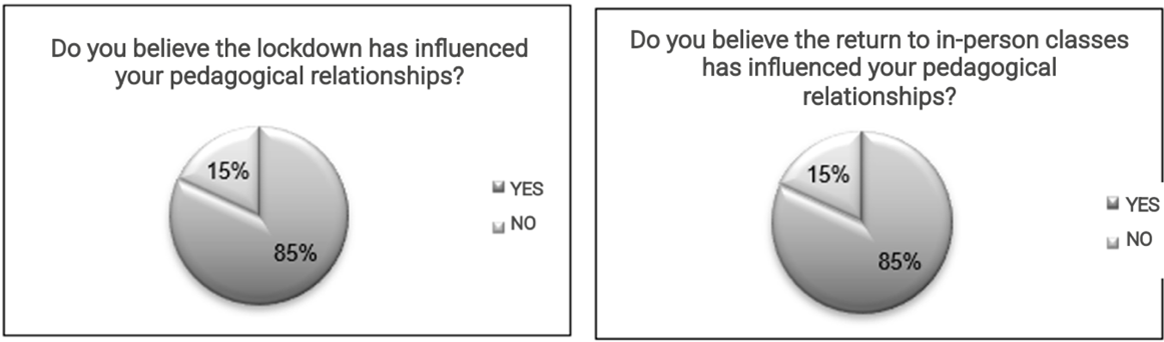
Student-student. In all, 85% of students (n = 44) acknowledged that both the lockdown and the return to in-person instruction had an impact on their pedagogical relationships (see Figure 3). They highlighted some positive aspects that facilitated relationships with their peers, like the fact they had more free time and the technology to interact with one another.
For assignments with my classmates, we’ve gotten on very well with the video calls. We’ve spent loads of hours together, we met up every morning, from Monday to Friday. (L-32-Q).
Students pointed to numerous perceived difficulties in their relationships, reflected in the frequency and quality of communication, as the main negative impact of the pandemic. The difficulties in the relationships with their closest peers stem from the absence of physical contact:
Physical contact is very important to me, hugs, kisses… I have had physical contact with my mom, my dad, and my brother, and I’m grateful for that, but I miss being around my girlfriends and hugging them. (L-53-AA).
However, students also believed that the sudden return to face-to-face classes was one factor that had made relationships with their peers difficult.
It’s been really difficult for me to interact with people. I still find it hard to speak in public today, and the worst thing is giving presentations of my work. (RS-52-Q).
Student-teacher. Positive aspects mentioned by the students include the openness shown by some teachers during the lockdown, which improved communication and therefore also the relationship with their students.
Iván and Rosa always responded to the messages we sent them, and they were willing to run online tutorials, which is much appreciated. I also think the lockdown has resulted in a closer relationship with our teachers than when we were in class. (L-11-Q).
Other students highlighted negative aspects, believing that communication with teachers was not always adequate. They also pointed to a feeling of solitude due to a lack of communication with teachers as one of the leading causes of poor academic performance:
Our relationships with teachers have become colder and more distant. It is difficult to communicate “normally” – only through Gmail or Blackboard. I felt lonely and ultimately, that showed in my grades. (L-31-AA).
Lastly, other factors that have had a negative impact on their pedagogical relationships concern teachers’ lack of technological skills. Students remarked that their relationship with teachers had been affected by teachers’ poor knowledge of IT tools.
Some teachers ought to receive training because they struggle quite a bit with technology. (L-55-Q).
Now [the teachers] look happier and more relaxed. You could see how tense they became as they got everything ready to give their class online. (RS-47-Q).
3.3 Pedagogical and didactic changes in teacher training and their repercussions
This third and last block presents information regarding the consequences of the pandemic for pedagogy and didactics, specifically the methods used and the roles assumed by teachers.
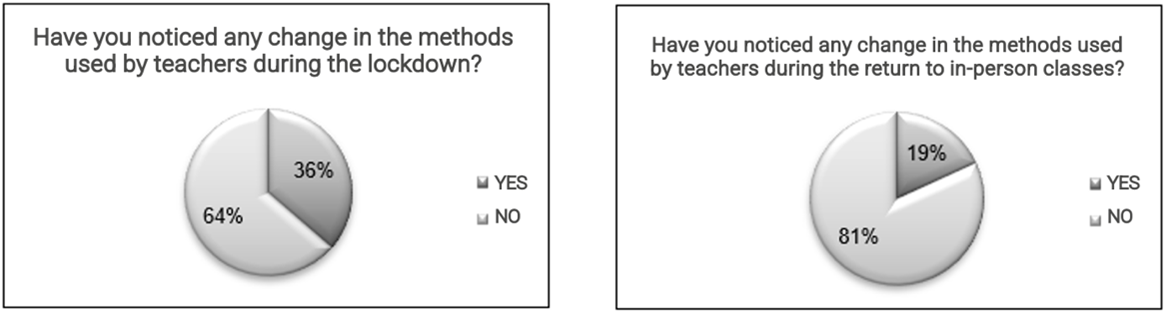
Changes in methodology. During the lockdown, 64% of students (n = 30) stated that teachers had not made any substantial methodological changes in teaching-learning processes (see Figure 4). Broadly speaking, the participants reported that only a couple of teachers had made changes to the established methodologies to better suit the reality of both the lockdown and the return to in-person instruction.
Only two teachers went to the trouble of changing the way they taught during the lockdown. They held tutorials and showed concern for us. As for the rest of them, it was as if they disappeared into thin air. (L-17-Q).
Students stated that they had noticed consequences from changes in the didactic methods used in the teaching-learning process during the lockdown. Specifically, 94% (n = 52) of students reported experiencing difficulties in the learning process as a result of poorly adapted teaching methods (Figure 5).
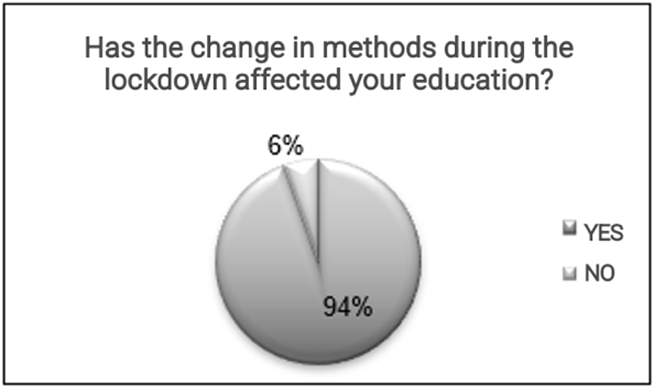
The main difficulties include the lack of interactivity, poor assimilation of new concepts, a lack of feedback, and difficulties following the syllabus, likely due to a lack of attention and concentration:
With online classes, everything has become more solitary, and the ability to assimilate the syllabus and the concepts is entirely different and been negatively affected. (L-53-AA).
It’s been very hard for me to follow the classes. The teacher went on and on as if we were in class, but it’s not the same online, he didn’t give us any feedback. Generally, it’s taken a lot more effort to follow the lessons. (L-24-Q).
Indeed, some participants noted a very heavy workload during lockdown and online learning. As reflected in the excerpt below, these academic demands led to the neglect of their relationships and personal wellbeing.
Instead of focusing on my health and taking care of my family, and devoting all my time to them, I’ve been cooped up in my bedroom 24 hours a day, doing college assignments. (L-33-AA).
A total of 81% of students (n = 45) did not believe the teachers had made methodological changes during the gradual return to in-person teaching either (see Figure 4). However, compared with the stay-at-home period, students acknowledged that the resumption of the earlier teaching methods upon returning to class had a positive impact on their learning.
During the lockdown, they sent us assignments to do at home during the week and now we do those assignments in class. We also have more options to work in groups and that supports our learning. (RS-50-Q).
Changes in the role of teachers. Finally, 75% of students (n = 41) believed that the role played by teachers had changed during the lockdown (Figure 6). They described teachers who took a back seat and merely explained what students had to do.
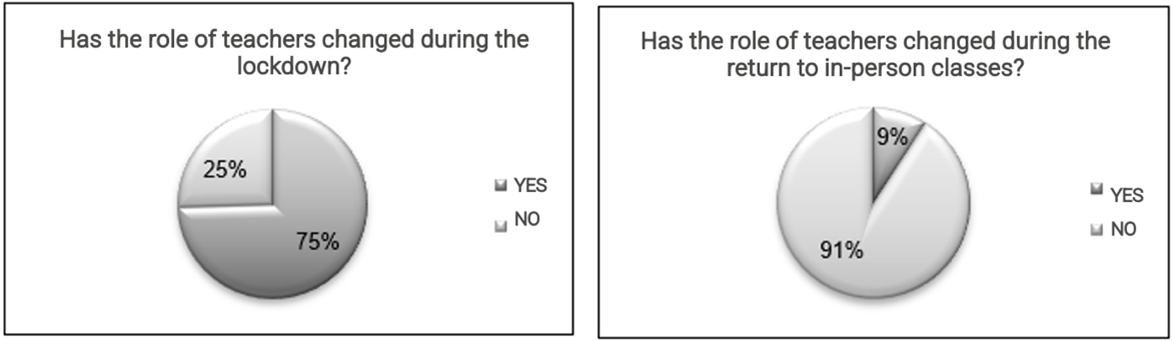
During the lockdown, most teachers sent us lots of work and explained very little. (L-34-Q).
However, during the gradual return to in-person instruction, most students (91%) did not believe the role of teachers had changed (Figure 6). In fact, teachers reclaimed their role as protagonists of the education process, as was characteristic of pre-pandemic times.
The classes we have now are better than during the lockdown because in addition to telling us what we have to do, the teacher also explains the course syllabus to us. (RS-31-AA).
IV. Discussion
The primary objective of this paper was to explore the emotional repercussions that relational and methodological changes caused by the COVID-19 pandemic and associated preventive measures had and continue to have on the initial education of future early childhood educators. Firstly, this study’s analysis of changes in relationships both with peers and with teachers showed an emotional impact during the lockdown period. Initially, as suggested by Atkinson (2011) and Hernández-Hernández and Sancho-Gil (2019), having more time for social interactions was viewed as a positive aspect that helped students to gain new knowledge while they were required to stay at home. However, the lack of physical contact, both with friends and with family members, was one of the main downsides.
Mention should be made of the importance of the use of ICT, which closed the distance in relationships and made collaboration and cooperation between teachers and students possible (García-Peñalvo et al., 2020). Yet this change has not been without difficulties. One of the main concerns raised by students is that teachers are poorly trained in the use of online learning formats, with teachers finding that they needed to use their own resources (knowledge, skills, competences, etc.) to offer what was in many cases a novel service (del Castillo-Olivares & del Castillo-Olivares, 2021). This appears to show that the formative model based on active methodologies and the use of ICT is primarily geared toward children’s socioeconomic development, while the training of future teachers is given only secondary importance (Echeita, 2017).
In addition, while many people were eager for a change of teaching model, the transition to online learning brought with it high levels of stress and emotional imbalance in students (González-Calvo et al., 2020). As the lockdown situation gradually became normalized, the increase in workload was seen as a source of discomfort. In addition, our analysis identified the following specific student difficulties linked to inadequate methodologies, which had a negative impact on the teaching-learning process: a lack of interactivity, poor assimilation of new concepts, a lack of feedback, and difficulties following the syllabus, among others.
One other issue brought to light is students’ continuing need for lectures and hence their preference for more direct instruction. To draw on Orbe-Nájera and Tipán-Meza (2019), this may be linked to social infantilization, which has delayed the beginning of adulthood, with direct repercussions for the construction of an identity as a college student. Whatever the case may be, the results of this study show that a lack of student autonomy was a significant source of stress during the lockdown, prompting a rethinking of the need for control in the education system and the place of faculty members today with respect to the development of student autonomy (Flecha & Villarejo, 2015; Sancho & Correa, 2013; Sandoval et al., 2020).
Lastly, the participants noted that the resumption of in-person classes led to an improvement in communication processes, which has had a positive impact on pedagogical relationships between peers and between teachers and students. Consequently, while we agree with Villalobos and De Cabrera (2009) that global crises of the kind recently experienced can offer opportunities to rethink teaching-learning models and highlight the importance of social relationships and emotions, the “new normal” remains governed by norms that condition social relationships across all areas (Nomen, 2021), so no notable methodological changes were observed in this regard.
4.1 Study limitations, strengths, and implications
The longitudinal nature of this study made it possible to observe and analyze changes over time, providing deeper insight into the way the pandemic affected students of the bachelor’s degree in early childhood education. Our qualitative analysis helped to explore in detail students’ experiences and perceptions of the pandemic’s emotional and relational impact.
The results of this study offer some preliminary evidence of the repercussions of changes in methodology due to COVID-19 on the education of future teachers. A significant link was found between the return to in-person instruction and some generalized stress, concentration difficulties, and excessive fatigue. However, one important limitation of this study is that these factors are not measured quantitatively on a specific scale. Given the scope and characteristics of this research, a mixed-methods approach combining quantitative and qualitative techniques is recommended, in particular to measure and analyze the levels of anxiety and learning difficulties of students and teachers as they use new technologies. The use of a standardized measure would provide a more comprehensive and enlightening view of the various aspects investigated here. Thus, the findings of this study indicate the importance of future research with more comprehensive and precise measures, providing a more solid understanding of the problem posed.
One final limitation is the paucity of existing literature on the emotional state of members of the university community (faculty and students) on returning to face-to-face classes, compared to research on the emotional impact of the pandemic in early childhood and primary education (Berasategi et al., 2020; Goikoetxea, 2020; Holmes et al., 2020; Ribot et al., 2020; UNICEF, 2020, among others). There is therefore a need for research into the factors surrounding in-person and online learning formats that may cause changes in the emotional state of students.
V. Conclusions
In the same vein as work by Giroux (2016), Hernández (2021), and Krichesky and Murillo (2018), this study helps to underscore the need to preserve social interaction in universities, as one defining human trait that constitutes a core component of the institutional identity of universities.
One other finding consistent with the literature reviewed (de Vicenzi, 2020; Navickiene et al., 2021, among others) is that the COVID-19 pandemic entailed important changes in the modus operandi of universities, at the forefront of which lies the critical role of ICT.
However, this study also showed that social interaction is necessary to promote the proper use of technology and collaborative methodologies. Adequate social and emotional training for future teachers is therefore essential to support their work in the face of any adversity, such as the social isolation under study here.
Lastly, this study has highlighted that although the pandemic accelerated a paradigm shift in education, teachers and students continue to exhibit a reluctance to relinquish their opposing roles (passivity-authority) characteristic of earlier methodologies and eras. Thus, our work casts light on the need to continue striving for a change in methodology that truly guarantees a well-rounded (cognitive, experiential, and/or affective) education for future teachers.
Translation: Joshua Parker
Author contributions
Irune Corres-Medrano: conceptualization, formal analysis, methodology (50%), data curation (50%), writing – original draft, writing – review & editing (70%), supervision.
Rakel Gamito Gomez: writing – review & editing (30%), validation.
Imanol Santamaría-Goicuria: investigation, methodology (50%), data curation (50%).
Declaration of no conflict of interest
The authors declare no conflict of interest.
Source of funding
This research received no funding.
Referencias
Atkinson, D. (2011). Art, equality and learning: Pedagogies against the state. Sense Publishers.
Berasategi, N., Idoiaga, N., Dosil, M., Eiguren, A., Pikaza, M. y Ozmaiz, N. (2020). Las voces de los niños y de las niñas en situación de confinamiento por el COVID-19 [The voices of children under COVID-19 lockdown]. Universidad del País Vasco/EHU.
Biesta, G. (2018). Interrupting the politics of learning. En K. Illeris, Contemporary theories of learning. Routledge.
Cabrera, A. M., Centurión, N. S. y Mora, C. O. (2022). Virtualización de clases presenciales en la universidad [The move to online learning in universities]. Educación Química, 33(3). https://doi.org/10.22201/fq.18708404e.2022.3.80254
del Castillo-Olivares, J. M., & del Castillo-Olivares, A. (2021). El impacto de la Covid-19 en el profesorado de educación superior y sus concepciones sobre la evaluación [The impact of COVID-19 on higher education teachers and their views on assessment]. Campus virtuales, 10(1), 89-101. http://www.uajournals.com/ojs/index.php/campusvirtuales/article/view/728/432
Chase, S. E. (2015). Investigación narrativa. Multiplicidad de enfoques, perspectivas y voces [Narrative research. A multiplicity of approaches, perspectives, and voices]. In N. K. Denzin & Y. S. Lincoln (Coords.), Métodos de recolección y análisis de datos (pp. 58-112). Gedisa.
Claessens, M. (2021). The science and politics of Covid-19. How scientists should tackle global crises. Springer.
Clandinin, D. J. (2007). Handbook of narrative inquiry: Mapping a methodology. Sage.
de Vicenzi, A. (2020). Del aula presencial al aula virtual universitaria en contexto de pandemia de COVID-19 [From the in-person to the online college class in a COVID-19 pandemic context]. Debate Universitario, 8(16). https://dialnet.unirioja.es/descarga/articulo/9057954.pdf
Denzin, N. K. y Lincoln, Y. S. (2017). The SAGE handbook of qualitative research (5a. ed.). Sage.
Dwivedi, Y. K, Hughes, D. L., Coombs, C., Constantiou, I., Duan, Y., Edwards, J. S., Gupta, B., Lal, B., Misra, S., Prashant, P., Raman, R., Rana, N. P., Sharma, S. K. y Upadhyay, N. (2020). Impact of COVID-19 pandemic on information management research and practice: Transforming education, work and life. International Journal of Information Management, 55, 1-20. https://doi.org/10.1016/j.ijinfomgt.2020.102211
Echeita, G. (2017). Educación inclusiva. Sonrisas y lágrimas [Inclusive education. Smiles and tears]. Aula abierta, 46, 17-24. https://doi.org/10.17811/rifie.46.2017.17-24
Fernández-Berrocal, P., Cabello, R., & Gutiérrez-Cobo, M.J. (2017). Avances en la investigación sobre competencias emocionales en educación [Advances in research on emotional skills in education]. Revista Interuniversitaria de Formación del Profesorado, 88(31.1), 15-26. http://hdl.handle.net/10201/120523
Flecha, R., & Villarejo, B. (2015). Pedagogía crítica: un acercamiento al derecho real de la educación [Critical pedagogy: An approach to the real right to education]. Revista Internacional de Educación para la Justicia Social, 4(2), 87-100. http://dx.doi.org/10.15366/riejs2015.4.2
Flores-Lueg, C., & Turra-Díaz, O. (2019). Contextos socioeducativos de prácticas y sus aportes a la formación pedagógica del futuro profesorado [Socio-educational contexts of practice and their contributions to future teachers’ pedagogical training]. Educar em revista, 35(73), 267-285. http://dx.doi.org/10.1590/0104-4060.62381
García-Peñalvo, F. J., Corell, A., Abella-García, V., & Grande, M. (2020). La evaluación online en la educación superior en tiempos de la COVID-19 [Online assessment in higher education in times of COVID-19]. Education in the Knowledge Society, 21, art. 12. https://doi.org/10.14201/eks.23013
Giroux, H.A. (2016). La educación superior y las políticas de ruptura [Higher education and the politics of disruption]. Entramados: Educación y Sociedad, (3), 15-26. https://fh.mdp.edu.ar/revistas/index.php/entramados/article/view/1615
Goikoetxea, M. (2020). ¿La salud de quién estamos defendiendo? Desigualdades sociales y sanitarias en tiempo de pandemia [Whose health are we protecting? Social and health inequalities in times of pandemic]. Zerbitzuan, 71, 119-130. https://doi.org/10.5569/1134-7147.71.07
González-Calvo, G., Barba-Martín, R.A., Bores-García, D., & Gallego-Lema, V. (2020). Learning to be a teacher without being in the classroom: COVID-19 as a threat to the professional development of future teachers. International and Multidisciplinary Journal of Social Sciences, 9(2), 152- 177. http://doi.org/10.17583/rimcis.2020.5783
González-Monteagudo, J., & León-Sánchez, M. (2020). Aprendizaje por proyectos como metodología para una escuela inclusiva e intercultural. Una propuesta didáctica en educación secundaria [A project-based learning methodology for an inclusive and intercultural school. A didactic proposal for secondary education]. REPI, Revista Educação, Pesquisa e Inclusão, 1, 23-34. http://dx.doi.org/10.18227/2675-3294repi.v1i1.6266
Goodson, I. F. (2004). Historias de vida del profesorado [Teachers’ life histories]. Octaedro.
Hernández, F. (2012). Las historias de vida en el marco del giro narrativo en la investigación en Ciencias Sociales: los desafíos de poner biografías en contexto [Life histories within the framework of the narrative turn in social science research: The challenges of contextualizing biographies]. In F. Hernández, J. M. Sancho, & J. I. Rivas (Coords.), Historias de vida en educación: Biografías en contexto (pp. 13-22). Esbrina-Recerca-Universitat de Barcelona.
Hernández, J. M. (2021). ¿Qué universidad para el siglo XXI? [What university for the 21st century?] Revista lusófona de educaçao, 52(52), 133-152. https://doi.org/10.24140/issn.1645-7250.rle52.09
Hernández-Hernández, F., & Sancho-Gil, J. M. (2019). Sobre los sentidos y lugares del aprender en la vida de los docentes y sus consecuencias para la formación del profesorado [On the meanings and places of learning in teachers’ lives and their implications for teacher education]. Profesorado, Revista de Currículum y Formación del Profesorado, 23(4), 68–87. https://doi.org/10.30827/profesorado.v23i4.11510
Holmes, E. A., O'Connor, R. C., Perry, V. H., Tracey, I., Wessely, S., Arseneault, S., Ballard, C., Christensen, H., Cohen, R., Everall, I., Ford, T., John, A., Kabir, T., King, K., Madan, I., Michie, S., Przybylski, A. K., Shafran, R., Sweeney, A., … Bullmore, E. (2020). Multidisciplinary research priorities for the COVID-19 pandemic: a call for action for mental health science. The Lancet Psychiatry, 7(6), 547-560. https://doi.org/10.1016/s2215-0366(20)30168-1
Krichesky, G. J., & Murillo F.J. (2018). La colaboración docente como factor de aprendizaje y promotor de mejora. Un estudio de casos [Teacher collaboration as a driver of learning and improvement. A case study]. Educación XX1, 21(1), 135-156. https://doi.org/10.5944/educXX1.20181
Lay-Lisboa, S., Araya-Bolvarán, E., Morabolí-Garay, C., Olivero-Tapia, G., & Santander-Andrade, C. (2018). Protagonismo infantil en la escuela. Las relaciones pedagógicas en la construcción de ciudadanía [Child protagonism in school. Pedagogical relationships in the construction of citizenship]. Sociedad e infancias, 2, 147-170. https://doi.org/10.5209/SOCI.59474
López, F. (2018). Retos de la educación superior en un contexto de incertidumbre y crisis global [Challenges of higher education in a context of uncertainty and global crisis]. Avaliação (Campinas), 23(2), 551-566. https://doi.org/10.1590/s1414-40772018000200015
Morales, I., Correa, M., & Salgado, A. (2020). Saberes pedagógicos en la enseñanza de la lengua castellana: Un enfoque biográfico narrativo para la interpretación de la identidad docente [Pedagogical knowledge in the teaching of Spanish: A narrative biographical approach to the interpretation of teacher identity]. Revista Complutense de Educación, 31(4), 529-538. https://doi.org/10.5209/rced.65848
Navickiene, V., Dagiene, V., Jasute, E., Butkiene, R. y Gudoniene, D. (2021). Pandemic-induced qualitative changes in the process of university studies from perspective of university authorities. Sustantibility, 13(17), 9887. https://doi.org/10.3390/su13179887
Nomen, L. (2021). La nueva normalidad y los futuros escenarios en Trabajo Social [The new normal and future scenarios in social work]. Itinerarios de Trabajo Social, (1), 55-61. https://doi.org/10.1344/its.v0i1.32432
OECD. (2020). The impact of COVID-19 on education. Insights from education at a glance 2020. https://web-archive.oecd.org/pdfViewer?path=/2020-09-08/562941-the-impact-of-covid-19-on-education-insights-education-at-a-glance-2020.pdf
Olivencia, J. J. L., & Hernández, A. S. J. (2012). La educación inclusiva en la universidad del siglo XXI. Un proceso permanente de cambio [Inclusive education in the university of the 21st century. A permanent process of change]. Revista Electrónica de Investigación y Docencia (REID), (8), 41-62. https://revistaselectronicas.ujaen.es/index.php/reid/article/view/1172
Orbe-Nájera, C., & Tipán-Meza, C. (2019). Infantilización en estudiantes universitarios: ¿un sistema que privilegia la dependencia? [Infantilization in university students: A system that favors dependence?] CienciAmérica, 8(2), 137-151. http://dx.doi.org/10.33210/ca.v8i2.216
Polkinghorne, D. E. (2005). Language and meaning: Data collection in qualitative research. Journal of Counseling Psychology, 52(2), 137–145. https://doi.org/10.1037/0022-0167.52.2.137
Pozo, J. I. (2016). Aprender en tiempos revueltos. La nueva ciencia del aprendizaje [Learning in troubled times. The new science of learning]. Alianza.
Ribot, V. de la C., Chang, N., & González, A. L. (2020). Efectos de la COVID-19 en la salud mental de la población [Effects of COVID-19 on the mental health of the population]. Revista Habanera de las Ciencias Médicas, 19. https://revhabanera.sld.cu/index.php/rhab/article/view/3307
Sancho, J.M., & Correa, J.M. (2013). Aprender a ser maestra. Perplejidades y paradojas [Learning to be a teacher. Perplexities and paradoxes]. Cuadernos de Pedagogía, (436), 18-21.
Sandoval, M., Simón, C., & Echeita, G. (2020). ¿Qué me ayuda a aprender y participar?: Herramientas para recoger las voces de los estudiantes [What helps me learn and participate? Tools for collecting student voices]. Educación Inclusiva, 13(1), 12-27. https://revistaeducacioninclusiva.es/index.php/REI/article/view/567
Simons, H. (2009). Case study research in practice. Sage.
Smith, M. (2019). Las emociones de los estudiantes y su impacto en el aprendizaje. Aulas emocionalmente positivas [Student emotions and their impact on learning. Emotionally positive classrooms]. Narcea.
Unesco. (2004). Las tecnologías de la información y la comunicación en la formación docente [Information and communication technologies in teacher education]. https://unesdoc.unesco.org/ark:/48223/pf0000129533_spa
Unesco. (2020). Covid-19 y educación superior: de los efectos inmediatos al día después. Análisis de impactos, respuesta y recomendaciones [COVID-19 and higher education: Today and tomorrow. Impact analysis, policy responses, and recommendations]. https://unesdoc.unesco.org/ark:/48223/pf0000375125
UNICEF. (2020). Salud mental e infancia en el escenario de la COVID-19 [Mental health and children in the context of COVID-19]. https://www.unicef.es/publicacion/salud-mental-e-infancia-en-el-escenario-de-la-covid-19-propuestas-de-unicef-espana
Villalobos, J., & de Cabrera, C.M. (2009). Los docentes y su necesidad de ejercer una práctica reflexiva [Teachers and their need for reflective practice]. Revista Teoría y Didáctica de las Ciencias Sociales, (14), 139-166. http://www.saber.ula.ve/handle/123456789/29671
Appendix 1
| Block | Questions |
|---|---|
| Emotional state | Has this experience (lockdown/return to in-person classes) affected your emotional state? |
| Has the lockdown/return to in-person classes entailed any emotional adaptation on your part? | |
| Have you used any strategy/resource to deal with this new reality? | |
| Pedagogical relationships | Has this experience (lockdown/return to in-person classes) affected your pedagogical relationships (student-student)? |
| Has this experience (lockdown/return to in-person classes) affected your pedagogical relationships (teacher-student)? | |
| Do you think anything was easy/difficult for you during this process? | |
| Didactic and pedagogical repercussions | How has the lockdown/return to in-person classes affected your education? |
| How would you explain the role of technology in the lockdown/return to in-person classes? | |
| What is your view of the way education has adapted to these unexpected circumstances? | |
| Have you noticed any change in the methods used by teachers during the lockdown/return to in-person classes? |