Reading in Spanish: Strategic Learning in Chinese University Students
 Xu Kong
  Universidad de Linyi, ChinaVilma María Pérez Viñas Universidad de Pinar del Río, CubaQinghua Qiu Universidad de Linyi, China
How to cite: Kong, X., Pérez, V. M., & Qiu, Q. (2025). Reading in Spanish: Strategic learning in Chinese university students. Revista Electrónica de Investigación Educativa, 27, e11, 1-15. https://doi.org/10.24320/redie.2025.27.e11.6118

Abstract
Spanish language teaching is experiencing substantial growth in China. However, university students struggle with reading. This study explores reading strategies employed by students of the Spanish degree at Linyi University. The sample was made up of high and low-reading achievement groups; a reading test and a self-report strategy questionnaire were administered, and the t-test and Pearson’s correlation were used to analyze the data. The findings indicated that a higher frequency of use of learning strategies in the cognitive, motivational, and affective domains was associated with better reading achievement. The study also identified statistically significant learning strategies employed by the high-achievement group. These results may inform future research on the teaching of reading strategies in Spanish as a foreign language.
Keywords: language teaching, Spanish, reading, university students, China
I. Introduction
In recent years, interest in learning Spanish has soared in China. Between 2000 and 2019, in mainland China alone, 86 Spanish departments were created (Yu, 2021). Yu attributes this to the fact that high-performing university graduates in Spanish find employment more easily than students of English, French, or German. Consequently, in China, scholarly work on learning and teaching Spanish is an important part of the field of pedagogy and didactics.
Meanwhile, Yang et al. (2020) note that the inclusion of Spanish as a foreign language (SFL) in the Chinese education system aligns with the demands and expectations of national development.
For Chinese students, learning Spanish is a complicated process in which reading plays a key role, showing the language’s characteristics, patterns of thinking, and text organization, in addition to social aspects such as the cultures of Hispanic peoples. Reading in Spanish is therefore indispensable for students’ future working lives across different spheres of socioeconomic and cultural development, at a local, national, and international level. In addition, assessment of reading comprehension in Spanish is a highly important part of the Level 4 Spanish Major Examination1 (EEE4), a system of testing that assesses the generic skills of university students majoring in Spanish (Yu, 2021). Since 2015, the exam has been based on a maximum score of 100 and the following grade scale: outstanding (80-100), merit (70-79), pass (60-69), and fail (0-59).
Yet many Chinese students struggle with reading in Spanish and exhibit inadequate learning. The following figure shows academic achievement in reading in Spanish in the EEE4 exam from 2017 to 2021 at Linyi University (LYU).
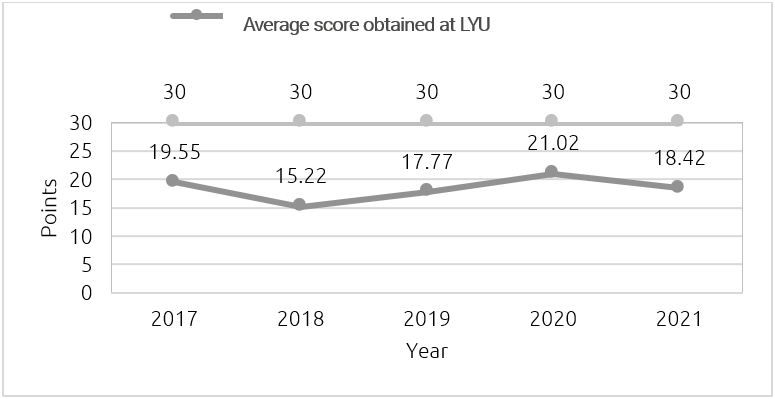
The reading test is graded out of 30 points, with a minimum of 18 points (60%) required to pass. To achieve a “merit” grade, students need a minimum of 21 points (70%). But attainment has been poor and was particularly low in 2018 and 2019, hence the need to gain a deeper understanding of how students learn and what is needed to improve student learning in reading in SFL.
In the 21st century, foreign language learning strategies continue to warrant further research, as shown by work by Liu and Dai (2003), Oxford (2017), Oxford and Gkonou (2018; 2020), Pawlak and Oxford (2018), and Thomas et al. (2022), among others. In the field of SFL, Míguez-Álvarez et al. (2022) studied the strategic behaviors of Portuguese students, while Borroto et al. (2021) explored learning strategies for reading by non-Spanish-speaking students at the University of Havana.
In China, research on foreign language learning strategies has focused primarily on the teaching of English. Our review of the literature supports Feng and Iriarte’s (2018) claim that little work has been conducted on the strategies deployed by Chinese students learning Spanish (see also Cabanes-Flores et al., 2021; Feng et al., 2019; Ramón & Cáceres, 2019; and Sánchez, 2009).
Feng et al. (2019) note that numerous studies on foreign language learning strategies have shown that these strategies support academic achievement, as one tool to develop linguistic competence.
Close attention should also be paid to SFL learning strategies on account of the prominence of SFL in Chinese universities and the existing challenges in teaching and learning Spanish. With this in mind, this study adopts the following definition of language learning strategies:
- they are conscious, teachable, intentional, self-chosen, and self-regulated thoughts and actions for learning the culture and language;
- they have several interlocking purposes: improving performance on immediate tasks, developing specific skills, and improving autonomy and long-term proficiency;
- they support cognitive, emotional (affective), social, motivational, and metastrategic regulation (e.g., planning, organizing, monitoring, and evaluating) of learning (Oxford, 2017); and
- they are flexibly and creatively combined into strategy clusters (strategies used simultaneously) and strategy chains (strategies used in sequence) to meet the learner’s needs and fit the context and the task (Oxford & Gkonou, 2018, as cited in Kong, Pérez, et al., 2021, p. 631).
We also adopt Oxford’s (2017) innovative classification of language learning strategies, which proposes the S2R (strategic self-regulation) model, made up of two layers (metastrategies and strategies) and four domains (cognitive, motivational, social, and affective). The metastrategies and strategies change dynamically in response to changing student needs as intentions differ across a range of sociocultural contexts (Oxford, 2017); this model highlights the role of self-regulation, with a focus on context and flexibility. Chang (2019) argues that the S2R model, based on a meta-analysis of definitions of learning strategies and psychological, sociocultural, and complex systems foundations, among others, constitutes a new theoretical framework for foreign language learning strategies and represents new trends in this field.
Research on language learning strategies has shown that “learning strategies for reading play an important role in reading comprehension in a foreign language, although there remains little consensus on which strategies are most effective at different levels of language proficiency” (Oxford, 2011, as cited in Kong, Qiu, & Pérez, 2021). According to Par (2020), to be successful learners, students of English as a foreign language should read extensively and employ certain effective reading strategies to construct the meaning of a text. This is applicable, in our view, to all students of foreign languages.
Frid (2022) suggests that reading strategies have a proven, unique impact on successful reading. Similarly, Bruen (2020) found a positive relationship between appropriate use of strategies and improvement in reading skills.
Here, we adopt the notion of learning strategies for reading outlined by Afflerbach et al. (2008), who view them as deliberate, objective-oriented attempts to control and modify reader efforts to decode, comprehend, and construct meanings from a text.
This research analyzed strategic behaviors in the development of reading skills by students majoring in Spanish at LYU, focusing on the differences between high and low-performing readers based on the learning strategies they employed, and exploring the relationships between these students’ use of learning strategies and reading achievement in Spanish.
II. Method
2.1 General design
Based on the proposed objective, this non-experimental, cross-sectional, descriptive, and correlational research adopts a quantitative approach to analyze the use of strategies by students, describe differences in the use of strategies between two extreme groups, and explore relationships between these strategies and academic achievement through a statistical analysis of the data collected. The study design was determined in accordance with Johnson and Christensen (2012), who propose the following definitions: non-experimental research is that which does not include deliberate manipulation of variables; a study is cross-sectional when the data for the variables is collected at a single point in time; descriptive research attempts to provide a precise description or observation of the state and characteristics of a given context or phenomenon; and correlational studies explore the relationships between one or more quantitative independent variables and one or more quantitative dependent variables.
2.2 Instruments
Reading test: Two tests were designed following assessment guidelines for the Spanish major at LYU – one intermediate-level test for second-year students, and another upper-intermediate test for third-year students – to assess their reading proficiency. The tests were scored out of 100, with a grade scale divided into outstanding (80-100), merit (70-79), pass (60-69), and fail (0-59).
Self-report questionnaire: This was designed based on SFL reading characteristics in universities in China and foreign language learning strategy theories by Afflerbach et al. (2008), Oxford (2017), and Oxford and Gkonou (2018). It was structured within the framework of Oxford’s (2017) S2R model and the Strategy Inventory for Language Learning (SILL) 7.0 (Oxford, 1990). The questionnaire comprised a total of 57 items on a 5-point Likert scale, divided into four domains (cognitive, motivational, social, and affective) and eight categories (metacognitive and cognitive strategies, metamotivational and motivational strategies, metasocial and social strategies, meta-affective and affective strategies).
A pilot study was performed with 84 students to test the reliability and validity of the questionnaire in each domain. Chronbach’s alpha tests yielded a value of 0.908 in the cognitive domain, 0.770 in the motivational domain, 0.765 in the social domain, and 0.806 in the affective domain. The KMO (Kaiser-Meyer-Olkin) statistic was verified and found to be 0.749 in the cognitive domain, 0.709 in the motivational domain, 0.724 in the social domain, and 0.809 in the affective domain. The questionnaire was considered to demonstrate acceptable reliability and validity.
The aim of the questionnaire was to gain insight into strategic behaviors by students in the extreme group samples and determine which reading comprehension strategies employed by the high-performing group were statistically significant at the .05 level and could be developed as part of an intervention study.
2.3 Population and sample
The population comprised 171 students from the four years of the major. The extreme high-performing (G1) and low-performing (G2) groups were formed purposively from the 75 students in the second and third years of the four-year major, who had two contact hours a week in the course “Reading in Spanish,” which served as the context for this research.
Four of the 75 students submitted invalid questionnaires (one was a blank questionnaire, and the other three students chose the same option for all items) and were therefore excluded from the study. Three criteria were used to evaluate Spanish reading achievement and classify the 71 students into extreme groups: 1) the results of the reading test; 2) the students’ academic achievement in Spanish;2 3) teachers’ qualitative assessment of the students’ reading ability in Spanish.3 The following decision rule and corresponding 10-point scoring system were employed to form the G1 (high-performing) and G2 (low-performing) groups, as shown in Table 1:
| Extreme group | Grades in the three criteria | Score |
|---|---|---|
| G1 | 3 "outstanding" | 10 |
| 2 "outstanding" and 1 "merit" | 9 | |
| 1 "outstanding" and 2 "merit" | 8 | |
| G2 | 3 "pass" | 4 |
| 2 "pass" and 1 "fail" | 3 | |
| 1 "pass" and 2 "fail" | 2 | |
| 3 "fail" | 1 |
The sample included 41 students: 15 in G1 and 26 in G2. The scores of the remaining 30 students fell outside the cutoff thresholds of the decision rule used.
2.4 Data processing
Prior to data analysis, all the options in the questionnaire were assigned quantitative values from 1 to 5 to indicate lowest and highest frequency, respectively, and SPSS 26.0 was used to analyze the quantitative data from the questionnaire. We used the independent samples t-test and mean frequencies to analyze differences in the use of strategies between the two extreme groups, and Pearson’s correlation coefficient to determine the correlation between students’ learning strategies and their Spanish reading achievement.
III. Results
3.1 Spanish reading achievement in G1 and G2
The difference in Spanish reading achievement between the two groups was statistically significant, as can be expected with extreme groups: a mean of 8.667 for G1 and 3.462 for G2, with p < .001.
The results of the reading test and the teachers’ qualitative assessment identified difficulties by G2 students with understanding specific information and complex sentences in the text, inferring meaning from context or morphology, and distinguishing between main and secondary ideas. Their difficulties also included the logical analysis of content and text organization, identifying the author’s intent, being slow readers, and being unable to activate prior knowledge of the topic.
3.2 Students’ use of learning strategies in the four domains
The findings from the self-report strategy questionnaire provided an overall picture of the use of learning strategies in the full sample of 41 students, with no breakdown by extreme group, in the four domains studied. The data in Table 2 shows that the four strategy domains are used in the following order of frequency, from highest to lowest: affective, cognitive, social, and motivational.
| Domains | Cognitive | Motivational | Social | Affective |
|---|---|---|---|---|
| Mean | 3.385 | 3.139 | 3.299 | 3.478 |
| Sample size | 41 | 41 | 41 | 41 |
3.3 Differences in strategic reading behaviors between students from extreme groups G1 and G2
The t-test revealed significant differences between the two groups in the use of learning strategies. The difference in overall use of strategies between G1 and G2 was statistically significant (p = .012). The results for each domain of strategies are presented below: Tables 3 and 4 for the cognitive domain, Tables 5 and 6 for the motivational domain, Table 7 for the social domain, and Table 8 for the affective domain.
| Metacognitive strategies | |||||||
|---|---|---|---|---|---|---|---|
| Item | 1 | 2 | 3 | 4 | 5 | 6 | Average |
| p | 0.016 | 0.309 | 0.038 | 0.016 | 0.045 | 0.593 | 0.016 |
| Mean G1 | 3.467 | 3.400 | 4.067 | 3.467 | 3.467 | 3.333 | 3.533 |
| Mean G2 | 2.769 | 3.115 | 3.577 | 2.769 | 2.923 | 3.192 | 3.058 |
Table 3 shows that G1 used metacognitive strategies more frequently than G2. In general, differences in the use of metacognitive strategies are statistically significant at the .05 level. Items 1 (“I make a plan to develop my reading in Spanish”), 3 (“When I read, I control my attention”), 4 (“I evaluate and reflect on the development of my reading”), and 5 (“I try to use effective methods to develop my reading”) were statistically significant.
| Cognitive strategies | |||||||||
|---|---|---|---|---|---|---|---|---|---|
| Item | 7 | 8 | 9 | 10 | 11 | 12 | 13 | 14 | 15 |
| p | 0.003 | 0.842 | 0.055 | 0.017 | 0.005 | 0.812 | 0.001 | 0.155 | 0.090 |
| Mean G1 | 4.267 | 3.800 | 3.933 | 4.067 | 4.000 | 3.667 | 4.133 | 4.000 | 3.933 |
| Mean G2 | 3.423 | 3.731 | 3.346 | 3.269 | 3.115 | 3.731 | 3.346 | 3.615 | 3.462 |
| Item | 16 | 17 | 18 | 19 | 20 | 21 | 22 | 23 | 24 |
| p | 0.307 | 0.012 | 0.492 | 0.230 | 0.241 | 0.478 | 0.601 | 0.819 | 0.252 |
| Mean G1 | 3.733 | 4.200 | 3.533 | 3.667 | 3.867 | 3.733 | 3.400 | 3.067 | 3.067 |
| Mean G2 | 3.423 | 3.577 | 3.308 | 3.231 | 3.538 | 3.538 | 3.231 | 3.000 | 2.654 |
| Ítems | 25 | 26 | 27 | 28 | 29 | 30 | 31 | Average | |
| p | 0.042 | 0.577 | 0.964 | 0.006 | 0.956 | 0.032 | 0.015 | 0.003 | |
| Mean G1 | 3.733 | 2.933 | 2.133 | 3.733 | 3.133 | 4.200 | 4.467 | 3.696 | |
| Mean G2 | 3.154 | 2.731 | 2.115 | 2.731 | 3.115 | 3.500 | 3.731 | 3.265 | |
This shows that, generally, differences in the use of cognitive strategies were statistically significant. Students who showed high reading achievement (G1) used cognitive strategies more frequently. The following items were statistically significant: 7 (“I study hard to learn the features of the language, like words, expressions, and grammar, to reduce language problems when reading”); 10 (“I use prior knowledge relating to the text to better understand the content of the text”); 11 (“I take care to identify coreferential relationships to better understand the text”); 13 (“When I come across words I don’t know, I guess their meaning based on my knowledge of how words are formed or similar words in another language I know”); 17 (“When I reading, I mark key information to make it easier to review or memorize”); 25 (“I memorize unknown words I come across in the texts I read in order to expand my vocabulary”); 28 (“Outside of class, I look for other texts or articles to read”); 30 (“When I take a reading test, first I read the questions and make predictions with them before reading the text”); and 31 (“To answer questions correctly, I return to the corresponding parts of the text to look for useful information”).
| Estrategias metamotivacionales | ||||||
|---|---|---|---|---|---|---|
| Ítems | 32 | 33 | 34 | 35 | 36 | Average |
| P | 0.022 | 0.149 | 0.186 | 0.349 | 0.001 | 0.014 |
| Media G1 | 3.333 | 3.267 | 3.067 | 3.533 | 3.733 | 3.387 |
| Media G2 | 2.692 | 2.846 | 2.654 | 3.269 | 2.846 | 2.862 |
The results show that, to some extent, statistically significant differences exist between G1 and G2 in the use of metamotivational strategies. High-performing readers placed a greater focus on their motivation for learning. Items 32 (“Before reading, I think about my purpose for reading the text”) and 36 (“I know how to find the motivation to read”) were statistically significant.
| Motivational strategies | |||||||||
|---|---|---|---|---|---|---|---|---|---|
| Item | 37 | 38 | 39 | 40 | 41 | 42 | 43 | 44 | Average |
| p | 0.016 | 0.370 | 0.235 | 0.282 | 0.824 | 0.741 | 0.058 | 0.001 | 0.050 |
| Mean G1 | 3.400 | 3.133 | 3.867 | 3.000 | 2.933 | 3.000 | 3.600 | 4.133 | 3.383 |
| Mean G2 | 2.692 | 2.808 | 3.500 | 3.385 | 3.000 | 2.923 | 3.038 | 3.308 | 3.082 |
Based on these findings, the students in G1 used two learning strategies that were statistically significant: items 37 (“I set objectives before reading”) and 44 (“I think about what I have gained from learning to read in Spanish”).
| Metasocial strategies | Social strategies | Social domain average | |||||||
|---|---|---|---|---|---|---|---|---|---|
| Item | 45 | 46 | 47 | 48 | 49 | 50 | 51 | 52 | |
| p | 0.176 | 0.766 | 0.491 | 0.407 | 0.167 | 0.320 | 0.085 | 0.661 | 0.421 |
| Mean G1 | 4.067 | 2.667 | 3.000 | 3.467 | 3.133 | 3.800 | 4.000 | 3.133 | 3.408 |
| Mean G2 | 3.731 | 2.808 | 2.731 | 3.192 | 3.462 | 3.500 | 3.462 | 3.000 | 3.236 |
In the social domain, differences in the use of metasocial and social strategies were not statistically significant.
| Meta-affective strategies | Affective strategies | Affective domain average | ||||||
|---|---|---|---|---|---|---|---|---|
| Item | 53 | 54 | Average | 55 | 56 | 57 | Average | |
| p | 0.015 | 0.873 | 0.235 | 0.134 | 0.049 | 0.115 | 0.043 | 0.064 |
| Mean G1 | 3.533 | 3.600 | 3.567 | 3.933 | 3.867 | 3.867 | 3.889 | 3.760 |
| Mean G2 | 2.846 | 3.654 | 3.250 | 3.423 | 3.231 | 3.423 | 3.359 | 3.315 |
Table 8 presents the use of strategies in the affective domain by both groups, where differences are not generally statistically significant. However, statistical significance was observed in the following learning strategies: 53 (“I pay attention to emotions when developing my reading ability”) and 56 (“I try to relax when I feel anxious when reading.”)
3.4 Relationship between students’ use of reading strategies and academic achievement
The data in Table 9 show that, overall, the use of learning strategies was positively correlated with reading achievement in SFL. The cognitive domain exhibited the strongest positive correlation with academic achievement, while a lower correlation was observed in the motivational domain. Correlation with the affective domain was very weak, while the social domain was not significantly correlated with academic achievement.
| Domains | Cognitive | Motivational | Social | Affective | Overall use |
|---|---|---|---|---|---|
| Correlation | 0.476** | 0.369* | 0.174 | 0.315* | 0.434** |
| p | 0.002 | 0.018 | 0.277 | 0.045 | 0.005 |
| Sample size | 41 | 41 | 41 | 41 | 41 |
The items for the strategic behaviors from the three domains for which a statistically significant correlation was observed with academic achievement are presented in Table 10. The strongest correlation with academic achievement was found with items 1, 7, 13, 28, 36, and 44, that is, with making a learning plan, studying hard to learn features of the language, mastering lexical inferencing techniques, reading more, finding motivation when reading, and thinking about the gains from learning. These strategies helped to raise academic achievement in reading in Spanish among students in the sample chosen.
| Domain | Cognitive | |||||||||
|---|---|---|---|---|---|---|---|---|---|---|
| Item | 1 | 3 | 4 | 7 | 10 | 11 | 13 | 17 | 25 | 28 |
| Correlation | 0.422 | 0.368 | 0.391 | 0.480 | 0.373 | 0.343 | 0.466 | 0.361 | 0.388 | 0.554 |
| p | 0.006 | 0.018 | 0.012 | 0.001 | .016 | 0.028 | 0.002 | 0.020 | 0.012 | 0.000 |
| Domain | Cognitive | Motivational | Affective | |||||||
| Item | 30 | 31 | 32 | 36 | 37 | 44 | 53 | |||
| Correlation | 0.330 | 0.368 | 0.356 | 0.485 | 0.376 | 0.451 | 0.398 | |||
| p | 0.035 | 0.018 | 0.023 | 0.001 | 0.015 | 0.003 | 0.010 | |||
IV. Discussion and conclusions
Developing reading comprehension is a key part of learning a foreign language. For Chinese-speaking students of Spanish, reading poses additional challenges due to the differences in linguistic and cultural codes. Improving academic achievement in reading is therefore an ever-present objective in the Spanish major at LYU, in light of identified learning needs.
The differences in academic achievement found in the sample of extreme groups demonstrate a need to encourage stronger pedagogical approaches to reading. In this major, reading is an area where students perform poorly, and students generally fail to capitalize on the benefits of reading.
Two views on the learning methods of Chinese-speaking learners of Spanish provide differing explanations of these results. Hammond and Gao (2002) characterize Chinese-speaking students as passive learners who do not ask questions for fear of discrediting their teachers, do not develop their critical thinking skills, adopt the learning strategies that have been presented to them without questioning their validity, and make excessive use of memorization.
While not disregarding this view, this study adopts the position of Kember and Watkins (2010), who found that Chinese students took on an active role in learning, asked questions in class, showed an interest in developing optimal critical thinking skills, were open to learning about new learning strategies and methods, and used memorization as a means of comprehension.
Foreign language learning strategies, and foreign language reading strategies in particular, have been widely explored in the literature. Koda (2005) argues that reading comprehension strategies are characterized by three elements: they are deliberate, they are oriented towards a problem or objective, and they are initiated/controlled by students.
Oxford (1990) defines an average frequency of strategy use between 3.5 and 5 as high, an average between 2.5 and 3.4 as medium, and an average between 1 and 2.4 as low. This study finds a medium frequency of strategy use, meaning that students used SFL reading comprehension strategies only at times, and they are not therefore considered strategic learners.
Our finding that the most common strategies in the overall sample were of an affective nature mirrors work by Liu and Dai (2003), who maintain that this is closely linked to learning models in China. In primary and secondary education, learning is directed by teachers. If difficulties in learning arise, students are able to turn to their teachers or family members for support, reducing stress. Entry to university reduces students’ dependence on teachers and family and they must learn to solve problems themselves in their education and in college life. For this, the use and role of affective strategies are especially important.
We believe that one distinctive trait of Chinese students is that they acquire the qualities of perseverance that are characteristic of Chinese education. Learning Spanish is a challenge for these students, who are required to reach an advanced level by the time they graduate, despite having almost no knowledge of the language before starting college. In this context, most students are able to overcome emotionally the difficulties they encounter in learning.
Our analysis of strategic behaviors in the cognitive domain shows a medium frequency of use. This aligns with work by Li (2006), who diagnosed the use of learning strategies to develop reading comprehension in English as a foreign language in a Chinese university context, noting that cognitive strategies serve to process input and are directly applicable to the learning process. To understand texts, students are required to use cognitive strategies, so these strategies tend not to be used at a low level of frequency.
The students in this research use motivational and social strategies less frequently, which could be explained by generally recognized characteristics of Chinese students, who are not very active and participate little in class, and who prefer studying alone to cooperative learning. This does however contrast with findings by Ramón and Cáceres (2019), who report that Chinese-speaking college students of Spanish are frequent users of sociocultural strategies, such as learning through interaction with others.
The greater frequency with which G1 students use learning strategies to develop reading comprehension is similar to findings reported by other researchers like Anderson (1991), Liu (2002), and Liu and Dai (2003).
Students in G1 exhibit a greater ability to make plans, exercise control, and evaluate learning, and they are more mindful of reading methods. These results are consistent with those of Ramón and Cáceres (2019), who describe these behaviors as “strategies for controlling and regulating the learning process, assessing needs, and evaluating progress achieved, which characterize adult students” (p. 18). The more frequent use of metacognitive strategies by high-performing students shows the importance of this kind of strategy. Indeed, Cabanes-Flores (2021) affirms that metacognition is important for successful learning of SFL by Chinese students.
The more frequent use of cognitive strategies by G1 students means that they focused more on learning features of the language, demonstrated a broader vocabulary and greater ability to deduce the meanings of words, were able to establish links between prior knowledge and new information from the text, were more mindful of relationships between pieces of information about the text in making deductions and predictions, made greater use of memorization techniques, and reported reading more outside of class.
In the cognitive domain, students in G1 used metastrategies and cognitive strategies more frequently than those in G2. Students in G1 were also characterized by the fact they used the interactive reading model; they used information provided by the text and their own prior knowledge, which the text may expand or change (Grabe & Stoller, 2020), and interactively combined aspects of the bottom-up and top-down models.
G1 students showed greater mastery of linguistic features and were more focused on expanding their vocabulary. According to Chen (1998), from a perspective of foreign language reading pedagogy and psychology, if learners reach a level of automatic word recognition, they are more easily able to access higher-level text comprehension processes, such as prediction, deduction, and synthesis.
The results for G1 in the motivational domain show that they more frequently used strategies to handle motivation. They also reported having a purpose when reading, in addition to reflecting on what they have learned, which helps to increase or maintain motivation in learning. Despite this, and in light of the characteristics of Chinese students, it is worth bearing in mind that teacher-induced motivation plays a less decisive role due to the sense of responsibility toward learning that is typical of the Chinese educational model. Studies like those of Lu et al. (2019) and Luo et al. (2022) provide further support for the influence of the motivational domain in Chinese-speaking students of Spanish and draw attention to important cultural aspects that should be considered, both for data interpretation and for the implementation of strategic teaching approaches.
The findings for the social domain can be explained by the learners’ context and the more individualized nature of learning, although other studies on Chinese university students of SFL report that these strategic behaviors tend to change; see Ramón and Cáceres (2019) and Sánchez (2009), who obtained similar results with Chinese students of Spanish and in schools like Instituto Cervantes or others in Spanish-speaking countries.
No significant differences were observed in the use of meta-affective strategies, but the strategy “I pay attention to emotions when developing my reading ability” was statistically significant. Students in G1 attended to their affective state more frequently and were good at solving affective problems in developing their reading skills, which is consistent with Liu and Dai (2003).
The less frequent use of affective strategies by students in G2 can be explained by the findings of a study by Feng and Iriarte (2018) on the strategic behaviors of Chinese college students majoring in Spanish:
(…) they pay little attention to the emotion factor when learning Spanish, and this is reflected in an infrequent use of affective strategies. The methods they use to regulate their emotions are limited. They do not know how to leverage affective factors to support their learning, nor are they able to prevent the negative effects of emotions during learning. (p. 10)
As noted by Oxford and Gkonou (2018), given that language classrooms across the world are becoming more and more multilingual and multicultural (now sometimes described as plurilingual and pluricultural), students need to control and manage their emotions within a context of multiple interactions with classmates and teachers from different social and cultural backgrounds. Thus, strategic learning plays a critical role both for regulating emotions and for academic achievement in the target language.
The correlation between academic achievement in reading and students’ learning strategies indicates that strategic behaviors in the motivational, affective, and, above all, cognitive domains can predict, in some sense, academic achievement in reading in Spanish, at least in the context of LYU: the more frequent the use of learning strategies in the cognitive, motivational, and affective domains, the better the students’ performance in SFL reading. Generally, these results align with findings by Feng et al. (2019) on the relationship between learning strategies and SFL students’ academic achievement in China, namely, that high and medium-performing students employ a wider range of learning strategies and exhibit a high level of cognitive and metacognitive skills.
In conclusion, this study explored the use of learning strategies to develop reading comprehension in SFL by students majoring in Spanish at LYU, with a focus on the differences between high and low-performing students. In general, we did not observe a high level of strategy use by students as they develop their Spanish reading comprehension in this degree program. A total of 19 learning strategies were found to exhibit statistically significant differences between the two groups. High-performing students tended to use metacognitive and cognitive strategies most frequently, followed by metamotivational and motivational strategies, as well as affective strategies. The use of learning strategies in the cognitive, motivational, and affective domains is positively correlated with students’ academic achievement in reading in Spanish. More specifically, 17 learning strategies were found to predict reading performance.
Lastly, the findings of this study may help to transform SFL reading at LYU and in similar contexts, insofar as learning strategies for reading that have been found to be statistically significant in a sample of high-performing students can be used to inform the design of intervention studies in this field. According to Thomas et al. (2022), the pedagogical implications of research into language learning strategies should never be overlooked. In this respect, we share below the criteria outlined by Pawlak and Oxford (2018):
Whatever aspect of [language learning strategies] we choose to investigate and whichever data collection tools we employ, no matter how innovative they might seem, the yardstick for appraising the empirical evidence we generate will be the degree to which it translates into everyday L2 instruction. (p. 532)
The results presented here are based on an analysis of methods that include a reading test and self-report strategy questionnaire, used to investigate strategic behaviors by students. While these methods are considered valid for the purposes of this research, they can be enhanced in combination with other, qualitative methods like case studies or narrative research, given the changing, contextually situated, and personalized nature of learning strategies, as asserted by Mizumoto (2018).
Translation: Joshua Parker
Author contribution
Xu Kong: conceptualization, formal analysis, investigation, writing – original draft.
Vilma María Pérez Viñas: methodology, project administration, supervision, validation, writing – review & editing.
Qinghua Qiu: data curation, software, visualization.
Declaration of no conflict of interest
The authors declare no conflict of interest.
Source of funding
No source of funding exists for this paper.
References
Afflerbach, P., Pearson, P. D. y Paris, S. G. (2008). Clarifying differences between reading skills and reading strategies. The Reading Teacher, 61(5), 364–373. http://dx.doi.org/10.1598/RT.61.5.1
Anderson, N. J. (1991). Individual differences in strategy use in second language reading and testing. The Modern Language Journal, 75(4), 460–472. https://doi.org/10.1111/j.1540-4781.1991.tb05384.x
Borroto, G., Sánchez, B., Olazábal, I., & Trujillo, T. de la C. (2021). Estrategias para el desarrollo de la comprensión lectora en idioma español como lengua extranjera [Strategies for the development of reading comprehension in Spanish as a foreign language]. Referencia Pedagógica, 9(1), 127-143. https://rrp.cujae.edu.cu/index.php/rrp/article/view/235
Bruen, J. (2020). Language learning strategies for reading comprehension: assessing the strategy use of young adults at beginners’ level taking Chinese, German, Japanese or Spanish as foreign languages at university. The Language Learning Journal, 48(2), 170-186. https://doi.org/10.1080/09571736.2017.1370606
Cabanes-Flores, L., Pérez-Vázquez, Y., & Valdés-Florat, M. O. (2021). Clase de Español como lengua extranjera: una vía para desarrollar la metacognición en estudiantes chinos [Spanish as a foreign language classes: A way to develop metacognition in Chinese students]. Educación y Sociedad, 19(3), 20–39. https://revistas.unica.cu/index.php/edusoc/article/view/1935
Chang, H. (2019). Celüexing ziwo tiaokong (S2R) moxing—er yu xuexi celue lilun de chengxu he tupo [The strategic self-regulation model (S2R) – Legacy and renewal of the theory of strategic second language learning]. Technology Enhanced Foreign Language Education, (188), 54-60. https://kns.cnki.net/kcms2/article/abstract?v=3uoqIhG8C44YLTlOAiTRKibYlV5Vjs7iLik5jEcCI09uHa3oBxtWoPDkL4lvUxbekY-_OolmF-2ZjnnTahO2hN0MAyK0cttd&uniplatform=NZKPT&src=copy
Chen, X. (1998). Waiyu yuedu jiaoxue yu xinlixue [Pedagogy and psychology of foreign language reading]. Beijing Language and Culture University Press.
Feng, Y., & Iriarte, F. (2018). Estrategias de aprendizaje que utilizan los estudiantes chinos que aprenden español como lengua extranjera [Learning strategies used by Chinese students learning Spanish as a foreign language]. marcoELE. Revista de Didáctica ELE, (27), 1-14. https://dialnet.unirioja.es/servlet/articulo?codigo=6741518
Feng, Y., Rueda, M., & Iriarte, F. (2019). Estrategias de aprendizaje y su relación con el rendimiento académico (gramática, lectura y audición) de los estudiantes chinos que aprenden español como lengua extranjera [Learning strategies and their relationship with the academic performance (grammar, reading, listening) of Chinese students learning Spanish as a foreign language]. SinoELE, 18, 56-70. https://dialnet.unirioja.es/servlet/articulo?codigo=7858545
Frid, B. (2022). Reading Strategy intervention and reading comprehension success in bilingual readers. [Thesis]. Electronic Thesis and Dissertation Repository, 8462. Western University. https://ir.lib.uwo.ca/etd/8462
Grabe, W. y Stoller, F. L. (2020). Teaching and researching reading (3rd ed.). Routledge.
Hammond, S. y Gao, H. (2002). Pan Gu’s paradigm: Chinese education’s return to holistic communication in learning. En X. Lu, W. Jia y R. Heisey. (Eds.). Chinese communication studies: Contexts and comparisons (pp. 227-244). Ablex.
Johnson, B. y Christensen, L. (2012). Educational research: Quantitative, qualitative, and mixed approaches (4th ed.). Sage.
Kember, D. y Watkins, D. (2010). Approaches to learning and teaching by the Chinese. En M. H. Bond. (Ed.). The Oxford Handbook of Chinese Psychology (pp. 169-185). Oxford University Press. https://doi.org/10.1093/oxfordhb/9780199541850.013.0013
Koda, K. (2005). Insights into second language reading. Cambridge University Press. https://doi.org/10.1017/CBO9781139524841
Kong, X., Pérez, V. M., Puentes, J. J., & Leyva, R. A. (2021). Elección fundamentada de una definición de estrategias de aprendizaje de lenguas extranjeras [Support for an informed definition of foreign language learning strategies]. Mendive, 19(2), 627-640. https://mendive.upr.edu.cu/index.php/MendiveUPR/article/view/2521
Kong, X., Qiu, Q., & Pérez, V. M. (2021). Una taxonomía de estrategias de aprendizaje de lectura en español como lengua extranjera [A taxonomy of learning strategies for reading in Spanish as a foreign language]. In J. C. Arboleda. (Ed.), X Congreso Internacional de Educación y Pedagogía: Lengua, Cultura y educación en la diversidad (pp. 656-671). Red Iberoamericana de Pedagogía. https://editorial.redipe.org/index.php/1/catalog/view/42/60/750
Li, X. (2006). Daxue yingyu yuedu zhong xuexi celue shiyong qingkuang de diaocha yanjiu [Diagnosis of the use of learning strategies for reading in English by university students]. Foreign Languages and Literature, 06, 137–141. https://kns.cnki.net/kcms2/article/abstract?v=3uoqIhG8C44YLTlOAiTRKgchrJ08w1e7eWoVfj7plMz3pwZWu9gRX-kLDLR5T-I4YkAZB4YjDjMP8Cj88zkd6-XTSLYRI_Uh&uniplatform=NZKPT&src=copy
Liu, R. y Dai, M. (2003). Zhongguo gaoxiao waiyu jiaoxue gaige xianzhuang yu fazhan celue yanjiu [Investigation into the current state of reform and development strategies in foreign language teaching in Chinese universities]. Foreign Language Teaching and Research Press.
Liu, Y. (2002). Xuexi chenggongzhe yu buchenggongzhe shiyong yingyu yuedu celue chayi de yanjiu [Investigation into differences in the use of reading strategies in English by successful and unsuccessful learners]. Foreign Language Teaching Abroad, 03, 24–29.
Lu, X., Zheng, Y., & Ren, W. (2019). La motivación en el aprendizaje de ELE: el caso de hablantes de L1 chino en niveles universitarios [Motivation for learning Spanish as a foreign language: The case of Chinese L1 speakers at university level]. Círculo de Lingüística Aplicada a la Comunicación, 79, 79-98. https://doi.org/10.5209/clac.65649
Luo, C., Biencinto, C., & Ruiz, J. M. (2022). Motivación de los estudiantes chinos en el aprendizaje del español [Motivation of Chinese students for learning Spanish]. Hispania, 105(1), 67-89. https://doi.org/10.1353/hpn.2022.0006
Míguez-Álvarez, C., Cuevas-Alonso, M. y Cruz, M. (2022). The relationship between metacomprehension and reading comprehension in spanish as a second language. Psicología Educativa, 28(1), 23-29. https://doi.org/10.5093/psed2021a26
Mizumoto, A. (2018). On questionnaire use in language learning strategies research. The Journal of Asia TEFL, 15(1), 184-192. http://dx.doi.org/10.18823/asiatefl.2018.15.1.12.184
Oxford, R. (1990). Language learning strategies. What every teacher should know. Heinle & Heinle Publishers. https://www.pdfdrive.com/language-learning-strategies-what-every-teacher-should-know-d161545126.html
Oxford, R. L. (2017). Teaching and researching language learning strategies: Self-regulation in context (2nd ed.). Routledge.
Oxford, R. L. y Gkonou, C. (2018). Interwoven: Culture, language, and learning strategies. Studies in Second Language Learning and Teaching 8(2), 403-426. https://doi.org/10.14746/ssllt.2018.8.2.10
Oxford, R. L. y Gkonou, C. (2020). Working with the complexity of language learners’ emotions and emotion regulation strategies. En R. J. Sampson y R. S. Pinner. (Eds.). Complexity perspectives on researching language learner and teacher psychology (pp. 52-67). Multilingual Matters. https://doi.org/10.21832/9781788923569
Par, L. (2020). The relationship between reading strategies and reading achievement of the EFL students. International Journal of Instruction, 13(2), 223-238. https://doi.org/10.29333/iji.2020.13216a
Pawlak M. y Oxford R. L. (2018). Conclusion: The future of research into language learning strategies. Studies in Second Language Learning and Teaching, 8(2), 525–535. https://doi.org/10.14746/ssllt.2018.8.2.15
Ramón, A., & Cáceres, M. T. (2019). Estrategias de aprendizaje de universitarios sinohablantes que aprenden español: Diagnóstico a través de un estudio de caso [Learning strategies of Chinese-speaking college students studying Spanish: A diagnosis through a case study]. Tonos Digital: Revista de Estudios Filológicos, (37), 1-33. http://hdl.handle.net/10201/74304
Sánchez, A. (2009). Estrategias de aprendizaje de alumnos chinos de español [Learning strategies of Chinese students of Spanish]. MarcoELE , (8), 1-38. https://marcoele.com/descargas/china/sanchez-grinan_estrategias.pdf
Thomas, N., Rose, H., Cohen, A. D., Gao, X., Sasaki, A. y Hernandez-Gonzalez, T. (2022). The third wind of language learning strategies research. Language Teaching, 55(3), 417-421. https://doi.org/10.1017/S0261444822000015
Yang, Z., Jiménez, I., & Montejo, M. N. (2020). La enseñanza del español como lengua extranjera en China y el desarrollo del profesorado [Teaching Spanish as a foreign language in China and teacher development]. Transformación, 16(1), 152-167. http://scielo.sld.cu/scielo.php?script=sci_arttext&pid=S2077-29552020000100152
Yu, M. (2021). El español en China [Spanish in China]. Anuario del Instituto Cervantes 2021 (pp. 657-683). Instituto Cervantes. https://cvc.cervantes.es/lengua/anuario/anuario_21/asia_oceania/china.htm