Gaze, Conversational Structures, and Mediation in Chilean Primary Education
 Marco Antonio Villalta-Paucar
  Universidad de Santiago de ChilePablo Livacic-Rojas Universidad de Santiago de ChileJéssica V. Rebolledo Etchepare Universidad de Santiago de ChileLautaro Bernardo Barriga Carbajal Universidad Bernardo O’Higgings, ChileAngélica Guzmán Universidad Católica Silva Henríquez, Chile
How to cite: Villalta-Paucar, M. A., Livacic-Rojas, P., Rebolledo, J. V., Barriga, L. B., & Guzmán, A. (2025). Gaze, conversational structures, and mediation in chilean primary education. Revista Electrónica de Investigación Educativa, 27, e10, 1-16. https://doi.org/10.24320/redie.2025.27.e10.6086

Abstract
The aim of this study is to analyze the relationship between conversational structures, mediation criteria, and eye movements of teachers working in different socioeducational contexts in Chilean primary classrooms. A mixed-methods approach was used with a quantitative focus, which included the use of multivariate analysis and within-subject tests. The study included 40 teachers from 24 elementary schools: 11 schools in the urban area of the Santiago Metropolitan Region and 13 rural schools in Araucanía. Actual lessons were filmed using eye-tracking lenses; the teachers’ gaze behavior was analyzed in classroom exchanges with and without the presence of criteria of Reuven Feuerstein’s mediated learning experience theory. The results indicate that gaze towards students is greater in exchanges with mediated learning experience criteria, compared to those without, and gaze duration on students or their materials is greater in rural classrooms.
Keywords: classroom, eye movements, interaction process analysis, primary education, mediation
I. Introduction
In the early 20th century, the first ethnographic studies of classrooms in the United States evaluated attention in class by analyzing students’ gaze at the teacher, recorded directly by an external observer in the classroom. The results, although crudely estimated, bore a relationship to other educational variables, such as achievement tests and teacher efficacy (Jackson, 2010). The technological advances of the 21st century, which include eye-tracking glasses, offer renewed opportunities for more precise studies of classroom gaze as an aspect of teacher efficacy (Burch et al., 2022; Jarodzka et al., 2020).
Studies in which teachers have worn eye-tracking glasses to watch classroom videos have shown that those with more teaching experience attend to more areas of interest relating to student behavior, compared to novice teachers, in order to make classroom management decisions (Wolff et al., 2016). More recent studies in authentic classroom situations have revealed differences in teacher gaze between Western and Asian cultures; teachers in Western schools look at their students more during attentional dialogue than teachers in East Asian schools, whose gaze is more focused on teaching materials during communicative dialogue (McIntyre et al., 2019; McIntyre et al., 2017). Face-targeted gaze between teachers and students in the classroom is affected by the communicative microcontext of communion or agency (Haataja et al., 2020); teachers’ gaze at students increases when educational dialogue is of high quality (Muhonen et al., 2020) and is greater towards students seated in the front row (Smidekova et al., 2018).
The studies presented show that teacher gaze in the classroom is associated with various types of communicative interactions. Research on pedagogical interaction in the classroom reports conversational patterns that support the alignment of teaching and learning processes, as shown in student participation (Emanuelsson & Sahlström, 2008; Haataja et al., 2019; Rekalde et al., 2014), mediated by pedagogical practice constructed appropriately for the context (Assael, 2020; Ferrada, 2017).
There are various classifications of classroom dialogues and criteria to describe their quality (Hennessy et al., 2016; Muhonen et al., 2020; Rojas-Drummond et al., 2020). This study adopts the perspective of conversation analysis, which defines dialogue as thematically interdependent turns by two distinct interlocutors, forming a dialogic unit known as an Exchange (Gardner, 2014; Kerbrat-Orecchioni, 1998). A conversation analysis approach stresses the cultural nature of classroom dialogue, built on communicative interdependence between teacher and student turns in a given sociocultural context (Gardner, 2014; Ishino, 2017; Rojas-Drummond et al., 2020).
The theory of mediated learning experience (MLE), formulated by Feuerstein et al. (2015), proposes criteria to identify educator interventions that mediate between the learner and cultural knowledge in different educational contexts and situations. These criteria are universal (applicable across all dialogic interactions that are meaningfully educational) and differentiating (specific to the learner’s needs and situation) and make it possible to determine the quality of teacher interventions to promote autonomous student learning (Kozulin, 2015; Orrú, 2003).
The two perspectives – conversation analysis and MLE theory – complement each other to explain classroom dialogues that promote culturally relevant learning (Figueroa, 2016; Poehner & Infante, 2015). Research has found that teachers’ gaze at children’s faces increases in dialogues or exchanges of an explanatory nature (where the student initiates pedagogical dialogue) when they include mediation criteria of the MLE theory (Villalta et al., 2019). Teacher gaze in dialogues that promote autonomous learning by students in the classroom remains fertile ground for further research. Support is given below for some hypotheses that can be explored.
Exchanges are units of dialogue composed of interdependent turns by distinct interlocutors that work towards an agreement on a topic (Kerbrat-Orecchioni, 1998). Some exchanges have a brief, culturally defined structure (for example, a greeting dialogue) and therefore impose low cognitive demand, while others, such as problem-solving dialogue, are considered to be of high cognitive demand, with a complex structure involving various turns by interlocutors to achieve learning with greater participation and interpersonal communication, as is the case with collaborative dialogues (Jurado et al., 2020; Rojas-Drummond et al., 2020; Vasalampi et al., 2021). In this sense, it may be that face-to-face gaze duration between teacher and student interlocutors is greater in exchanges that are more cognitively demanding.
Basic education classrooms in rural schools in Chile are multigrade and include students of different ages and levels of education, in groups of 6 to 12 students per class; schools are geographically remote and serve a high proportion of students of Mapuche origin (Núñez-Muñoz et al., 2020; Núñez et al., 2022). Teachers and students interact all day long. Urban classroom sizes range from 25 to 40 students, who are immersed in city dynamics. Teachers and students interact with other people and networks during their day. This difference in realities suggests that in rural schools, teacher gaze toward students’ faces – a characteristic feature of face-to-face interaction – may be greater than in urban schools.
The universal and differentiating criteria of the MLE theory are evident in teacher turns within an exchange (Villalta et al., 2018). The teacher’s intervention is intended to promote learner autonomy in students. One might suppose, therefore, that teacher gaze toward students or student activities may be greater in duration in exchanges characterized by a mediation criterion of the MLE theory, compared to those in which no mediation is present.
The differences in sociocultural realities between urban and rural schools influence the role of MLE theory criteria (universal and differentiating) in classroom exchanges (Villalta et al., 2019; Villalta et al., 2022). Accordingly, teacher gaze at students’ faces may be expected to be longer in exchanges with a mediation criterion in rural classrooms than in urban classrooms.
This study seeks to answer the following questions: a) Are there differences in teacher gaze behavior based on the type of classroom exchange?; b) Does teacher gaze behavior in classroom exchanges differ between urban or rural classrooms?; c) Do exchanges with MLE mediation criteria bear any relationship to teacher gaze behavior? The objective of the study is to explore the relationship between conversational structures, mediation criteria, and teacher eye movements in classrooms in different socioeducational contexts in basic education in Chile.
II. Method
This study is descriptive in nature and follows a mixed-methods approach with a quantitative focus (Moscoso, 2017; Pérez, 2011; Pluye, 2020).
A purposive sample was formed, guided by the study objective, with participants sought and selected based on the following inclusion criteria: a) school location: urban or rural; b) educational stage taught: basic education. A total of 40 teachers, from 24 primary schools in Chile, participated (11 teachers from urban schools in the Santiago Metropolitan Area, and 13 teachers from rural schools in Araucanía). The schools selected worked with students from areas of high and medium educational vulnerability, based on the Chilean Ministry of Education’s school vulnerability index, meaning that families find themselves in socioeconomic need, with limited access to healthcare and recreational and accessibility services. All the rural schools in this study operate in areas of high educational vulnerability and report educational attainment similar to, or higher than, that of comparable schools in the region.
The sample comprises 39 female teachers and 1 male teacher (from a rural school), with between 1 and 37 years of experience working in first-grade classrooms, that is, with children between 5 and 7 years of age. Rural classrooms are multigrade; they include students from both first and second grades (with between 5 and 12 students per class). Classrooms in urban schools are composed exclusively of first-grade students, with between 25 and 40 children per class.
2.2 Instruments
Tobii Pro Glasses 2 wearable eye tracker to record the teacher’s gaze. The eye-tracking glasses have a front-facing camera with a resolution of 1920 x 1080 pixels, four infra-red sensors for pupil detection and tracking, and a built-in microphone to record sound, with a sampling range of 100 Hz. The glasses are connected to a recording unit carried in the participant’s pocket. The teachers put the eye-tracking glasses on at the beginning of lessons and removed them at the end.
SONY HDR-CX440 camcorder in a fixed position for additional recording of classroom interaction. The fixed camera was placed at the back of the room, facing the board and behind the students.
2.3 Procedure
The research process followed ethics protocols approved by an accredited research ethics committee in Chile. Administrative staff, teachers, and guardians were contacted and informed of the study objectives and procedures. Informed consent and assent forms were signed to collect video recordings of lessons.
Data was collected from the video recordings of actual lessons taught between 2015 and 2018. The lessons had a duration of 50 to 90 minutes. For the analysis, we selected 10 minutes from the lesson, divided into two periods distinguished by the pedagogical objective of class activities: 1) the first five minutes, corresponding to the opening phase (this phase was selected because it involves preparatory activities to introduce the lesson objectives, prior to content development, during which the teacher and the group establish the spatial and temporal framework for communication in the class); and 2) the last five minutes of the lesson, corresponding to the development and/or closing phase (this phase was selected because it involves activities to summarize or evaluate the content covered in class). Observation was performed in 30 Spanish lessons, 2 natural science lessons, and 8 mathematics lessons.
Conversational structures and teacher-student exchanges were coded for the lesson periods analyzed. Exchanges are dialogic units composed of teacher and student turns, following an initiation, response, and closure (IRC) structure, to serve a specific communicative purpose. The duration and length of the exchange depend on the agreement between the interlocutors. In the lessons observed, some exchanges were simple or characterized by rapid agreement, such as when the student carried out an instruction given by the teacher. Other exchanges were complex and required more than three turns for the interaction to reach agreement, for example, when information was being collected about a topic that was going to be covered in class. In this study, we observed and coded six types of exchange (see Table 1).
| Type of exchange | Definition |
|---|---|
| Expository | The focus is on transmitting curricular content. |
| Co-constructed | The focus is on evaluating content or a procedure. |
| Regulatory | The focus is on regulating the order of participation of students in class. |
| Explanatory | The focus is on understanding curricular content. The exchange is initiated by the student requesting information from the teacher about the curricular content of the lesson. |
| Cooperative | The focus is on the student generating new information to complete a task set previously. |
| Collaborative | The focus is a reflection or analysis by the student about the student’s own actions, or an intervention to resolve or address an issue or problem that has no predefined processes or answers. |
| Source: Villalta-Paucar et al. (2022, p. 101). | |
The exchanges were analyzed to determine the presence or absence of MLE criteria in teacher turns. MLE criteria can be universal (necessary in all educational relationships) or differentiating (specific to the needs of the student interlocutor). The criteria observed in the lessons are presented in Table 2.
| Mediation criterion | Definition |
|---|---|
| Intentionality and reciprocity Universal criterion |
The teacher involves the subject in the learning experience, clearly setting out the objectives and adapting the necessary stimuli (e.g., changing the tone of voice, moving around the classroom, using and transforming graphic resources) for students to achieve the intended learning outcomes. |
| Meaning Universal criterion |
The teacher explains his or her own meaning of the importance of the topic being covered and encourages students to attribute their own personal value to it (a focus on why and what for). |
| Transcendence Universal criterion |
The teacher goes beyond the specific immediate situation, establishing relationships, generating transfer, and/or extending it to curricular or extracurricular situations. |
| Challenge Differentiating criterion |
The teacher encourages students to face new and increasingly complex situations and has them recognize their novelty, foresees any difficulties, and guides them as they tackle these challenges. |
| Competence Differentiating criterion |
The teacher helps students to develop a positive image and a sense of ability by explicitly recognizing their accomplishments. The teacher uses mistakes as a learning opportunity, identifying their cause and encouraging students to correct them. |
| Sharing Differentiating criterion |
The teacher develops a sense of “us” by encouraging participation by all students and promoting collaborative work strategies (sharing experiences, helping each other, putting oneself in someone else’s place). |
| Psychological differentiation and individualization Differentiating criterion |
The teacher focuses on the individual differences and needs of each student, using different methods of explanation, enabling different paces of learning, and encouraging a diversity of opinions. |
| Regulation and self-control Differentiating criterion |
The teacher fosters students’ self-regulation. Impulsive behavior is controlled through planning strategies. Inhibited students are helped to overcome their passive nature by creating a sense of competence and/or strategies to approach tasks. |
| Planning Differentiating criterion |
The teacher explains the objectives and the procedures necessary to attain them and ensures they are clear to students, by providing and/or creating together with the students a step-by-step plan, considering the deadlines and strategies necessary to meet the objectives. |
| Note: This list includes only the universal and differentiating criteria observed in the lessons. Source: Adapted from Villalta et al. (2018, p. 119). |
|
Eye behavior in the exchanges was coded based on gaze fixations in previously defined areas of interest. Four areas of interest were defined for this study.
| Area of interest | Definition |
|---|---|
| Student materials | Fixation is on the exercise book, pencil, or materials being used by the student. |
| Teacher materials | Gaze fixation is on the board, notebook or other book being used by the teacher in the lesson. |
| Student face | Gaze fixation is on the student’s face, head, or hands. |
| Non-instructional | Gaze fixation does not fall under the above categories (gaze is on the ceiling, wall, window, floor, door, etc.). |
| Source: Adapted from McIntyre et al. (2019, p. 218). | |
2.4 Data analysis
The exchanges and MLE criteria were coded by trained coders using the Videograph program, with a Kappa coefficient of between 0.81 and 0.93, indicating high consistency.
Gaze fixations were coded with Tobii Glasses Analyzer software, version 1.171. Fixations were recorded in intervals of 75 milliseconds on a map of static areas of interest (see Table 3). The software reports fixations on static areas of interest in seconds.
A total of 957 exchanges were coded, with a duration of gaze fixations between 1 and 98 seconds: in total, 7,522 seconds. Within these exchanges, 392 teacher turns were coded with one or more MLE criteria present, corresponding to a total of 3,479 seconds of fixations.
A mixed multivariate analysis of variance was performed, using a mixed factorial design, with within-subject gaze fixations as dependent variables, and including the following independent variables and interactions: School + Teacher + Exchange + MLE + School location + Exchange * MLE + Exchange * School location + MLE * School location + Exchange * MLE * School location. In conjunction with the F test, Scheffé’s post hoc comparison test (for different sample sizes) was used to evaluate differences in gaze fixation; groups were formed based on 1) exchange (6 types of exchange); 2) use of MLE criteria (yes/no); and 3) school location (urban/rural), with a significance level of .05 for hypothesis testing.
III. Resultados
Table 4 shows that regardless of the school location (urban or rural area), in expository exchanges teachers tend to look for longer at their own work materials (TMT: board, book, demonstration materials) and not use mediated learning experience (MLE) criteria in their interventions. Regardless of school location, teachers tend to look for longer at students’ materials (SMT: exercise book, study materials) in Regulatory exchanges, without using MLE criteria. Teachers in urban settings look at students’ materials for longer in Co-constructed and Explanatory exchanges with the use of MLE criteria, while for teachers in rural classrooms, this is only the case in Co-constructed exchanges.
Meanwhile, teachers in rural classrooms tend to look for longer at their own work materials (TMT) in Cooperative exchanges, where MLE criteria are not observed, whereas in urban settings, teachers focus more on their students’ faces (ST) during these exchanges and MLE criteria are present. We also observe that teachers in both urban and rural settings look at their students for longer (ST: their faces, establishing face-to-face interaction) in Collaborative exchanges, especially those with MLE criteria.
| MTE | MTP | ME | NI | |||||||||||
|---|---|---|---|---|---|---|---|---|---|---|---|---|---|---|
| INT | EAM | ZN | M | DS | N | M | DS | N | M | DS | N | M | DS | N |
| EX | NM | U | 1.64 | 2.77 | 37 | 2.68 | 4.84 | 37 | 1.23 | 1.99 | 37 | 1.78 | 2.35 | 37 |
| R | 2.24 | 3.00 | 42 | 5.52 | 8.59 | 42 | 2.25 | 2.72 | 42 | 1.74 | 1.87 | 42 | ||
| CM | U | 1.99 | 2.59 | 34 | 1.90 | 3.52 | 34 | 1.75 | 2.11 | 34 | 1.46 | 2.03 | 34 | |
| R | 5.14 | 10.35 | 24 | 1.86 | 2.65 | 24 | 3.72 | 2.99 | 24 | 1.44 | 1.32 | 24 | ||
| R | NM | U | 2.04 | 2.64 | 63 | 0.36 | 0.84 | 63 | 1.15 | 1.71 | 63 | 1.78 | 2.74 | 63 |
| R | 4.42 | 5.30 | 39 | 2.31 | 7.73 | 39 | 2.68 | 3.28 | 39 | 1.57 | 1.52 | 39 | ||
| CM | U | 2.04 | 2.86 | 59 | 0.49 | 1.32 | 59 | 0.83 | 0.92 | 59 | 1.20 | 1.28 | 59 | |
| R | 3.49 | 3.46 | 29 | 0.62 | 1.19 | 29 | 2.88 | 3.69 | 29 | 1.51 | 1.50 | 29 | ||
| CF | NM | U | 2.54 | 6.20 | 50 | 1.33 | 3.92 | 50 | 2.05 | 2.28 | 50 | 1.17 | 1.40 | 50 |
| R | 4.13 | 5.59 | 30 | 3.25 | 3.82 | 30 | 6.26 | 6.77 | 30 | 2.12 | 2.35 | 30 | ||
| CM | U | 6.27 | 7.17 | 38 | 0.69 | 1.88 | 38 | 4.87 | 6.27 | 38 | 2.19 | 3.80 | 38 | |
| R | 10.12 | 16.13 | 22 | 2.83 | 4.39 | 22 | 6.57 | 9.32 | 22 | 2.12 | 3.30 | 22 | ||
| EXP | NM | U | 7.84 | 4.41 | 2 | 0.00 | 0.00 | 2 | 1.40 | 1.67 | 2 | 1.19 | 1.68 | 2 |
| R | 14.88 | 19.65 | 5 | 3.07 | 5.96 | 5 | 3.79 | 5.99 | 5 | 1.12 | 1.01 | 5 | ||
| CM | U | 9.96 | 8.30 | 5 | 0.00 | 0.00 | 5 | 1.41 | 1.35 | 5 | 0.35 | 0.32 | 5 | |
| R | 9.92 | 12.77 | 8 | 1.32 | 3.31 | 8 | 2.56 | 2.30 | 8 | 0.69 | 0.49 | 8 | ||
| COP | NM | U | 1.56 | 3.76 | 28 | 0.47 | 0.88 | 28 | 1.88 | 1.97 | 28 | 1.39 | 1.59 | 28 |
| R | 4.65 | 6.41 | 20 | 7.17 | 10.89 | 20 | 4.19 | 2.56 | 20 | 2.38 | 3.06 | 20 | ||
| CM | U | 2.57 | 2.71 | 20 | 2.39 | 3.78 | 20 | 2.80 | 2.57 | 20 | 2.41 | 2.73 | 20 | |
| R | 3.47 | 4.80 | 15 | 4.21 | 6.47 | 15 | 6.36 | 5.76 | 15 | 3.07 | 2.25 | 15 | ||
| CL | NM | U | 3.31 | 2.93 | 6 | 0.33 | 0.52 | 6 | 4.22 | 5.04 | 6 | 2.64 | 2.65 | 6 |
| R | 9.66 | 8.60 | 11 | 0.31 | 0.50 | 11 | 8.73 | 5.08 | 11 | 4.06 | 2.36 | 11 | ||
| CM | U | 3.41 | 3.45 | 11 | 0.97 | 1.79 | 11 | 5.59 | 4.42 | 11 | 2.28 | 1.63 | 11 | |
| R | 1.46 | 1.51 | 3 | 1.29 | 2.24 | 3 | 22.09 | 25.28 | 3 | 5.58 | 4.85 | 3 | ||
| Note: Types of exchange (EXC): Expository (EX), Regulatory (R), Co-constructed (CC), Explanatory (EXP), Cooperative (COP), Collaborative (CL). Mediated learning experience criteria (MLE): Non-mediated exchange (NM), Mediated exchange (MED). School location (SL): Urban (U), Rural (R). Area of gaze fixation: Student materials (SMT), Teacher materials (TMT), Student face (ST), Non-instructional (NI). Descriptive statistics: Mean (M); Standard deviation (SD); Number of exchanges (N). |
||||||||||||||
In addition, Table 5 appears to show sufficient evidence that the Exchange variable produces the most changes in teacher gaze fixation in the areas Student materials, Teacher materials, Student face, and Non-instructional. Changes were identified with high accuracy in the Student materials, Teacher materials, Student face, and Non-instructional areas of interest, with the independent variable Exchange showing a low impact on these areas.
Similarly, the evidence for the variables Mediated learning experience (MLE) and School location (SL) shows that, in the case of the MLE variable, there is a high and significant difference in teacher gaze fixation in the Student face area when exchanges include MLE criteria, compared to those exchanges in which no use of MLE criteria was observed. Meanwhile, the School location variable produces significant changes in teacher gaze fixation in the areas Teacher materials, Student face, and Non-instructional, which is greater among rural teachers than in urban classrooms.
| Independent variable | Area of interest | F | ν | p | η2 | 1-β | Comparisons |
|---|---|---|---|---|---|---|---|
| INT | MTE | 5.23 | 5;601 | 0.00 | 0.05 | 0.99 | EX<CF; EX<EXP; R<CF; R<EXP; CF<EXP; EX>CP; |
| MTP | 4.50 | 5;601 | 0.00 | 0.04 | 0.97 | EX>R; R<CP; | |
| ME | 22.95 | 5;601 | 0.00 | 0.18 | 1.00 | EX<CF; EX<CL; R<CF; R<CP; R<CL; CF<CL; CP<CL | |
| NI | 5.12 | 5;601 | 0.00 | 0.05 | 0.99 | EX<CL; R<CL; CF<CL; EX<CL | |
| EAM | MTE | 0.27 | 1;601 | 0.87 | 0.00 | 0.05 | |
| MTP | 1.71 | 1;601 | 0.19 | 0.00 | 0.26 | ||
| ME | 8.49 | 1;601 | 0.00 | 0.02 | 0.83 | NM<CM | |
| NI | 0.16 | 1;601 | 0.69 | 0.00 | 0.07 | ||
| ZN | MTE | 1.40 | 1;601 | 0.24 | 0.00 | 0.22 | |
| MTP | 6.35 | 1;601 | 0.01 | 0.01 | 0.71 | R>U | |
| ME | 39.13 | 1;601 | 0.01 | 0.07 | 1.00 | R>U | |
| NI | 2.31 | 1;601 | 0.07 | 0.04 | 0.33 | R<U | |
| Note: Exchange (ESC); Expository (EX); Regulatory (R); Co-constructed (CC); Explanatory (EXP); Cooperative (CP); Collaborative (CL); Mediated learning experience (MLE); No mediation (NM); Mediation present (MED); School location (SL); Student materials (SMT); Teacher materials (TMT); Student face (ST); Non-instructional (NI); Rural (R); Urban (U); Analysis of variance test to compare the means of three or more groups (F); Degrees of freedom (ν); Exact probability of statistical hypothesis test (p); Effect size (η2); Statistical power of hypothesis test (1-β). | |||||||
In addition, multivariate tests to determine the significance of the impact on gaze fixation time showed statistically significant differences in exchanges with MLE criteria in urban and rural locations (F = 2.32; p < .001). Equally, within-subject tests also showed statistically significant differences in gaze fixation time between exchanges with MLE criteria in urban schools and those in rural schools [F (5) = 3.49; p < .001].
Figure 1 shows that the distribution of gaze fixation areas tends to be similar in the six types of exchange with and without MLE criteria. Gaze duration on student materials is greater in Explanatory exchanges, both with and without MLE criteria, while gaze duration on student faces is greater in Collaborative exchanges, especially those in which MLE criteria are present. Gaze fixation on teacher materials is greater in Expository exchanges without MLE criteria.
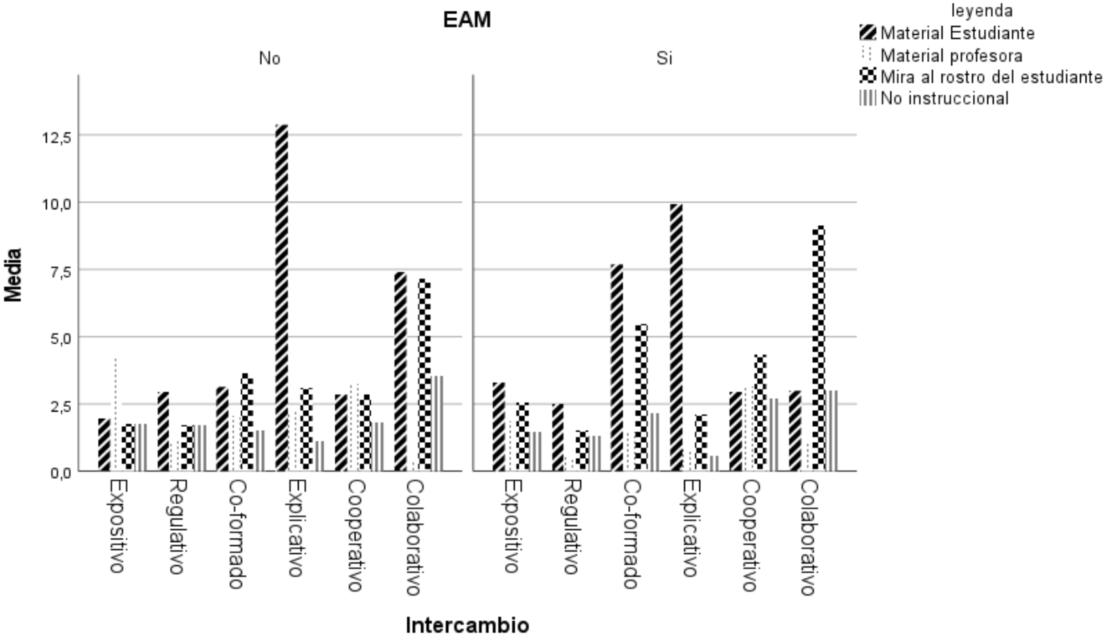
Translation
| EAM | MLE |
| No | No |
| Sí | Yes |
| Intercambio | Exchange |
| Expositivo | Expository |
| Regulativo | Regulatory |
| Co-formado | Co-constructed |
| Explicativo | Explanatory |
| Cooperativo | Cooperative |
| Colaborativo | Collaborative |
| Media | Mean |
| Leyenda | Legend |
| Material estudiante | Student materials |
| Material profesora | Teacher materials |
| Mira al rostro del estudiante | Student face |
| No instruccional | Non-instructional |
Figure 2 reports that teachers in rural classrooms spend longer looking at students’ faces and materials compared to those of urban classrooms. Gaze on students’ faces is greater in Collaborative exchanges with MLE criteria among rural teachers than in exchanges without MLE criteria and among urban teachers. In addition, urban teachers exhibit a higher average gaze duration on student materials in Explanatory exchanges with MLE criteria, compared to gaze fixations in exchanges in which no MLE criteria were present.
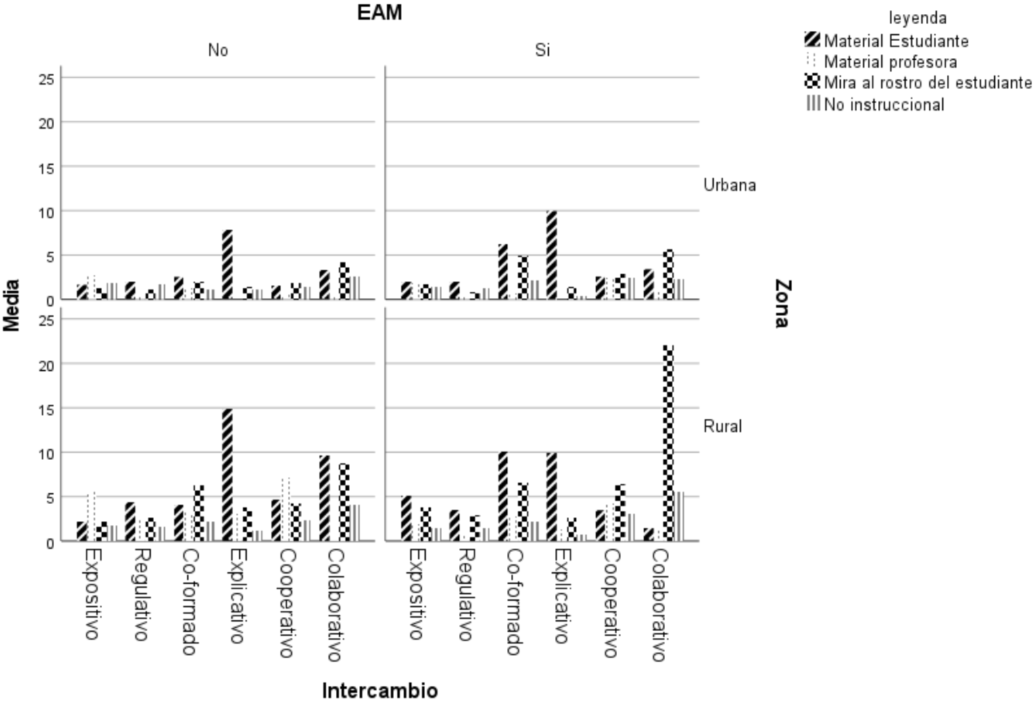
Translation
| EAM | MLE |
| No | No |
| Sí | Yes |
| Intercambio | Exchange |
| Expositivo | Expository |
| Regulativo | Regulatory |
| Co-formado | Co-constructed |
| Explicativo | Explanatory |
| Cooperativo | Cooperative |
| Colaborativo | Collaborative |
| Media | Mean |
| Leyenda | Legend |
| Material estudiante | Student materials |
| Material profesora | Teacher materials |
| Mira al rostro del estudiante | Student face |
| No instruccional | Non-instructional |
| Zona | Location |
| Urbana | Urban |
| Rural | Rural |
IV. Discussion and conclusions
The results from our sample data suggest sufficient evidence that the type of exchange produces statistically significant differences in teachers’ gaze behavior in the areas of interest under study: student materials, teacher materials, student face, and non-instructional.
McIntyre et al. (2019) study teacher gaze in real-world classrooms and its relationship with decision-making in the classroom; this relationship is influenced by length of experience working in the classroom and cultural aspects in the United Kingdom and Hong Kong that shape teacher priorities. Our study contributes to understanding the role of gaze in relation to pedagogical objectives at the micro level of conversational structures – exchanges – in Latin American classrooms and in rural and urban contexts: Expository, Co-constructed, Regulatory, Explanatory, Cooperative, and Collaborative.
Furthermore, the results from our sample data suggest sufficient evidence to report that the use or non-use of mediated learning experience (MLE) criteria and the urban or rural nature of classroom location produce statistically significant differences in teacher gaze behavior.
Various studies have reported the influence of a school’s sociocultural context in understanding inclusion in the classroom (Assael, 2020; Ferreira et al., 2018; Sánchez et al., 2019), and that of the type of dialogue used by teachers in the classroom to promote learning (Khan, 2021; Rojas-Drummond et al., 2020; Vasalampi et al., 2021). Our research builds on this by incorporating teacher gaze duration in basic education as a communicative resource that increases when exchanges include the criteria of the mediated learning experience (MLE) theory, especially those that are more cognitively demanding for students as more active participation by both interlocutors – teacher and student – is required to organize and construct these exchanges, as is the case with Collaborative, Cooperative, Explanatory, and Co-constructed exchanges.
Face-to-face communication supports cooperative social interaction in reciprocal exchanges (Schilbach, 2015), and in schools, the non-verbal component of educational dialogue plays an important role (McIntyre et al., 2017; Muhonen et al., 2020; Smidekova et al., 2018). Our research builds on this by finding that, in real-world lessons, face-to-face conversation between teachers and students is more frequent in rural classrooms than it is in urban settings. This may be associated with the number of students in the classroom, and not necessarily the presence of mediated learning experience criteria in exchanges (Villalta et al., 2019). A face-to-face interaction is more likely in rural classrooms than in urban ones.
The criteria of Feuerstein’s mediated learning experience (MLE) theory have been viewed as one part of quality pedagogical communication that is centered on students and their learning process (Poehner & Infante, 2015; Sandoval-Obando et al., 2018; Shamir et al., 2006), and MLE criteria may be present in different types of dialogues or exchanges (Villalta et al., 2021). In this sense, our research finds that gaze directed at student faces is a communicative resource that is used to a greater extent in pedagogical dialogues in which mediation criteria are present than in dialogues without these criteria.
Recent studies have reported that teacher gaze in classroom interactions with students is influenced by teacher experience, culture, and type of dialogue (McIntyre et al., 2019; McIntyre et al., 2017; Muhonen et al., 2020; Villalta et al., 2019). The teaching experience of the participants in this study varied widely (from 1 to 37 years), and determining the precise influence of this variable on gaze shall require further study. This research has confirmed that teachers’ in-class gaze distribution in exchanges with MLE criteria differs between urban and rural classrooms. Teachers in rural classrooms exhibit longer gaze fixation on students’ materials and faces than their urban counterparts, in mediated Co-constructed and Collaborative exchanges.
This study examines, from the microlevel of classroom communication, the relationship between gaze, dialogue, mediation, and context in the classroom. The type of dialogue used in the classroom has effects on the teacher’s gaze on students and their study materials. The use of mediated learning experience (MLE) criteria to promote autonomous learning in students is consistent with increased gaze fixation on faces and sustained face-to-face interaction, especially in Collaborative exchanges.
Teacher gaze serves a communicative function in all pedagogical exchanges, and gaze fixations on students and students’ materials increase in duration when students initiate exchanges themselves, as is the case with Explanatory exchanges, or when they engage in dialogue that calls upon their experience, as in Collaborative exchanges.
This study found that in smaller classes, such as those in rural settings, teachers are able to devote more time to each student than in urban classrooms. However, the number of students may not be a sufficient condition for dialogue centered on students and the student learning process. There are cultural representations and beliefs attached to teaching contexts that warrant further study. For example, beliefs concerning the role of teaching in promoting learning are reflected here in expository structures in which teacher gaze fixation on the teacher’s own materials tends to be longer.
One limitation of this research is that it does not consider the influence of the subject matter in the relationships explored. Most of the lessons observed were Spanish classes, but some lessons in other subjects were also included. It is highly likely that the lesson content has an impact on possible conversational structures and gaze during such exchanges. Another limitation is the lack of a more detailed analysis of length of teaching experience in the study variables. Future research should explore the influence of subject matter at the micro level of pedagogical interaction in the classroom, as well as the impact of teaching experience and teachers’ reflections on their own practice.
Translation: Joshua Parker
Contribución de autoría
Marco Antonio Villalta-Paucar: conceptualization, investigation, methodology, funding acquisition, supervision, writing – original draft.
Pablo Livacic Rojas: formal analysis, software, validation, visualization.
Jéssica Verónica Rebolledo Etchepare: data curation, project administration, writing-review & editing (40%).
Lautaro Barriga Carvajal: writing – review & editing (30%)
Angélica Guzmán: writing – review & editing (30%)
Declaration of no conflict of interest
The authors declare no conflict of interest.
Source of funding
FONDECYT projects 1200106 and 1150237, Government of Chile.
References
Assael, C. (2020). Tensiones entre la igualdad y la diferencia: la construcción del otro desde los discursos de los docentes [Tensions between equality and difference: Construction of the Other from teacher discourse]. Revista Q, 11(22), 10-22. http://hdl.handle.net/20.500.11912/8102
Burch, M., Haymoz, R. y Lindau, S. (2022). The benefits and drawbacks of eye tracking for improving educational systems. 2022 Symposium on Eye Tracking Research and Applications.
Emanuelsson, J. y Sahlström, F. (2008). The price of participation: Teacher control versus student participation in classroom interaction. Scandinavian Journal of Educational Research, 52(2), 205-223. https://doi.org/10.1080/00313830801915853
Ferrada, D. (2017). Formación docente para la diversidad. Propuestas desde la región del Biobío, Chile [Teacher education for diversity. Proposals from the Biobío Region, Chile]. Revista Mexicana de Investigación Educativa, 22(74), 783-811.
Ferreira, J. M., Karila, K., Muniz, L., Amaral, P. F. y Kupiainen, R. (2018). Children’s perspectives on their learning in school spaces: What can we learn from children in Brazil and Finland? International Journal of Early Childhood, 50, 259-277. https://doi.org/10.1007/s13158-018-0228-6
Feuerstein, R., Falik, L. H. y Feuerstein, R. S. (2015). Changing minds and brains - the legacy of Reuven Feuerstein. Higher Thinking and Cognition Through Mediated Learning. Teachers College Press.
Figueroa, I. (2016). Rol mediador de aprendizajes en educación parvularia: procesos de apropiación en el contexto de una propuesta formativa en experiencia de aprendizaje mediado [Mediating role in early childhood learning: Appropriation processes in the context of a training proposal in mediated learning experience]. Summa Psicológica UST, 13(1), 33-44.
Gardner, R. (2014). Conversation analysis in the classroom. En J. Sidnell Y T. Stivers (Eds.), The handbook of conversation analysis (pp. 593-611). Wiley Blackwell.
Haataja, E., Garcia, E., Salonen, V., Laine, A., Toivanen, M. y Hannula, M. S. (2019). Teacher's visual attention when scaffolding collaborative mathematical problem solving. Teaching and Teacher Education, 86, 102877. https://doi.org/10.1016/j.tate.2019.102877
Haataja, E., Salonen, V., Laine, A., Toivanen, M. y Hannula, M. S. (2020). The relation between teacher-student eye contact and teachers’ interpersonal behavior during group work: A multiple-person gaze-tracking case study in secondary mathematics education. Educational Psychology Review, 33, 51-67. https://doi.org/10.1007/s10648-020-09538-w
Hennessy, S., Rojas-Drummond, S., Higham, R., Márquez, A. M., Maine, F., Ríos, R. M., García-Carrión, R., Torreblanca, O. y Barrera, M. J. (2016). Developing a coding scheme for analysing classroom dialogue across educational contexts. Learning, Culture and Social Interaction, 9, 16-44. https://doi.org/10.1016/j.lcsi.2015.12.001
Ishino, M. (2017). Subversive questions for classroom turn-taking traffic management. Journal of Pragmatics, 117, 41-57. https://doi.org/10.1016/j.pragma.2017.05.011
Jackson, P. W. (2010). La vida en las aulas [Life in the classroom]. Morata.
Jarodzka, H., Skuballa, I. y Gruber, H. (2020). Eye-tracking in educational practice: Investigating visual perception underlying teaching and learning in the classroom. Educational Psychology Review, 33, 1-10. https://doi.org/10.1007/s10648-020-09565-7
Jurado, M., Avello, R., & Bravo, G. (2020). Caracterización de la comunicación interpersonal en el proceso enseñanza-aprendizaje [Characterization of interpersonal communication in the teaching-learning process]. Revista Electrónica de Investigación Educativa, 22. https://doi.org/10.24320/redie.2020.22.e09.2284
Kerbrat-Orecchioni, C. (1998). Les interactions verbales. Approche interactionnelle et structure des conversations [Verbal interactions. Interactional approach and conversational structure] (Vol. I). Armand Colin.
Khan, S. (2021). The process of subject content transformation as examined through psychological and sociological perspectives: A study conducted in Oxfordshire, England. Cultural-Historical Psychology, 17(2), 65-75. https://doi.org/10.17759/chp.2021170207
Kozulin, A. (2015). The impact of cognitive education training on teachers’ cognitive performance. Journal of Cognitive Education and Psychology, 14(2), 252-262. https://doi.org/10.1891/1945-8959.14.2.252
McIntyre, N. A., Jarodzka, H. y Klassen, R. M. (2019). Capturing teacher priorities: Using real-world eye-tracking to investigate expert teacher priorities across two cultures. Learning and Instruction, 60, 215-224. https://doi.org/10.1016/j.learninstruc.2017.12.003
McIntyre, N. A., Mainhard, M. T. y Klassen, R. M. (2017). Are you looking to teach? Cultural, temporal and dynamic insights into expert teacher gaze. Learning and Instruction, 49, 41-53. https://doi.org/10.1016/j.learninstruc.2016.12.005
Moscoso, J. N. (2017). Los métodos mixtos en la investigación en educación: hacia un uso reflexivo [Mixed methods in education research: Towards a reflexive use]. Cadernos de Pesquisa, 47(164), 632-649. https://doi.org/10.1590/198053143763
Muhonen, H., Pakarinen, E., Rasku-Puttonen, H. y Lerkkanen, M.-K. (2020). Dialogue through the eyes: Exploring teachers’ focus of attention during educational dialogue. International Journal of Educational Research, 102, 1-12. https://doi.org/10.1016/j.ijer.2020.101607
Núñez, C. G., González-Niculcar, B., Peña, M. A., & Ascorra, P. E. (2022). Análisis de facilitadores y barreras en educación rural en Chile: Inclusión en un país segregado [Analysis of facilitators and barriers in rural education in Chile: Inclusion in a segregated country]. Athenea Digital. Revista de Pensamiento e Investigación Social, 22(2), e2654, 1-25. https://doi.org/10.5565/rev/athenea.2654
Núñez-Muñoz, C. G., Peña-Ochoa, M., González-Niculcar, B., & Ascorra-Costa, P. (2020). Una mirada desde la inclusión al Programa de Integración Escolar (PIE) en escuelas rurales chilenas: un análisis de casos [An inclusion-oriented view of the School Integration Program (PIE) in rural schools in Chile: A case study]. Revista Colombiana de Educación, (79), 347-368. https://revistas.pedagogica.edu.co/index.php/RCE/article/view/9725
Orrú, S. E. (2003). Reuven Feuerstein y la Teoría de la Modificabilidad Cognitiva Estructural [Reuven Feuerstein and structural cognitive modifiability theory]. Revista de Educación, 332, 33-54.
Pérez, Z. P. (2011). Los diseños de método mixto en la investigación en educación: una experiencia concreta [Mixed-methods designs in education research: One particular experience]. Revista Electrónica Educare, 15(1), 15-29. https://doi.org/10.15359/ree.15-1.2
Pluye, P. (2020). Integración en métodos mixtos. Marco conceptual para la integración de fases, resultados y datos cualitativos y cuantitativos [Integration in mixed methods. Conceptual framework for integrating phases, results, and qualitative and quantitative data]. In V. Ridde & C. Dagenais (Eds.), Evaluación de las intervenciones sanitarias en salud global. Métodos avanzados (pp. 195-220). IRD.
Poehner, M. E. e Infante, P. (2015). Mediated development. Language and Sociocultural Theory, 2(2), 161-183. https://doi.org/10.1558/lst.v2i2.26982
Rekalde, I., Vizcarra, M. T., & Macazaga, A. M. (2014). La observación como estrategia de investigación para construir contextos de aprendizaje y fomentar procesos participativos [Observation as a research strategy for building learning contexts and encouraging participatory processes]. Educación XX1, 17(1), 201-220. https://doi.org/10.5944/educxx1.17.1.10711
Rojas-Drummond, S., Barrera, M. J., Hernández, I. y Vélez, M. (2020). Dialogic interactions, co-regulation and the appropriation of text composition abilities in primary school children. Learning, Culture and Social Interaction, 24, 100354. https://doi.org/10.1016/j.lcsi.2019.100354
Sánchez, S., Rodríguez, H. y Sandoval, M. (2019). Descriptive analysis of school Inclusion through Index for Inclusion. Psychology, Society, and Education, 11(1), 1-13. https://ojs.ual.es/ojs/index.php/psye/article/view/653
Sandoval-Obando, E. E., Moreno, A., Walper, K., Leguizamón, D. y Salvador, M. (2018). Pedagogical Strategies to Promote Mediated Learning Experiences in Vulnerable Contexts. Universitas Psychologica, 17(5), 1-13. https://doi.org/10.11144/javeriana.upsy17-5.pspm
Schilbach, L. (2015). Eye to eye, face to face and brain to brain: novel approaches to study the behavioral dynamics and neural mechanisms of social interactions. Current Opinion in Behavioral Sciences, 3, 130-135. https://doi.org/10.1016/j.cobeha.2015.03.006
Shamir, A., Tzuriel, D. y Rozen, M. (2006). Peer mediation-The effects of program intervention, maths level, and verbal ability on mediation style and improvement in maths problem solving. School Psychology International, 27(2), 209-231. https://doi.org/10.1177/0143034306064548
Smidekova, Z., Janik, M., Minarikova, E. y Holmqvist, K. (2018). Teachers' gaze over space and time in a real-world classroom. Journal of Eye Movement Research, 13(4), 1-20. https://doi.org/10.16910/jemr.13.4.1
Vasalampi, K., Metsäpelto, R.-L., Salminen, J., Lerkkanen, M. K., Mäensivu, M. y Poikkeus, A. M. (2021). Promotion of school engagement through dialogic teaching practices in the context of a teacher professional development programme. Learning, Culture and Social Interaction, 30. https://doi.org/10.1016/j.lcsi.2021.100538
Villalta, M. A., Assael, C., & Baeza, A. (2018). Conversación y mediación del aprendizaje en aulas de diversos contextos socioculturales [Conversation and mediation of learning in classrooms in different sociocultural contexts]. Perfiles Educativos, 40(160), 101-119. https://doi.org/10.22201/iisue.24486167e.2018.160.58496
Villalta, M. A., Assael, C., Delgado-Vásquez, A. E., Torres-Acuña, W. y Lebeer, J. (2022). Effect of Mediated learning in teacher-child interactions in urban and rural primary school classrooms. Language and Sociocultural Theory, 8(2), 239-262. https://doi.org/10.1558/lst.18173
Villalta, M., Vera-Villarroel, P., Assael, C. y Segovia, A. (2019). Eye tracking and conversational structures in chilean rural and urban elementary education classrooms. Interciencia, 44(5), 266-273.
Villalta-Paucar, M. A., Martinic-Valencia, S., & Assael-Budnik, C. (2022). Interacción y práctica reflexiva del docente en la sala de clase [Interaction and reflective practice of teachers in the classroom]. Revista Colombiana de Educación (86), 95-118. https://doi.org/10.17227/rce.num86-12270
Wolff, C. E., Jarodzka, H., van den Bogert, N. y Boshuizen, H. P. A. (2016). Teacher vision: expert and novice teachers’ perception of problematic classroom management scenes. Instructional Science, 44, 243-265. https://doi.org/10.1007/s11251-016-9367-z