Competencia digital y factores que influyen en la participación de docentes en cursos virtuales masivos
 María Amalia Salazar AlvaradoAdriana Mata-CalderónOlmer Núñez SosaCarmen Yaribel CruzMelissa Cubero Villalobos
How to cite: Salazar, M. A., Mata-Calderón, A., Núñez, O., Cruz, C. Y. y Cubero, M. (2025). Digital competence and factors influencing teacher participation in massive open online courses. Revista Electrónica de Investigación Educativa, 27, e06, 1-18. https://doi.org/10.24320/redie.2025.27.e06.5978

Abstract
The COVID-19 pandemic compelled teachers to develop skills to continue the education process remotely; massive open online courses (MOOCs) were one of the most effective strategies. This research aimed to identify the personal and institutional factors that facilitate or hinder completion of a MOOC. A quantitative, exploratory, cross-sectional study was conducted, with a nonprobability sample of 1,277 teachers. Descriptive and logistic regression analyses were performed with data from a self-assessment and a survey taken by participants enrolled in MOOCs on digital competence. The findings show that participants’ level of digital competence is not a determining factor for completion of these courses, and course completion is facilitated by factors like personal interest and professional development but hindered by the technology platform and time availability. Gender, years of ICT use, and participants’ view of the courses were also identified as significant factors. These results can provide guidance for professional development initiatives to promote conditions that support the completion of this type of course.
Keywords: MOOC, teacher qualifications, electronic learning, information technology
I. Introduction
The period from 2020 to 2021 saw the unfolding of the COVID-19 health crisis. The effect of the pandemic on education was reflected in the temporary closure of schools. However, to ensure continuity in the education process and lessen the impact on student learning, the decision was made to leverage the opportunities of virtual and distance education (García, 2021), using information and communication technology (ICT) to support teaching-learning processes (Arias et al., 2020; Portillo et al., 2020).
This change in modality made it clear that many teachers were not sufficiently equipped to use technologies as supporting tools (European Commission, n.d.). For example, Sojuel and Nanne-Lippmann (2021) found that in Central America and the Caribbean, teachers struggled to engage students in activities, develop approaches to education that met the needs of their specific context, and select resources appropriately.
As the pandemic subsided, education systems in the region gradually resumed in-person learning. However, it is important that the experience gained and effort expended during that time become long-term digital transformation strategies (Inter-American Dialogue, 2021), such that stakeholders are made aware that education processes can no longer dispense with the use of ICT (Expósito & Marsollier, 2021). Achieving effective use of these technologies will require the support and involvement of teachers, who demonstrated during the pandemic that they played a key role in implementing different initiatives (Inter-American Dialogue, 2021). Yet knowledge of and proficiency in digital media is not sufficient: teachers need to develop the digital competences to effectively integrate technologies into teaching-learning processes (Guàrdia et al., 2022; Inter-American Dialogue, 2021), taking into account contexts, learning goals, and didactic strategies, among other aspects.
Redecker and Punie (2020) define teacher digital competences (TDCs) as the “necessary competences to fully exploit the potential of digital technologies for enhancing teaching and learning and for adequately preparing their students for life and work in a digital society” (p. 12). Meanwhile, Zúñiga, Molina et al. (2021) describe them as “the responsible, creative, and critical use of digital technologies to enhance the work of teachers in all aspects: teaching and learning, professional development, and educational management” (p. 7).
At the macro level of educational management, establishing TDCs offers a solid foundation to guide education policies and establish a common language to support the exchange of teaching practices between countries, while serving as a conceptual reference to validate assessment instruments and tools (Redecker & Punie, 2020) and conduct teacher diagnostics in ICT (Zúñiga, Núñez et al., 2021). At a micro level of the learning environment, it can enable teachers to improve teaching-learning and professional development processes (Romero-Córdova & Arraizu-Muñoz, 2023).
Given their importance, strategies have been implemented with the aim of strengthening TDCs. In today’s post-pandemic world, massive open online courses (MOOCs) offer an alternative to achieve this (Romero-Córdova & Arraizu-Muñoz, 2023). MOOCs are offered on online education platforms and can be taken under the guidance of a mediator or self-paced, meaning that progress in the course depends on the student (López, 2017). One of the leading forefathers of MOOCs (Siemens, as cited in Bartolomé & Steffens, 2015) has noted that learning occurs in MOOCs through connectivism, which posits that learning is a change in a person’s performance that takes place within a community of individuals interested in a given topic.
MOOCs can be used to cover content with learning strategies that seek to promote the participants’ professional development and are characterized as free online courses, primarily audiovisual in nature and open to an unlimited number of students; they also employ collaborative and participatory methodologies (López, 2017). The benefits of MOOCs include their ubiquity, free access, credibility, and high quality; disadvantages include “high dropout rates; a lack of feedback; low interaction; the lack of a credible verification of learning outcomes and peer assessment; and the existence of a wide range of subjects, but with no explicit curriculum” (López-Meneses et al., 2020, p. 79).
1.1 Factors that facilitate or limit teacher participation in MOOCs
Given the high dropout rates, it is important to identify the factors that facilitate or limit teacher participation in MOOCs. Intrinsic motivation, understood as a commitment to professional improvement and teaching practice, has been found to positively impact whether teachers begin and remain on courses (Ballesteros et al., 2020; Pant et al., 2023; Rolón & Benítez, 2023; Sánchez et al., 2022; Yamba-Yugsi & Luján-Mora, 2017). This motivation is shaped by teachers’ interest in the subject matter of the course (Rolón & Benítez, 2023), particularly when they find the course helpful and conducive to improving their knowledge and skills (Goopio & Cheung, 2020; Pozón-López et al., 2019).
Other personal factors that may support successful completion are previous experiences with MOOCs, level of education, and the time that teachers devote to the course (Goopio & Cheung, 2020). External factors identified include whether courses are compulsory (Ballesteros et al., 2020), the benefits of earning a certificate (Goopio & Cheung, 2020), and the characteristics of the platform (interactivity and ease of use).
Personal factors that limit massive online course participation and completion include a lack of motivation and poor time management in carrying out the proposed activities (Goopio & Cheung, 2020; Ruiz-Corbella et al., 2016). One key aspect is access to technology (equipment and connectivity), without which it is not possible to take these courses (Ruiz-Corbella et al., 2016).
Another variable to consider is sex, as women may have less time and energy to expend on online training than men, due to a greater family caregiving burden (Caro-Acero & Casas, 2013, as cited in Arias-Velandia et al., 2018). Teachers may also decide not to complete a course if they view it to be poorly organized (Yamba-Yugsi & Luján-Mora, 2017). Likewise, TDCs have been identified as a factor that can both facilitate and limit participation in MOOCs (Ballesteros et al., 2020; Rodríguez et al., 2023; Ruiz-Corbella et al., 2016). In this respect, teachers interviewed by Ballesteros et al. (2020) remarked that participation in courses of this kind required “basic knowledge of computer and browser use, the use of some product development software, and information search skills, among others” (p. 13).
1.2 Priority Training Programs (OFP), an experience in developing TDCs
In light of the loss of learning caused by the pandemic, Costa Rica’s Ministry of Public Education (MEP) proposed the Comprehensive Academic Catch-Up Plan (PINA) (Consejo Nacional de Rectores (Costa Rica). Programa Estado de la Nación, 2021). This plan included the Priority Training Programs initiative (OFP, or Oferta Formativa Priorizada in Spanish), which sought to strengthen the quality and innovation of the Costa Rican education system through refresher training for teachers (Ministerio de Educación Pública, 2022). A total of 13 massive online courses were offered, targeting all teachers in Costa Rican public schools (approximately 54,000 individuals) and implemented by the Omar Dengo Foundation (FOD), in coordination with the Uladislao Gámez Solano Professional Development Institute (IDP-UGS).
The courses were provided through the platform “UPE-La puerta del conocimiento” (Fundación Omar Dengo, 2017), in an online, self-paced format, with a duration of 20 hours of instruction. It is important to note that, initially, this training was mandatory for teachers, but technical issues with the platform ultimately led to the decision to make participation voluntary.
This paper sets out to identify the factors that facilitate or hinder completion of massive online courses in a group of teachers invited to participate in the OFP, taking into consideration elements relating to their TDCs and personal and school characteristics. This work is based on the hypothesis that TDCs and certain aspects associated with teachers’ professional practice, ICT background, and school characteristics (see detail in Table 3) have a positive effect on massive online course completion. In addition, it has been theorized that certain characteristics of teaching staff, such as age and sex, also have an effect on course completion.
II. Method
To achieve our objective, this study drew from two sources of data: 1) a survey of teachers enrolled in OFP courses in 2022; and 2) a self-assessment of TDCs, taken by teachers in public education in Costa Rica in 2020.
OFP study. This data is taken from a survey conducted in May 2022 with teachers enrolled in OFP, both those who completed the course that they were enrolled in and those who did not. The survey aimed to explore the perception that teaching staff had of massive online courses, in addition to aspects that facilitated or hindered participation. In total, information was collected from 7,860 individuals aged between 19 and 65 years (M = 42.7, SD = 8.49). Women accounted for 78% of participants, and 65% of participants reported holding a licentiate degree (licenciatura).1
Study of the self-assessment of TDCs. The second data source is taken from a study by Zúñiga, Núñez et al. (2021) and consists of a self-assessment by 17,731 public school teachers in Costa Rica in 2020, who worked at all levels of primary and secondary education. This instrument measured 12 digital competences, based on the digital competence matrix of the Innovation Center for Brazilian Education (Centro de Inovação para a Educação Brasileira [CIEB], 2019), included in the study report. Table 1 details the structure of this matrix and shows how the proposed competences fall into three major areas: pedagogy, digital citizenship, and professional development. The stages of progression for these competences are presented in Table 2.
| Areas | Competences | Description |
|---|---|---|
|
Pedagogy Use of educational technology to support teaching practices. |
1. Teaching practice | Incorporating technology into student learning experiences and teaching strategies. |
| 2. Evaluation | Using ICT to support and guide the learning process and evaluate student performance. | |
| 3. Personalization | Using technology to create learning experiences that meet the needs of each student. | |
| 4. Selection and creation | Selecting and creating digital resources that support the teaching-learning process and management. | |
|
Digital citizenship Use of technology to discuss life in society and how to use information technology responsibly. |
5. Responsible use | Carrying out and promoting the ethical and responsible use of technology (cyberbullying, privacy, digital identity, and legal implications). |
| 6. Safe use | Carrying out and promoting the safe use of technology (data protection tools and strategies). | |
| 7. Critical use | Carrying out and promoting critical interpretation of information available in digital media. | |
| 8. Inclusion | Using technological resources to promote inclusion and educational equity. | |
|
Professional development Use of technology to ensure continuing education and professional growth. |
9. Self-development | Using ICT in activities for continuing education and professional development. |
| 10. Self-assessment | Using ICT to assess one’s teaching practice and take action to improve it. | |
| 11. Sharing | Using technology to participate and promote participation in virtual communities for learning and exchange between colleagues. | |
| 12. Communication | Using ICT to maintain active, systematic, and efficient communication with stakeholders in the educational community. | |
| Source: CIEB (2019). | ||
| Level | Description |
|---|---|
| Exposure | No use of technology in teaching practice, the teacher requires help from others to use technology, or any use of technology is only personal. Teaching staff see technology as an instrument and not as a part of digital culture. |
| Familiarization | The teacher is beginning to gain familiarity with technology and uses it occasionally in activities. He or she sees technology as a means to support teaching. Technology use is centered on teachers themselves. |
| Adaptation | Technology is used regularly and can be integrated into the planning of learning activities. The teacher sees technology as a complementary resource to enhance the teaching-learning process. |
| Integration | Technology is frequently used in planning activities and in interaction with students. The teacher integrates and contextualizes the use of technology in the teaching-learning process. |
| Transformation | Teaching staff use technology innovatively, share experiences with colleagues, and perform collaborative projects beyond their school, showing maturity within digital culture. They see technology as a tool for social transformation. |
| Source: CIEB (2019). | |
In this study, this information was not used merely as a reference but served to establish a subsample made up of those who took the OFP survey and had also previously completed the self-assessment instrument (Figure 1). The objective was to explore whether TDCs had an impact on course completion by teachers.
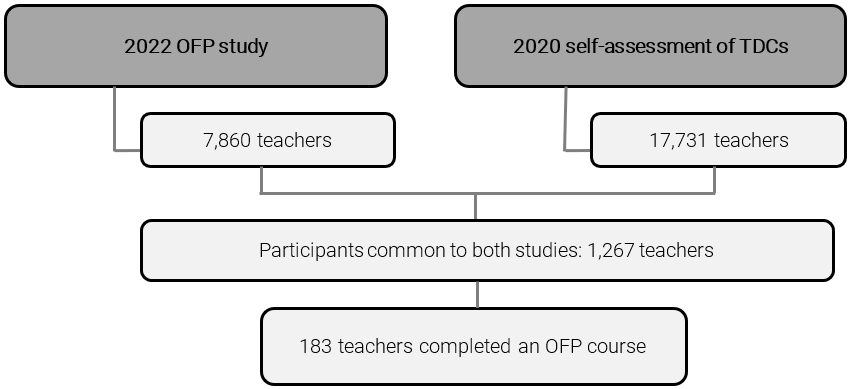
Several statistical techniques were employed for the analysis. First, descriptive statistics were obtained to identify the frequencies of the multiple-choice questions associated with the factors that facilitate or limit participation in MOOCs. Moreover, to compare TDC levels between the group that completed the OFP course and the group that did not, an analysis of variance was performed using indicators that approximate different areas of TDCs (see Table 4). Next, a bivariate logistic regression was performed (Hosmer & Lemeshow, 2000) in order to detect factors that influenced participation in OFP courses. The dependent variable was defined as whether teachers completed the course or not, and the independent variables were the characteristics of teachers and their TDCs. These variables are detailed in Table 3.
| Description | Type | Value |
|---|---|---|
| Dependent variable | ||
| Completed the OFP course or not | Dichotomous |
0 = Did not complete (withdrew from course) 1 = Did complete (passed, failed) |
| Independent variables: teacher characteristics | ||
| Personal characteristics | ||
| Teacher’s sex | Dichotomous |
0 = Female 1 = Male 8 = Other (excluded) |
| Teacher’s age, in years at last birthday | Quantitative | 21 to 64 |
| Professional practice | ||
| Teaching experience | Quantitative | 2 to 37 |
| Academic degree | Ordinal |
1 = Teaching diploma 2 = Bachelor’s degree 3 = Licentiate degree (Licenciatura) 4 = Master’s degree 5 = Doctorate 8 = Other (excluded) |
| Specialization | Qualitative |
0 = Other 1 = IT or commercial or industrial technical specialization |
| Type of teaching appointment | Dichotomous |
0 = No tenure 1 = Tenured |
| ICT background | ||
| Perception of improvement in competences resulting from course1 | Continuous | 00 to 10 |
| Perception of course quality2 | Continuous | 0 to 10 |
| Received formal ICT education | Dichotomous |
0 = No 1 = Yes |
| Has received ICT training | Dichotomous |
0 = No 1 = Yes |
| Years using ICT in education | Discrete | 0 to 15 |
| ICT access3 | Quantitative | 0 to 10 |
| Independent variables: TDCs | ||
| Indicator of TDCs4 | Continuous | 0 to 10 |
| Indicator for the area “Pedagogy” | Continuous | 0 to 10 |
| Indicator for the area “Professional development” | Continuous | 0 to 10 |
| Indicator for the area “Digital citizenship” | Continuous | 0 to 10 |
| Independent variables: school characteristics | ||
| Internet in class | Dichotomous |
0 = No 1 = Yes |
| Technological devices in school | Discrete | 0 to 6 |
| Type of school location | Dichotomous |
0 = Rural 1 = Urban |
|
Notes: 1 Indicator that approximates the perception of the extent to which courses contributed to the development of 7 TDCs, answered on a 5-point Likert scale. A higher score indicates greater course contribution. 2 Indicator that includes questions on various characteristics relating to technical and academic support provided in the courses. A higher score indicates greater satisfaction with these characteristics. 3 Indicator that approximates access to ICT, measured based on the frequency with which teachers use computers and their liking for ICT. The closer a teacher’s score is to 10, the better his or her ICT access. 4 Indicator that approximates improvement in TDCs. A higher score indicates greater improvement by the teacher. |
||
The analysis of variance and logistic regression were performed in R (version 4.2.2) and SPSS (version 27), with a significance level of 5%. In addition, the G*Power program (version 3.1.9.7) was used for power analysis in the hypothesis tests.
III. Results
3.1 Teacher digital competences and their relation to participation in MOOCs
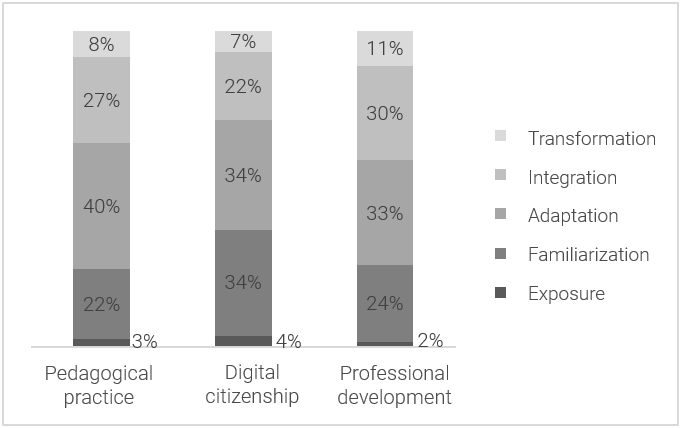
Of the 7,860 teachers surveyed who participated in an OFP course, 36% completed it, 55% reported not doing so, and 9% did not answer. In addition, the TDCs from the self-assessment were associated with this subsample and most teachers were found to be at the familiarization and adaptation levels (Figure 2), in each of the three areas considered (Tables 1 and 2).
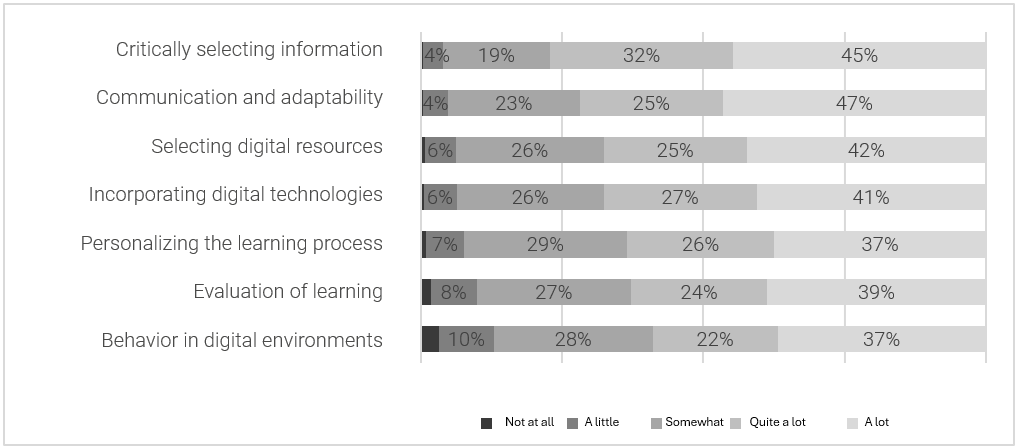
Given that one of the aims of the OFP was to enhance TDCs, teachers were also asked if the courses they took part in helped to improve these competences. The results (Figure 3) show that the main improvement was in the ability to critically select information online, based on criteria that include credibility, relevance, source evaluation, and currency.
We explored whether those who completed an OFP course exhibited differences in five indicators associated with their TDCs and their perception of the OFP (Table 4), compared with those who did not complete the course. The results show potential significant differences in three of the six indicators considered in the analysis: in pedagogy, in the perception of improvement in competences, and in the perception of course quality. These results point to a positive influence of TDCs, in particular those associated with the use of technology for pedagogical purposes.
| Statistic | Participation in OFP | Total | |
|---|---|---|---|
| Did not participate | Did participate | ||
| Indicator of TDCs (p = 0.01, 1−β = 0.73) | |||
| Sample | 1084 | 183 | 1267 |
| Mean | 4.87 | 5.29 | 4.93 |
| Standard deviation | 2.03 | 2.06 | 2.04 |
| Indicator for the area “Pedagogy” 2021 (p = 0.01, 1−β = 0.78) * | |||
| Sample | 1084 | 183 | 1267 |
| Mean | 4.97 | 5.44 | 5.04 |
| Standard deviation | 2.13 | 2.19 | 2.14 |
| Indicator for the area “Professional development” 2021 (p = 0.03, 1−β = 0.61) | |||
| Sample | 1084 | 183 | 1267 |
| Mean | 4.50 | 4.90 | 4.56 |
| Standard deviation | 2.23 | 2.25 | 2.24 |
| Indicator for the area “Digital citizenship” 2021 (p = 0.03, 1−β = 0.60) | |||
| Sample | 1084 | 183 | 1267 |
| Mean | 5.12 | 5.52 | 5.18 |
| Standard deviation | 2.26 | 2.25 | 2.27 |
| Perception of improvement in competences resulting from course (p = 0.01, 1−β = 0.74) * | |||
| Sample | 1084 | 183 | 1267 |
| Mean | 7.06 | 7.41 | 7.11 |
| Standard deviation | 1.82 | 1.59 | 1.79 |
| Perception of course quality (p = 0.01, 1−β = 0.72) * | |||
| Sample | 1084 | 183 | 1267 |
| Mean | 6.68 | 7.06 | 6.74 |
| Standard deviation | 1.86 | 1.84 | 1.87 |
| Notes: * Significant difference; p = p-value, representing significance in an independent samples t-test; 1−β = statistical power of the hypothesis test. | |||
3.2 Factors that facilitate or hinder the completion of MOOCs
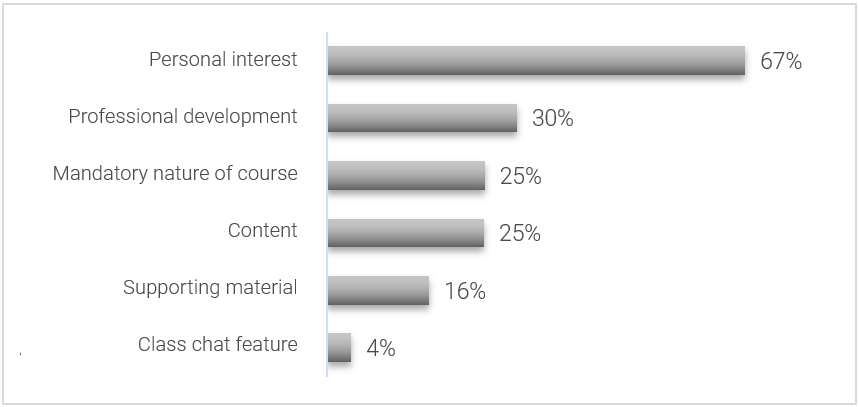
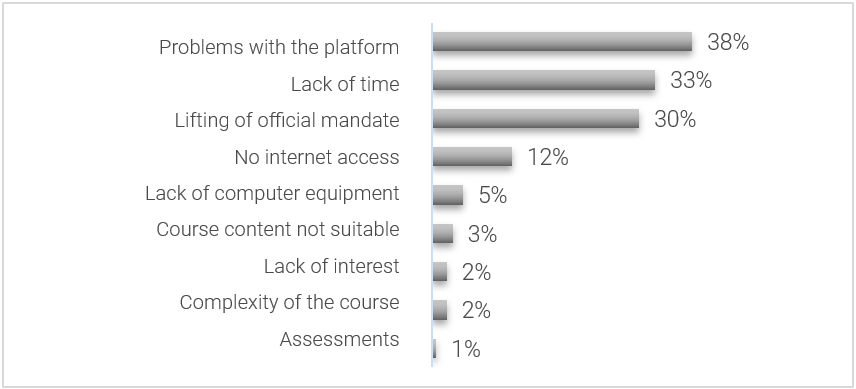
The participants in the OFP survey were also asked to identify the factors that enabled or impeded their completion of the course. Figure 4 shows the factors that supported course completion, such as personal interest and having professional development as a goal, while Figure 5 lists the factors reported by participants to hinder course completion, most notably problems with the platform, a lack of time, and the lifting of the official mandate (which meant that course participation was voluntary, rather than compulsory).
To determine which other factors influenced course completion and to what extent, a logistic regression was performed. The results show that, in contrast to the proposed hypothesis, only three of the 20 variables in the analysis exhibit significant results (see Table 5). These are 1) sex, with men being 53% more likely to complete the course than women; 2) view of the OFP; individuals with a positive view of the program were more likely to complete the course, with the probability of course completion increasing by 12% for each additional point in their course rating; and 3) years using ICT in education, with the probability of course completion increasing by 5% for each year teachers used digital technology in their lessons.
| Variable | B | Std. Error | Exp(B) | Sig. |
|---|---|---|---|---|
| Sex (Male) | 0.42 | 0.18 | 1.53 | 0.02 * |
| Age | -0.01 | 0.01 | 0.99 | 0.48 |
| Experience | -0.02 | 0.02 | 0.98 | 0.22 |
| Academic degree (Bachelor’s degree) | -0.35 | 0.57 | 0.70 | 0.54 |
| Academic degree (Licentiate degree) | -0.61 | 0.52 | 0.54 | 0.24 |
| Academic degree (Master’s degree) | -0.49 | 0.53 | 0.61 | 0.35 |
| Specialization (IT or technical specialization) | 0.25 | 0.24 | 1.29 | 0.30 |
| Type of teaching appointment (Tenured) | 0.32 | 0.22 | 1.38 | 0.13 |
| Perception of improvement in competences resulting from course | 0.01 | 0.05 | 1.01 | 0.82 |
| Perception of course quality | 0.11 | 0.05 | 1.12 | 0.02 * |
| Received formal ICT education (Yes) | 0.18 | 0.19 | 1.20 | 0.35 |
| Received ICT training (Yes) | -0.02 | 0.20 | 0.98 | 0.91 |
| Years using ICT in education | 0.05 | 0.02 | 1.05 | 0.01 * |
| ICT access | 0.10 | 0.08 | 1.11 | 0.21 |
| Indicator for the area “Pedagogy” | -0.04 | 0.07 | 0.96 | 0.57 |
| Indicator for the area “Professional development” | 0.03 | 0.07 | 1.03 | 0.62 |
| Indicator for the area “Digital citizenship” | 0.00 | 0.06 | 1.00 | 0.96 |
| Internet in class (Yes) | 0.26 | 0.18 | 1.29 | 0.16 |
| Technological devices in school | -0.05 | 0.07 | 0.95 | 0.47 |
| School location (Urban) | 0.27 | 0.18 | 1.31 | 0.13 |
| Constant | -3.29 | 1.01 | 0.04 | 0.00 |
| Note: Values significant at p < 0.05 | ||||
The model uses 1,238 cases as it excludes 29 records from the database due to missing values in the variables. The Hosmer-Lemeshow test (chi-square: 4.67; degrees of freedom: 8, and significance: 0.792) suggests that the observed values and the values predicted by the model may be similar. The resulting coefficient of determination (Nagelkerke’s R2) is 0.058. Using a cutoff point of 0.15 (due to low participation rates in the courses), the model correctly predicts 63% of cases. In conclusion, although the model explains 6% of variability in data, the other statistics of fit suggest that the model may be used to evaluate factors that influence participation in MOOCs.
IV. Discussion and conclusions
This study aimed to identify TDC factors and teacher and school characteristics that facilitate or hinder the completion of massive online courses. In general, the results show that TDCs in the subsample were mostly at the familiarization and adaptation levels. Those who took and completed courses were found to score significantly higher in the self-assessment of digital competences in pedagogy than those who did not complete courses. This result is important as it contrasts with qualitative perception-based research findings that digital competences may facilitate or limit course participation and completion (Ballesteros et al., 2020, Rodríguez et al., 2023; Ruiz-Corbella et al., 2016).
On the other hand, the statistical results of this study show that despite a higher level of TDCs in pedagogy among those who completed courses, and contrary to our hypothesis, these differences did not prove significant in the logistic regression. This means that TDCs do not appear to be determining factors in course completion.
In addition, the longer teachers have been using ICT in education, the more likely they are to complete courses. This indicates that teachers who already make greater use of technology in their work may view ICTs as familiar, everyday tools, making them more inclined to gain new ICT knowledge and skills and therefore also participate in and complete massive online courses on TDCs.
In this regard, Valdés et al. (2011) found that having a computer at home was associated with an increased need for teacher training, specifically pedagogical aspects to use ICT in the classroom, and with previous training in ICT use. This may indicate that a greater proximity to technology results in a greater desire to learn to use it in the classroom.
This study also found that participants who completed the course had a greater perception of improvement in TDCs. This is important because, as reported by Goopio and Cheung (2020) and Pozón-López et al. (2019), one of the key motivators for participating in courses of this kind is the feeling that they may improve knowledge and skills or support job performance (Pant et al., 2023). At the same time, Gordillo et al. (2019) remark that MOOCs fulfill all the conditions to provide an attractive, low-cost option well suited for teacher digital competence training.
The results show that the main reasons that teachers gave for failing to complete the courses included difficulty finding time to complete them, problems using the platform, and the decision to make participation voluntary rather than compulsory. The time factor was also identified by Ruiz-Corbella et al. (2016) as one of the main difficulties in completing MOOCs, while Ballesteros et al. (2020) found that it was not just time per se, but the way participants managed their time.
Pozón-López et al. (2019) found that participants in MOOCs recognized that characteristics like interactivity and ease of use of the platform were important aspects in completing courses. For example, Liu et al. (2015) observed that difficulties navigating the platform and unintuitive interfaces affected the learning experience of participants and resulted in negative course perceptions. This is reaffirmed by our results, both from the perspective of those who withdrew from their course, who cited the platform as one reason, and from the perspective of those who did complete their course, who had a more positive view of the quality of the platform.
These initial exploratory results appear to suggest that the platform was not easy to use. However, given that it was viewed in a positive light by those who did succeed in completing courses, it may be that users need to take some time to familiarize themselves with the platform and understand how it works.
The fact that various participants reported that the switch to optional, rather than compulsory, participation was a factor in their failure to complete the courses is consistent with findings by Ballesteros et al. (2020), underscoring the importance of making key teacher training mandatory. In the same vein, making participation compulsory requires certain commitments by education authorities to facilitate it, such as allowing teachers to complete training within their working hours and guaranteeing the necessary resources (internet access, computers, a properly functioning platform).
In addition, our analysis also found that men were more likely to complete the courses. This aligns with results by Arias-Velandia et al. (2017) and Caro-Acero and Casas (2013, as cited in Arias-Velandia et al., 2018), who find that women may score more poorly in assessments and have higher rates of dropout. They link this to the additional burden of family caregiving (children, older adults, people with disabilities) faced by many women.
Teachers who succeeded in completing courses cited personal interest and professional development as their main motivations. This is consistent with research by Yamba-Yugsi and Luján-Mora (2017), Ballesteros et al. (2020), and Sánchez et al. (2022), who identify intrinsic motivation as key to participation in this kind of MOOC. Similarly, Beltrán-Sánchez et al. (2019) highlight positive teacher attitude as a factor influencing the proper implementation of digital literacy programs. These results appear to indicate that motivation is a key consideration in encouraging teachers to engage in training and integrate ICT into the education process.
This study has shown that most teachers who enroll in these courses do not complete them. This echoes research by García et al. (2017), who report that only between 5% and 10% of students enrolled in a MOOC complete the course. This underscores the importance of exploring the factors that hinder or facilitate the completion of massive online courses. Great effort is expended on designing and implementing these courses, but completion rates are very low.
In conclusion, this study finds that the TDC level of participants in MOOCs is not a determining factor in course completion. Rather, there are other aspects, like personal interest in the subject and a desire to pursue professional development opportunities, that teachers view as facilitating course completion. Conversely, difficulties using the platform and time constraints are impeding factors. Lastly, we found that, contrary to our hypothesis, only aspects like participants’ sex, the number of years of technology use, and their view of the courses significantly affected MOOC completion in the teacher population.
The findings of this study give rise to a series of recommendations for designing courses of this kind. For example, we believe it advisable for teachers to be offered resources on effective time management strategies, in addition to the resources specific to the training course in question. It is also important for education authorities to support participation in these courses during teachers’ working hours, thus helping to bridge the gender gap observed in course completion.
Pilot testing of prospective platforms is recommended to anticipate any errors and make them intuitive and easy to use, which should help users of MOOCs to become familiar with them. Lastly, we suggest including in the course design introductory elements relating to the benefits of completing the courses and showing how knowledge acquired can be applied in teaching practice. This is with the aim of supporting the perceived usefulness of training activities and raising the motivation of enrolled users.
Importantly, the results of this study have some limitations that should be noted. First, although some factors were identified that may facilitate or hinder teachers’ completion of massive online courses, this list was not exhaustive. There may be other aspects that have a significant impact, but which were not considered in this research. In addition, the TDC information used for the various statistical analyses was taken from a study conducted in 2020. While this is the most recent data available, there is a lag of about two years between this data and our research. Lastly, this research used convenience sampling, so the results cannot be generalized to the entire population.
Importantly, the results of this study have some limitations that should be noted. First, although some factors were identified that may facilitate or hinder teachers’ completion of massive online courses, this list was not exhaustive. There may be other aspects that have a significant impact, but which were not considered in this research. In addition, the TDC information used for the various statistical analyses was taken from a study conducted in 2020. While this is the most recent data available, there is a lag of about two years between this data and our research. Lastly, this research used convenience sampling, so the results cannot be generalized to the entire population.
Translation: Joshua Parker
Author contributions
María Amalia Salazar Alvarado: Conceptualization (33%), methodology (30%), writing –original draft (25%), writing – review and editing (40%).
Adriana Mata-Calderón: Conceptualization (33%), methodology (30%), writing –original draft (25%), writing – review and editing (40%).
Olmer Núñez Sosa: Conceptualization (33%), Forma analysis, methodology (40%), writing –original draft (20%), writing – review and editing (20%).
Carmen Yaribel Cruz Salgado: Investigation, writing –original draft (15%).
Melissa Cubero Villalobos: Writing –original draft (15%).
Declaration of no conflict of interest
The authors declare no conflict of interest.
Source of funding
The research has not received funding.
References
Arias, E., Pérez, M., Vásquez, M., & Brechner, M. (2020). Hablemos de Política Educativa en América Latina y el Caribe #2: de la educación a distancia a la híbrida, 4 elementos clave para hacerla realidad [Education policy brief, Latin America and the Caribbean. Four key elements to make hybrid education a reality]. Inter-American Development Bank.http://dx.doi.org/10.18235/0002756
Arias-Velandia, N., Rincón-Báez, W. U., & Cruz-Pulido, J. M. (2018). Desempeño de mujeres y hombres en educación superior presencial, virtual y a distancia en Colombia [Male and female performance in face-to-face, virtual, and distance higher education in Colombia]. Revista Panorama, 12(22), 58–69. https://doi.org/10.15765/pnrm.v12i22.1142
Arias-Velandia, N., Rodríguez-Granobles, H., & Castro-Martínez, J. (2017). Avances en la identificación y conceptualización de variables y factores relacionados con la deserción en educación presencial y virtual [ponencia] [Advances in identifying and conceptualizing variables and factors associated with dropout in face-to-face and virtual education (presentation)]. In N. Arias-Velandia & F. Poveda-Aguja (Eds.), Investigación en educación virtual y a distancia en y para la diversidad (pp. 61-74). Politécnico Grancolombiano. https://alejandria.poligran.edu.co/handle/10823/1193
Ballesteros, M. L., Mercado, M. A., García, N. J., & Glasserman, L. D. (2020). Experiencias de aprendizaje profesional docente en MOOC: profesores de Sonora, México, que participaron en la Colección de Aprendizajes Clave [Teacher professional learning experiences in MOOCs: Teachers from Sonora, Mexico, who participated in the Key Learning Collection]. Texto Livre, 13(3), 79-102. https://doi.org/10.35699/1983-3652.2020.25099
Bartolomé, A., & Steffens, K. (2015). ¿Son los MOOC una alternativa de aprendizaje? [Are MOOCs promising learning environments?] Comunicar, 12(44), 91-99. http://dx.doi.org/10.3916/C44-2015-10
Beltrán-Sánchez, J. A., García, R. I., Ramírez-Montoya, M. S., & Tánori, J. (2019). Factores que influyen en la integración del Programa de Inclusión y Alfabetización Digital en la docencia en escuelas primarias [Factors influencing the integration of the Digital Literacy and Inclusion Program into primary school teaching]. Revista Electrónica de Investigación Educativa, 21(e31), 1-11. https://doi.org/10.24320/redie.2019.21.e31.2088
Centro de Inovação para a Educação Brasileira. (2019). Notas técnicas #15: Autoevaluación de competencias digitales de profesores (Traducción Fundación Omar Dengo) [Technical notes #15: Self-assessment of teachers’ digital competences (Translation by Fundación Omar Dengo)]. https://cieb.net.br/wp-content/uploads/2019/06/CIEB_NotaTecnica15_junho_-2019.pdf
Consejo Nacional de Rectores (Costa Rica). Programa Estado de la Nación. (2021). Octavo informe Estado de la Educación 2021 [Eighth State of Education Report 2021]. http://hdl.handle.net/20.500.12337/8152
European Commission. (s.f.). Selfie: A tool to support learning in the digital age. https://ec.europa.eu/education/schools-go-digital_en
Expósito, C. D., & Marsollier, R. (2021). Percepción docente de las debilidades del sistema educativo en el regreso a las aulas: un estudio cualitativo en tiempos de COVID-19 [Teachers’ perception of the weaknesses of the education system in returning to the classroom. A qualitative study in times of COVID-19]. Revista Educación las Américas, 11(1), 1-16. https://doi.org/10.35811/rea.v11i1.136
Fundación Omar Dengo. (2017). UPE-La puerta al conocimiento.
García, F. J., Fidalgo, A., & Sein-Enchaluce, M. L. (2017). Los MOOC: un análisis desde una perspectiva de la innovación institucional universitaria [MOOCs: An analysis from a university institutional innovation perspective]. La Cuestión Universitaria, (9), 117-135. https://dialnet.unirioja.es/servlet/articulo?codigo=6279487
García, L. (2021). COVID-19 y educación a distancia digital: preconfinamiento, confinamiento y posconfinamiento [COVID-19 and digital distance education: pre-lockdown, lockdown, and post-lockdown]. Revista Iberoamericana de Educación a Distancia, 24(1), 09-32. http://dx.doi.org/10.5944/ried.24.1.28080
Goopio, J. y Cheung, C. (2020). The MOOC dropout phenomenon and retention strategies. Journal of Teaching in Travel and Tourism, 21(2), 177-197. https://doi.org/10.1080/15313220.2020.1809050
Gordillo, A., López-Pernas, S., & Barra, E. (2019). Efectividad de los MOOC para docentes en el uso seguro de las TIC [Effectiveness of MOOCs for training teachers in the safe use of ICT]. Comunicar, 27(61), 103-112. https://doi.org/10.3916/C61-2019-09
Guàrdia, L., Romero, M., & Raffaghelli, E. (2022). Desarrollo profesional docente más allá de la pandemia: un estudio Delphi sobre el potencial del concepto de ecologías de aprendizaje [Teachers’ professional development beyond the pandemic: A Delphi study on the potential of the concept of learning ecologies]. Educación, 31(60), 79-112. https://doi.org/10.18800/educacion.202201.004
Hosmer, D. W. y Lemeshow, S. (2000). Applied Logistic Regression. John Wiley & Sons.
Inter-American Dialogue. (2021). Technology and educational innovation post-pandemic: A call for educational transformation. https://bit.ly/3UG4yuR
Liu, M., Kang, J. y McKelroy, E. (2015). Examining learners’ perspective of taking a MOOC: reasons, excitement, and perception of usefulness. Educational Media International, 52(2), 129-146. http://dx.doi.org/10.1080/09523987.2015.1053289
López, E. (2017). El fenómeno MOOC y el futuro de la universidad [The MOOC phenomenon and the future of university]. Fronteras de la Ciencia, (1), 90-97. https://fronterasdelaciencia.com/el-fenomeno-y-el-futuro-de-la-universidad-mooc/
López-Meneses, E., Gómez-Galán J., Bernal-Bravo C., & Vázquez-Cano E. (2020). Fortalezas y debilidades de los cursos masivos abiertos en línea (MOOC) frente a otros modelos de enseñanza en contextos socio-educativos [Strengths and weaknesses of massive open online courses (MOOCs) in comparison to other teaching models in socio-educational contexts]. Formación Universitaria,13(6), 77-84. http://dx.doi.org/10.4067/S0718-50062020000600077
Ministerio de Educación Pública. (2022). Plan Integral de nivelación académica, 2022-2025 [Comprehensive Academic Catch-Up Plan, 2022-2025]. https://recursos.mep.go.cr/2021/nivelacion_academica/
Pant, H. V., Lohani, M. C. y Pande, J. (2023). Thematic and sentiment analysis of learners’ feedback in MOOCs. Journal of Learning for Development, 10(1), 38–54. https://eric.ed.gov/?id=EJ1383648
Portillo, S. A., Castellanos, L. I., Reynoso, O. V, & Gavotto, O. I. (2020). Enseñanza remota de emergencia ante la pandemia COVID-19 en educación media superior y educación superior [Emergency remote teaching in the face of the COVID-19 pandemic in upper secondary and higher education]. Propósitos y Representaciones, 8(Esp.3), e589. http://dx.doi.org/10.20511/pyr2020.v8nSPE3.589
Pozón-López, I., Kalinic, Z., Higueras-Castillo, E. y Liébana-Cabanillas, F. (2019). A multi-analytical approach to modeling of customer satisfaction and intention to use in Massive Open Online Courses (MOOC). Interactive Learning Environment, 20(8), 1003-1021. https://doi.org/10.1080/10494820.2019.1636074
Redecker, C. y Punie, Y. (2020). Marco europeo para la competencia digital de los educadores: DigCompEdu [European Framework for the Digital Competence of Educators: DigCompEdu]. INTEF. https://www.libreria.educacion.gob.es/libro/marco-europeo-para-la-competencia-digital-de-los-educadores-digcompedu_182024/
Rodríguez, D. G., Mercado, Y. I, & García, R. I. (2023). Las experiencias de profesionales de la educación en el desarrollo de los MOOC [The experiences of education professionals in the development of MOOCs]. In R. I. García, E. del Hierro, J. Angulo & S. J. Mortis (Eds.), Integración de la tecnología en ambientes de aprendizaje: experiencias de docentes y estudiantes (pp. 55-72). https://bit.ly/3p7bqY9
Rolón, V, & Benítez, M. C. (2023). Cursos masivos y abiertos en línea en la educación superior [Massive open online courses in higher education]. Revista UNIDA Científica, 7(1), 20–31. https://revistacientifica.unida.edu.py/publicaciones/index.php/cientifica/article/view/136
Romero-Córdova, J, & Arriazu-Muñoz, R. (2023). El aprendizaje de competencias en los MOOC: una revisión sistemática de literatura [Learning competencies in MOOCs: A systematic literature review]. Revista Latinoamericana de Tecnología Educativa - RELATEC, 22(1), 107-122. https://doi.org/10.17398/1695-288X.22.1.107
Ruiz-Corbella, M., Diestro, A, & García-Blanco, M. (2016). Participación en foros virtuales en cursos masivos (UNED) [Participation in virtual forums in massive courses (UNED)]. Revista Electrónica de Investigación Educativa, 18(3), 121-134. http://redie.uabc.mx/redie/article/view/883
Sánchez, M., Miró M. L., Ruiz, F. J, & Cebrián, M. (2022). Evaluación de programas online de capacitación docente sobre innovación y competencias digitales durante la Covid-19: #webinarsUNIA [Evaluation of online teacher training programs on innovation and digital competences during COVID-19: #webinarsUNIA]. Revista Iberoamericana de Educación a Distancia, 25(1), 121-140. https://doi.org/10.5944/ried.25.1.30763
Sojuel, D, & Nanne-Lippmann, I. (2021). Transición a la educación remota en emergencia de docentes y estudiantes en Centroamérica y el Caribe [Transition of teachers and students in Central America and the Caribbean to emergency remote teaching]. Revista Caribeña de Investigación Educativa, 5(2), 107-123. https://doi.org/10.32541/recie.2021.v5i2.pp107-123
Valdés, A. A., Angulo, J., Urías, M. L., García, R. I, & Mortis, S. V. (2011). Necesidades de capacitación de docentes de educación básica en el uso de las TIC [Training needs of primary school teachers in using ICT]. Pixel-Bit. Revista de medios y educación, (39), 211-223. https://recyt.fecyt.es/index.php/pixel/article/view/61460
Yamba-Yugsi, M, & Luján-Mora. S. (2017). Cursos MOOC: factores que disminuyen el abandono en los participantes [MOOCs: Factors that decrease desertion in students]. Enfoque UTE, 8(1), 1-15. https://doi.org/10.29019/enfoqueute.v8n1.124
Zúñiga, M. I., Molina, M., Picado, K. y Solano, R. (septiembre, 2021). Aproximación al estado de las Competencias Digitales Docentes de los educadores del MEP antes de la pandemia por COVID-19 [Overview of the state of teacher digital competences among MEP educators prior to the COVID-19 pandemic]. Ponencia del VIII Informe Estado de la Educación, San José, Costa Rica. CONARE-PEN. http://hdl.handle.net/20.500.12337/8169
Zúñiga, M., Núñez, O., Matarrita, S. y Picado, K. (septiembre, 2021). Competencias digitales de los docentes: desafíos y ruta de acción para lograr un uso efectivo y sostenido de las TIC al servicio del mejoramiento educativo [Teacher digital competences: Challenges and course of action to achieve sustained and effective use of ICT for improving education]. Ponencia del VIII Informe Estado de la Educación, San José, Costa Rica. CONARE-PEN. https://repositorio.conare.ac.cr/handle/20.500.12337/8168