Education in and for Democracy in Spain: Teacher Testimonies
 María Luisa Rico Gómez
 Universidad de Alicante, España Ana Isabel Ponce GeaUniversidad de Alicante, España
How to cite: Rico, M. L. y Ponce, A. I. (2024). Education in and for Democracy in Spain: Teacher Testimonies. Revista Electrónica de Investigación Educativa, 26, e10, 1-16. https://doi.org/10.24320/redie.2024.26.e10.5341

Abstract
The aim of this paper is to document the difficulties faced by teachers in Spain, since the General Education Law of 1970, in implementing education in and for democracy under the conceptual paradigm of the common good. This issue is explored from three perspectives: legislation, the relationship between school and society, and classroom methodologies. A qualitative approach was employed, based on interviews from which testimonies were collected from nine teachers in basic education. The results show the teachers’ interest in providing education in democratic values and the obstacles they face in achieving this objective, a result of a separation between the political and sociocultural purposes of education, the influence of each ideological context, and a failure to understand education as a common good.
Keywords: citizenship education, democracy, teaching testimonies
I. Introduction
Education is a key pillar in the construction and strengthening of democracy. Collaborative teaching strategies can be used to enhance engagement in spaces of participation based on the defense of human rights and responsibilities. Given this understanding, there is interest in building a democratic culture within educational institutions.
In this regard, there is extensive literature linking education to the development of civic and democratic behavior, shared responsibility and social justice, so much so that human dignity itself is inseparable from development as a citizen (Giner, 2007). Examples include work by Bisquerra (2008), Escámez and Gil (2002), Feu et al. (2017), Hidalgo-Zurita and Robles-Zurita (2020), Mesa (2019), Sánchez-Gey (2021), and Simó et al. (2016).
The concept of democracy involves civic engagement in public decisions, through the exercise of reflection and critical debate. As part of this process, the mission of schools is to educate citizens in this exercise of democracy, based on values grounded in freedom and respect, to build a free, tolerant, and just society (Bolívar, 2008) in which citizens can coexist (Garcés, 2021). Thus, education, as a working space for democracy, requires equal opportunities, participatory and deliberative school governance by the whole educational community, a critical and participatory curriculum, and a democratic school culture as a sense of identity and group belonging (Belavi & Murillo, 2020).
Indeed, the power of socialization that education has in and for democracy – as both a purpose and an educational practice – entails a series of attitudes and behaviors based on values that must be learned by lived experience in educational settings as part of daily social interaction (Novoa et al., 2019). Educating citizens in democratic values for the development of citizenship supposes, from a legal perspective, an awareness of rights, responsibilities, and active participation, but from a sociocultural and civic perspective, it also includes attitudes and behaviors that promote integration into society and participation in public life, two areas associated with the definition of democracy in both its political and legal dimension and its civic and social dimension (Cortina, 1997). This educational mission, from the conception of a cosmopolitan populace, should be guided by the values of coexistence and a guarantee of equal opportunities (Gaete & Luna, 2019; Puig & Morales, 2015).
This conception of education bears a relation to the well-established debate on whether education should be understood as a public good or a common good. If education is defined as a public good, following the theory of Samuelson (1954), state intervention is justified on the grounds of equity, equal opportunity, and social justice to guarantee social cohesion. Buchanan’s (1965) line of theory has associated education with an impure public good, as it accommodates supply by private actors to achieve universal schooling and the moral and legal purpose of education. Ostrom’s (1990) thesis, a more recent trend in pedagogical theory, defends the concept of education as a common good, defining it as a collective form of sustainable use and exploitation of the communal, the meaning of which is not determined by legal ownership and which does not necessarily follow the market rules of exclusion. Indeed, as established by UNESCO (2015), education is a common good as it carries shared responsibility and a commitment toward others. Thus, education depends on the value placed by the community on this shared responsibility around the idea of justice to ensure life together based on principles of coexistence and democracy (Flores-Crespo, 2018; Nebel, 2018).
This understanding means strengthening spaces of democratic participation and exchange in the educational community, with teacher training geared toward the common interest, educating engaged citizens under the principles of justice of a social state based on the rule of law and an education in and for democracy (Grau et al., 2019).
In 1970, the Spanish General Education Law (LGE), introduced under the Franco regime (1939-1975), designated schools as spaces for education in democratic values, under the idea of a common good, and as an institution that provides a service of public significance regardless of legal ownership (Viñao, 2021). This marked the beginning of the modernization of schools and democratic openness in education, the roots of which can be found in what is known as the Libro Blanco (“White Paper”) (Ministerio de Educación y Ciencia, 1969), which presented an analysis of the situation of education in Spain. The Libro Blanco was also the origin of the reference to the “peaceful and silent revolution” in education, found in the preamble to the LGE (Delgado, 2021, p. 301).
After a period of fascist autarky, a national Catholic ideology prevailed in the 1940s and 1950s. In particular, 1959 saw the beginning of a period of technocratic developmentalism, with the introduction of Economic and Social Development Plans that continued until 1975. Planning efforts placed a focus on education as a key factor for the country’s economic and social stabilization.
The 1960s brought the beginning of a series of educational reforms and the raising of the school leaving age to 14, enacted in 1964. In addition, schooling facilities for primary and middle education were expanded within a context of widespread anguish at the Franco regime, with social and student uprisings putting pressure on the system to open the way for social rights and freedoms. This demand for educational reform and compulsory schooling was similar to that found in developing countries (Escolano, 1989; Milito & Groves, 2013).
Thus, as part of an ideology to safeguard tradition and promote modernization, calls were made for the state to introduce a system based on equal opportunities, with the goal of providing greater social justice and democratizing education (Milito & Groves, 2013). This led to a twofold disjuncture that dominated education policy in Spain. In considering education as a private right, within a neoliberal and conservative paradigm, the state was left as a subsidiary actor. If, on the other hand, education was considered from the outset a predominantly public right, constituting a common good under the umbrella of social democratic principles, the state was to become the main provider and guarantor of this service. Article 27 of the Spanish Constitution (Constitución Española, 1978) brought these two perspectives together through a tacit agreement that recognized, under the principle of equality, the universal right of each person to education and the freedom to teach and to establish schools, as well as families’ freedom of school choice (Merchán, 2021).
The Organic Law on School By-Laws (LOECE) (Ley Orgánica 5/1980) introduced the concepts of freedom of education, families’ right to choose a type of education, and administrative regulation of public and private schools. Subsequently, the Organic Law on the Right to Education (LODE) of 1985, social democratic in nature, mandated the right to equal access and developed rules for private teaching based on agreements known as conciertos.1
Following the same approach, the Law on the General Organization of the Education System (LOGSE) (Ley Orgánica 1/1990) expanded free and compulsory schooling to the age of 16, under the principle of social equality, and provided for free high school and professional education. In addition, access rights were expanded for adults and those with special education needs, for which social guarantee programs (PGS, in Spanish) were developed and special attention was paid to the civic dimension of education in the transmission of democratic values. This interest in the democratization of education was brought to completion with the Organic Law on School Participation, Evaluation, and Governance (LOPEG) (Ley Orgánica 9/1995), enabling participation of the education community in school management.
The Organic Law of Education (LOE) of 2006 made a commitment to democratic practices and behaviors that began with the law’s own implementation process, as it was submitted to public debate to reach a social consensus (Tiana, 2016). The law ensured that the educational community was well represented in school management, strengthening the decision-making role of teaching staff and school councils. It also introduced the subject Education for Citizenship in schools.
By contrast, the Organic Law on Quality in Education (LOCE) of 2002 and the Organic Law for the Improvement of the Quality of Education (LOMCE) of 2013 never came into force, resulting in an emphasis on the neoliberal and conservative dimension of education. The LOMCE led to a rupture in the tacit agreement enshrined in Article 27 of the Constitution of 1978, prioritizing a restrictive and instrumental sense of freedom of school choice. The idea of quality and improvement in education was promoted through greater privatization using public funding. A new value was placed on teacher authority, the presence of religion in classrooms, and the traditional teaching of a culture of effort and discipline. In addition, decision-making power was removed from the educational community in meetings of teaching staff and school councils, which were composed chiefly of administrative agents (Puelles, 2016). This broke with the idea of education as a common good, favoring instead the idea of a private good and commodity funded by public resources, the state being reduced to a subsidiary regulator of the education service (Viñao, 2016).
This being so, the conception of education in and for democracy is contextual and dependent on the ideological approach taken by legislation. This article aims to understand the challenges involved in implementing the aims of successive educational reforms in Spain since the LGE in 1970, based on teacher testimony concerning the pedagogical and administrative foundations used to promote the development of democratic schools, within the paradigm of education as a common good. Using testimonies to explore this reality within the education system shows how teachers have experienced the dialectics of the two dimensions of education mentioned above: the political and legislative dimension and the sociocultural dimension.
This led us to establish the following general objective and specific objectives for our research:
General objective: Analyze the challenges teachers have faced since the LGE to develop schools as spaces of common good and democratic citizenship.
Specific objective 1: Determine the problems inherent to the legislation itself and to education management, and which affect teaching practice.
Specific objective 2: Explain the obstacles arising from the relationships between school and society.
Specific objective 3: Analyze the difficulties for democratic values, in terms of classroom methodologies and practices.
II. Method
Within the framework of an interpretive paradigm, this research followed a case study design (Martínez et al., 2014). In contrast to methods that use large samples, case studies focus on providing depth of analysis of an object of study through the voices of participants. Since a single case would not provide all the information necessary to meet the research objectives, we opted for a multi-case study, evaluative and inclusive in nature (Martín, 2011). One-on-one interviews were the main technique employed.
Sample. Following the case study approach, this research used theoretical sampling to explain the object of study. Sampling followed a non-probability and purposive process, in which the criteria for selection were of critical importance:
- Teachers with professional experience in compulsory basic education.
- Retired teachers, with years of experience in the field of education.
- Teachers with diverse backgrounds, in terms of specialization, stage of education, geographic location, administrative roles, their own education, etc.
Based on these criteria and after progressive inclusion of participants depending on the level of saturation of the analysis, the final sample was made up of nine teachers in compulsory basic education, four male and five female. For the most part, they came from and worked in the Valencian Community and the Autonomous Community of the Region of Murcia. These two autonomous communities were selected due to the difference in regional cultural identity. This provided a broader perception of the categories studied, beyond a local level, and also enabled us to contrast any differences in meanings.
The profile of participants (see Table 1) was important in interpreting the study results.
| Participant | Details |
|---|---|
| Participant 1 (P1) | Female. Worked as a teacher and school counselor. Alternated between in-class teaching and temporary assignments over her 45-year career. |
| Participant 2 (P2) | Male. Has worked since the 1980s in public and private schools. In public schools, he has held around twenty different roles. |
| Participant 3 (P3) | Female. Studied in the 1970s. Began working at the age of 20 in a non-democratic context. Has taught various subjects at various stages of education. |
| Participant 4 (P4) | Female. Entered the Spanish education system after growing up as the daughter of emigrants in France. Studied primary teaching and began working in 1977. Has 38 years of teaching experience. |
| Participant 5 (P5) | Male. Studied primary teaching in Alicante. Began working in 1971 in a Patronato school,2 later switching to a public school. Has experience across the whole of the primary education stage in its current form, and in the seventh and eighth grades of basic general education. |
| Participant 6 (P6) | Male. Studied primary teaching in Alicante in 1983. Studied a three-year degree (diplomatura) in social sciences, pedagogy, and a doctorate. Worked at various stages and schools and on a temporary assignment basis at the Institute of Education Sciences. Later, he joined the university. |
| Participant 7 (P7) | Female. Studied primary teaching, pedagogy, and social and community intervention. During her career, she held temporary assignments in various educational bodies. She has been involved in developing various education laws, including the LOMLOE (Organic Law on the Amendment of the LOE). |
| Participant 8 (P8) | Female. Studied primary teaching and fine arts. Has a lengthy professional career. Since retiring 15 years ago, she has remained involved with education through art and education projects. |
| Participant 9 (P9) | Male. Studied primary teaching and geography and history. Has 43 years of teaching experience in different areas. Took part in the Libro Blanco on education and helped to inspire the program for the encouragement and promotion of adult education in the Valencian Community. |
Instrument. The study employed only one instrument to collect information: a protocol for an in-depth interview, with a series of general questions enabling participants to detail or discuss other topics of interest. The interview was designed specifically for the study.
Following an explanation of the research objectives, interviewees were asked to discuss their own education, the reason why they chose their occupation, their years of teaching experience and practice, and administrative roles held. The other questions were asked randomly. To ensure the specific objectives were accomplished, the protocol also included the following questions: “What methodology have you implemented in the classroom?” “What influence have you had on education for democracy?” “What role have students played?” “What conception do families have of school?” and “What role have legislative reforms played in the construction of democracy?” To end, interviewees were asked to summarize the role of schools in shaping democratic identity. The validity of the interview is supported by factors associated with the interviewer, the interview, and the interviewee (Martín, 2011).
Procedure. Figure 1 presents the main phases of the research process.
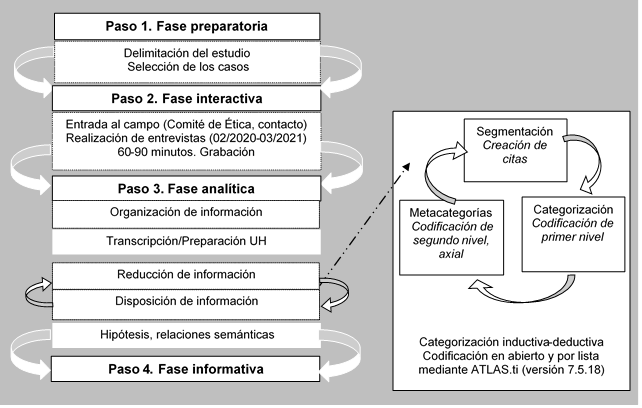

The interviews were conducted at participants’ homes on the following dates: February 11, 2020 (P1); February 19, 2020 (P2), February 21, 2020 (P3, P4), February 24, 2020 (P5), February 25, 2021 (P6), March 18, 2021 (P7, P8, P9).
Given the nature of the research, a deductive and inductive analysis was carried out following the procedures of Huberman and Miles (2000), for which we used ATLAS.ti software (version 7.5.18). This analysis was performed separately by each researcher and the resulting categories were reformulated by contrasting the two processes (Table 2). The aim was to triangulate the information to achieve sound results. The analysis began with five interviews, which made up the initial sample, and the remaining interviews were progressively added until data saturation was reached.
| Meta-category | Category |
|---|---|
| Legislation and educational authorities | Formulation of legislation |
| Application of legislation | |
| Relationship between school and society | Social and historical context |
| Families | |
| Methodology and practices | School culture |
| Discipline |
III. Results
The results are described below in accordance with our specific objectives.
3.1 Problems relating to legislation and education management
In pursuit of this specific objective, we analyzed the categories “Formulation of legislation” and “Application of legislation.” In the formulation of legislation, teachers shared three obstacles to education in democracy: the link to political changes, the lack of a structural reform, and the development of legislation in a way that is removed from educational practices. One teacher remarked, “Since 1970 (…) there have been perhaps 10 or 11 educational laws (…) the citizens of this country don’t know where they stand… it’s crazy” [P9].
First, the idea that education law is dependent on the political context is worth discussing. The sentiment shared above by participant 9 was common to all participants. Legal instruments were perceived as disorienting or detrimental to values education: “Every incoming minister wanted his or her own medal in education. And so education and education laws turned into a succession of awards of medals to ministers, a diabolical fabrication” [P4]. The idea behind educational legislation was seen as detached from educational practice: “I haven’t seen a law in which teachers have had any major say (…) in how these laws were drafted and could be applied to specific cases” [P4].
Moreover, changes in law were not innocuous as far as the idea of democratic education was concerned. Laws were developed in a way that reflected the governing ideology and varied in the extent of their support for participatory processes:
(…) Left-leaning governments (…) have always been more inclined to believe that people can reason for themselves (…) [and] create a proper democracy (…) than right-wing governments, which have no interest in people being able to think for themselves because they pose a threat [P1].
There was a feeling that it was with the LODE in 1985 that a channel was first established for the development of standards of democracy in schools. An explanation was also given of the ideological issue that has guided education policy surrounding the idea of education as a common good and a socializer of standards of democracy. It was agreed that the idea of democratization has been gaining ground, albeit disguised under the principle of freedom of school choice by families and the concierto agreements: “We’re equating that idea to democratization for all, the freedom of choice that families had to choose their ideology, but with public funding (…) But in fact, you’re making an ideology ‘within’” [P2].
This whole ideological disjuncture is clear from the following observation:
(…) Beginning in ’85, when the LODE was passed, (…) that was an important step toward increasing participation, (…) in the eighties and nineties, the LOGSE included school councils (…) [But] Aznar (…) wrecked the law with regulations; he removed all values education (…) The LOE brought up the issues of values education and participation again (…) But then, (…) the People’s Party (PP) won again (…) there’s a very strong element of liberal capitalism in the LOMCE [P7].
Secondly, teachers identified a separate issue: the lack of structural reforms as government projects. “They apply Band-Aid solutions but don’t address the heart of the matter, for example by making the education system fully secular” [P9].
It is precisely in the application of legislation that participants identified another obstacle to the construction of democratic practices, which they illustrated with the example of the LOGSE. While they described this law as the most innovative and democratic, it was spatially inconsistent in its implementation and failed to produce any great long-term effect over time: “In my area, what did I notice with the LOGSE? That the books changed, but they were incomprehensible” [P8].
According to these teachers, the degree to which the law was implemented was determined by the school’s location, although this process was hampered by frequent legislative changes that did not allow full implementation. This problem of the application of legislation to the reality of education was also mentioned in relation to other legal frameworks like the Law on Adult Education in the Valencian Community [P2], compensatory education [P3], or the recent Law on Inclusion in the Valencian Community [P2]. This is a view that is shared regardless of the regional context in which the law is being developed or applied.
3.2 Problems relating to the relationships between school and society
Fulfilling this second objective called for an analysis of the categories “Social and historical context” and “Families.” From the 1970s, schools in Spain must be understood in the context of a democratic transition, in which desires for change and openness converged with an interest in maintaining the traditional values of the nation proper to Francoism. This made it difficult to conceive of schools as a common good.
Politics has a great influence on the conception of the educational model, the way it is organized and managed, and the role of teachers in the two ideological and social directions reflected in the LGE. Participant 2 alluded to this issue clearly: “In a small town, an adult school is a place where opinions are formed. People gravitate towards engagement, alternatives, and political participation. And in this country, that causes fear.”
The creation of participatory spaces brought not only difficulties for democratization in schools, but also a control of teacher performance and, ultimately, academic freedom. Participant 3 recounted how her brother put his job in jeopardy through an attempt at social criticism, a matter provided for by the LGE:
(…) my brother is pretty left-wing, too. And the problem is the mayor was very hard right and so was the school’s principal, that’s just the way it was – the remnants of Francoism [P3].
This social and political framework makes it difficult to build democratic values in schools without adequate reform, despite victory by the socialist government in the 1980s. This resulted in a deficit that the teachers say remains to this day, “(…) this is not a democratic country. It still has democratic deficits that stem from the transition, and which affect us in schools” [P9].
This political context extends to schools, causing social division in teachers and students: “You get to school and you’ve got both worlds. The world created by Francoism and the world that was beating back” [P3]. But this classification is not only the result of ideological considerations; schools associated the right to access and enjoy education to a question of class, reflected in everyday practice: “Bring out the afternoon snacks for the poor,” was a refrain heard in some Salesian schools.
Furthermore, the Church plays a decisive role in shaping education. Not only are some teachers selected by the bishop’s office in keeping with the importance of religion in classrooms, but the religious tradition is still evident in schools after compulsory religion was abolished: “And so even though parents didn’t want the crucifix on the wall, because schools were now completely secular, there were teachers who wouldn’t agree to that” [P5].
However, the greatest challenge for democratic practices was the appropriation of educational discourse by the Church, resulting in continual interferences in political decisions:
The concordat of ’59 is not pre-democratic but dictatorial (…) Every time governments that were, let’s say, progressive attempted to make even a minor change, the Church rose up in arms and kicked up a storm [P9].
Against this backdrop, schools were not perceived as transformative but as dependent on social evolution: “Schools will always lag behind society (…) how can what is taught in schools contradict common knowledge?” [P9]
In this context, participatory education and education in democratic values are seen as conditioned by the socialization practices that guide social interactions. A similar phenomenon occurs with the relationship between schools and families, which, despite appearing progressively more participatory, is not free of obstacles to the development of democratic values in classrooms.
Firstly, the teachers perceived a lack of interest in pedagogical matters in the education process, especially in recent years, when school councils and other school participatory groups have become a farce exacerbated by the curtailment of powers in the recent LOMCE. They are figureheads if not direct actors in a politicized participation process. The teachers noted that this behavior differed from the very early school councils, “where you could be blown away by such great wealth3, ideas, contributions” [P3].
Secondly, pressure from families leads to a fear of breaking with traditional practices and hence a replication of non-participatory methodologies:
(…) I was playing, taking part… and I didn’t realize the end of the year was approaching and you hadn’t taught them to read. What a nightmare, having the mothers come wondering what the kids had done [P1].
But above all, families educate in values that may be contrary to those of a democracy, in which case schools are seen as ineffective:
(…) life is more or less structured into time periods of years with 365 days, of which 120 are school days. For those 120 days, they spend five to seven hours in school. There are still 13, 15, or 17 hours when they’re not in school, they’re with their families, in that environment [P9].
For years now, this discord between schools and families has been more widely noticed. Essentially, teachers think that “(…) you promote values in the classroom and they go back home and these values don’t exist” [P5]. Thus, the relationship between schools and families has undergone a substantial change, having shifted from a sense of collaboration and everyone rowing in the same direction to one of “nosaltres criticant a la familia i la familia al Mestre [us criticizing families and families criticizing teachers]” [P6].
3.3 Problems relating to classroom methodologies and practices
In response to the third specific objective, we considered the categories “School culture” and “Discipline.” One issue raised by teachers as particularly influential in developing classroom practices was school culture. “We were supposed to introduce democratic approaches (…) [and] encourage activities that gave children and their families a leading role in the world of education management” [P9]. But a legislative change does not directly entail a change in the unwritten rules of schools. In a context where educational changes are introduced into schools where the prevailing norm is “what we’ve always done,” teaching innovations break with the expectations that have been set. One example is the ideology under which the LOGSE was introduced: “I began to realize I could see the light, but what I had around me was… when I began project-based work and values education, that resulted in lifelong bullying for me” [P8].
In spaces at the forefront of education, such as pilot schools, teachers felt that innovation prevailed. But where the change was an individual choice, it was very difficult to break trends: “(…) the agony I went through to teach them to read with the primer… it would kill me if I were still there!” [P1]
A paradigmatic example of the influence of school culture can be found in the methodology and use of resources, where textbooks constitute the primary support: “(…) condiciona moltíssim, i d'alguna manera crec que era una trampa de model neoliberal, el que fa és reconvertir l'escola en una presa de productivitat” [It exerts a very strong influence and in a way I think it was a trap in the neoliberal model; what it does is turn the school back into a powerhouse for productivity]” [P6]. The predominance of textbooks results in the application of some traditional methodologies, the most resistant of which is assessment: “(…) you do competence-based tasks and activities, but then go back to examining with cold hard content” [P2].
This is all the result of a lack of genuine pedagogical innovation. New resources are introduced that lack any theoretical justification or utility and which do not represent a driving force for a change in school culture. “The apparatus was introduced into the vast majority of schools and that’s the end of the story. (…) What input are we going to have, other than the apparatus… we didn’t even meet up. And we’ve only got ourselves to blame. I’m not blaming anyone else” [P3].
Lastly, managing discipline was troublesome in a context of opening up education: “The children really grew and discipline was what failed most – because how can you impose discipline with democratic rule? (…) And it’s true that in some classes the kids got out of hand” [P3]. So it is that, in addition to those for whom consensus was a problem, there were also those who were incapable of “claiming their place” with the necessary authority.
IV. Discussion and conclusions
To return to the general objective of our research, we have explored the challenges for teaching practices in developing schools as spaces of common good and democratic citizenship based on the LGE. The teachers’ testimonies clearly show the disjuncture between the political and legislative dimension and the sociocultural dimension of education, as far as the role of schools as educators in democratic values is concerned. The impact of a context of continual ideological and political changes was identified as a decisive factor by teachers who favor a neoliberal and conservative approach or a democratic and participatory one (Samuelson, 1954). This view was shared by our interviewees regardless of their location, which was not a determining factor; rather, teachers were more concerned with the idea of and desire for change and improvement, from a perspective of democratic participation.
The idea of participation based on the principles of plurality, respect, freedom, and justice translated into a pedagogical approach that entails communal school management practices, coexistence based on dialogue and criticism, and decision-making rooted in the principle of shared responsibility (Crespo et al., 2018). This applied to and was associated with all three meta-categories explored (legislation, the relationship between school and the community, and classroom methodology).
Indeed, participants argued for a series of principles to govern educational practice in terms of participation at various levels of legislative and pedagogical action; from a sociocultural standpoint, educational practice should be based on civic and democratic values, applying the most juridical conceptualization of knowledge of public civic rights and duties (Cortina, 1997). Thus, teachers understand that democratizing society through education does not only mean quantitatively extending access to a greater number of individuals, but establishing community standards of social interaction and governance that incorporate individual interests within the idea of the common good (Ramis, 2013).
In each testimony, teachers expressed the problems they have experienced in their everyday practice since the LGE with a critical perspective. They also reconciled principles enshrined in law with their interest in a participatory, civic, and democratic education based on ideological and contextual factors: “It was a way to get them to understand the democratic system that had just been introduced in Spain (…). And it was necessary for children to understand how this structure worked (…) [how to] teach in a democracy (…)” [P8].
Specifically, the interviews offer a reflection on how schools have been unable to accomplish this participatory and critical goal due to the lack of a sociocultural structure supported by substantial political reform capable of turning schools into spaces that enable an understanding of daily administrative and teaching practices from the perspective of democracy and as a common good (Medina, 2015). Instead, what these accounts by teachers have shown is that schools have pursued and continue to pursue ideological and political interests: “Believe that change can come from education? Not in the slightest!” [P7].
In this sense – and the most recent example being the LOMCE – it is clear that it has not been understood that education is a communal, non-excludable good, where participatory equality should be continually nurtured and which cannot be guided by market principles (Friedrich, 2016). This idea is supported by participant 7 when she describes how this conservative ideology has prevailed:
(…) this has always been very clear to the Spanish right: citizens should not develop a sense of judgment or become more educated in order to make choices but simply to obey, (…) the way to achieve this is by not educating in values.
This same legislation restricts the ways in which the educational community can participate in school management, teacher autonomy, and the teaching approach. At the same time, it disguises the principle of freedom with a more utilitarian interest in families’ ability to choose and establish schools, downplaying the importance of freedom as a universal value in personal development: “You can see it in the curtailment of the powers of school councils” [P2]. Furthermore, the matter of freedom of school choice leads us to conceive of education as a private good.
A school that educates in democratic values is a community way of life based on social cooperation, interaction, and participation, which brings to mind the idea of the common as a social good with equal opportunities for all. This aim is guided by the idea of democratic participation by all actors within the educational community and the idea of a cosmopolitan populace (Puig & Morales, 2015).
This explains the importance of the relationship between school and the educational community, particularly family. Families have hindered these teaching efforts, challenged from a critical perspective due to the difficulties and above all cultural issues: “Most parents, we have to shoehorn them in to work. There’s an abandonment by families.” [P2] This has been the reason for criticism of the importance of social engagement in school management through the use of representative bodies for school councils and, especially, students and families, to shape habits of democratic behavior. This led teachers to remark on the educational benefit of opening up schools to society: “(…) above all, open up the classroom. It’s so tightly closed, so tightly closed… open it up to society” [P5].
In addition, to apply this participatory approach in the classroom, democratization needs to begin with the teaching methodology. The mechanisms for dialogue, respect, and deliberation need to be strengthened from a foundation of classroom learning, in order to achieve a democratic curriculum (Carrillo et al., 2019). In this regard, we observed that teachers were convinced of the value of applied methodology to build such an education in democratic values: “(…) podríem enfocar-se de cara al que és educar la democràcia si se'm plantejara el currículum de l'aprenentatge de projectes (…).I això seria una bona manera de aprofitar el currículum [they could focus on what educating for democracy is if a project-based learning curriculum were presented to me (…) And that would be a good way to make the most of the curriculum]” [P6]. However, it was also acknowledged that that is more dependent on the teacher’s interest in implementing it than the legislative framework, due to a failure to consolidate the operational mechanisms for educational innovation in democratic values that have been progressively established mainly since the LOGSE: “This is something that is still down to the individual discretion of teachers” [P9].
Therefore, we can conclude that the conception of education as a pillar for the development of democratic values is present in the interest and convictions of teachers, as part of the idea of cooperative interaction and engagement among agents of the educational community and its social commitment, hence their critical views of the difficulties experienced in implementing this goal. These are difficulties that, due to the separation between the political and legislative dimension and the sociocultural aspect of education, have impeded the ultimate aim of democratic socialization. This has been compounded by an ideological and political influence that has hampered the understanding of education as a common good. This thesis remains to be consolidated with a wider sample of participants, as well as work on other variables, such as the guarantee of the right to universal access to education and the issue of curriculum-based democratization (Bolívar, 2008).
Translation: Joshua Parker
Author contributions
María Luisa Rico Gómez: research, conceptualization, analysis, results, drafting, review and editing.
Ana Isabel Ponce Gea: research, conceptualization, analysis, results, drafting, review and editing.
Declaration of conflict of interest
The authors declare no conflict of interest.
Source of funding
Programa de Redes-I3CE de Calidad, Innovación e Investigación en Docencia Universitaria. Call for submissions 2020-21. Office of the Vice-President for Educational Quality and Innovation (Vicerrectorado de Calidad e Innovación Educativa) of the University of Alicante (UA, Spain).
References
Belavi, G. y Murillo, F. J. (2020). Democracia y justicia social en las escuelas: dimensiones para pensar y mejorar la práctica educativa [Democracy and social justice in schools: Dimensions to think out and improve educational practice]. REICE. Revista Iberoamericana sobre Calidad, Eficacia y Cambio en Educación, 18(3), 5-28. https://doi.org/10.15366/reice2020.18.3.001
Bisquerra, R. (2008). Educación para la ciudadanía y convivencia. El enfoque de la educación emocional [Education for citizenship and coexistence. The focus of emotional education]. Wolters Kluwer.
Bolívar, A. (2008). Ciudadanía y competencias básicas [Citizenship and basic skills]. Fundación Ecoem.
Buchanan, J. M. (1965). An Economic Theory of Clubs. Economica, New Series, 32(125), 1-14. https://doi.org/10.2307/2552442
Carrillo, I., Simó, N. y Soler, J. (2019). Aprender a participar en los centros de secundaria. Inclusión y calidad democrática [Learning to participate in secondary schools. Inclusion and democratic quality]. Edicions de la Universitat de Barcelona.
Constitución Española de 1978 [Const]. Artículo 27, 29 de diciembre de 1978 [Article 27, December 29th, 1978] in Boletín Oficial del Estado [BOE], no. 311 (Spain).
Cortina, A. (1997). Ciudadanos del mundo. Hacia una teoría de la ciudadanía [Citizens of the world. Toward a theory of citizenship]. Alianza Editorial.
Crespo, M., Megías, J.M., Rodríguez, M. y Parages, M.J. (2018). La escuela, un espacio para la convivencia democrática. [Schools, a space for democratic coexistence]. Revista Interuniversitaria de formación del profesorado, 92(32.2), 81-96. https://recyt.fecyt.es/index.php/RIFOP/issue/view/3386
Delgado, P. (2021). La Ley General de Educación en la memoria: del reconocimiento a la negación [The General Education Act in memory: From recognition to denial]. Historia y Memoria de la Educación, (14), 289-319. https://dialnet.unirioja.es/servlet/articulo?codigo=7962259
Escámez, J. y Gil, R. (2002). La educación de la ciudadanía. De la participación en la escuela a la participación ciudadana [Educating citizenship. From participation in schools to citizen participation]. CCS.
Escolano, A. (1989). Discurso ideológico, modernización técnica y pedagógica crítica durante el franquismo [Ideological discourse, technical modernization, and critical pedagogy during the Franco regime]. Historia de la educación: Historia de la Educación, 8,7-28. https://revistas.usal.es/index.php/0212-0267/article/view/6824
Feu, J., Serra, C., Canimas, J., Làzaro, L. y Simón-Gil, N. (2017). Democracy and education: A theoretical proposal for the analysis of democratic practices in schools. Studies in Philosophy and Education, 36, 647-661. https://doi.org/10.1007/s11217-017-9570-7
Flores-Crespo, P. (2018). La calidad de la educación como bien común [The quality of education as a common good]. Metafísica y persona, (20), 125-136. https://doi.org/10.24310/Metyper.2018.v0i20.4826
Friedrich, D. (2016). Teach for All, Public-Private Partnerships, and the Erosion of the Public in Education. En A. Verger, C. Lubienski y G. Steiner-Khamsi (Eds.), The Global Education Industry. World yearbook of education 2016 (pp. 160-174). Routledge.s
Gaete, A. y Luna, L. (2019). Educación inclusiva y democracia [Inclusive education and democracy]. Revista Fuentes, 21(2), 161-175. http://dx.doi.org/10.12795/revistafuentes.2019.v21.i2.02
Garcés, V. H. (2021). Educación ciudadana y convivencia democrática. Entre las políticas educativas, la alfabetización escolar y el aprendizaje en la ciudad [Citizen education and democratic coexistence. Between education policies, school literacy, and learning in a city]. Folios, (53), 19-30. http://www.scielo.org.co/scielo.php?script=sci_arttext&pid=S0123-48702021000100019
Giner, S. (2007). La dignidad cívica [Civic dignity]. In J. R. Carracedo, A. M. Salmerón, & M. Toscano (Eds.), Ética, ciudadanía y democracia (pp. 115-141). Contrastes.
Grau, R., García, L. y López, R. (2019). Percepciones sobre la escuela democrática en Argentina y España [Insights into democratic schools in Argentina and Spain]. Educaçao e Pesquisa, São Paulo, 45. https://doi.org/10.1590/s1678-4634201945188681
Hidalgo-Zurita, M. y Robles-Zurita, J. A. (2020). Participación política en España: el papel de la educación [Political participation in Spain: The role of education]. Papeles de Economía Española, 166, 203-215. https://www.funcas.es/wp-content/uploads/2021/01/Marisa-Hidalgo-Jos%C3%A9-Antonio-Robles.pdf
Huberman, A. M., & Miles, M. B. (2000). Métodos para el manejo y análisis de datos [Methods for data management and analysis]. In C. A. Denman & J. Armando (Eds.), Por los rincones. Antología de métodos cualitativos en la investigación social(pp. 253-301). El Colegio de Sonora.
Ley Orgánica 1/1990. De Ordenación General del Sistema Educativo. 3 de octubre de 1990 [Organic Law 1/1990. On the General Organization of the Education System. October 3rd, 1990]. Boletín Oficial del Estado [BOE] no. 238.
Ley Orgánica 5/1980. Por la que se regula el Estatuto de Centros Escolares. 27 de junio de 1980 [Organic Law 5/1980. Regulating School By-Laws. June 27th, 1980]. Boletín Oficial del Estado [BOE] no. 154.
Ley Orgánica 9/1995. De la participación, la evaluación y el gobierno de los centros docentes. 20 de noviembre de 1995 [Organic Law 9/1995. On School Participation, Evaluation, and Governance. November 20th, 1995]. Boletín Oficial del Estado [BOE] no. 278.
Martín, B. (2011). Técnicas e instrumentos de recogida de información [Information collection techniques and instruments]. In S. Cubo, B. Martín, & J. L. Ramos (Coords.), Métodos de investigación y análisis de datos en ciencias sociales y de la salud (pp. 173-233). Pirámide.
Martínez, R., Castellanos, M. A. y Chacón, J. C. (2014). Métodos de investigación en Psicología [Research methods in psychology]. EOS.
Medina, J. (2015). Educación democrática y política educativa: el sistema educativo a debate [Democratic education and education policy: The education system discussed]. Cuestiones Pedagógicas, (24), 103-124. https://revistascientificas.us.es/index.php/Cuestiones-Pedagogicas/article/view/9710
Merchán, F. J. (2021). La política educativa de la democracia en España (1978-2019): escolarización, conflicto Iglesia-Estado y calidad de la educación [The educational policy of democracy in Spain (1978-2019): Schooling, Church-state conflict, and quality of education]. Archivos Analíticos de Políticas Educativas, 29(61). https://doi.org/10.14507/epaa.29.5736
Mesa, M. (2019). La educación para la ciudadanía global: una apuesta por la democracia [Education for global citizenship: Promoting democracy]. Revista Internacional de Educación para la Justicia Social, 8(1). https://doi.org/10.15366/riejs2019.8.1.001
Milito, C. C., & Groves, T. (2013). ¿Modernización o democratización? La construcción de un nuevo sistema educativo entre el tardofranquismo y la democracia [Modernization or democratization? The construction of a new education system between late Francoism and democracy]. Bordón, 65(4), 135-148. https://recyt.fecyt.es/index.php/BORDON/article/view/Bordon.2013.65409
Ministerio de Educación y Ciencia (1969). La educación en España. Bases para una política educativa [Education in Spain. Foundations for an education policy]. Ministerio de Educación y Ciencia.
Nebel, M. (2018). Operacionalizar el bien común. Teoría, vocabulario y medición [Operationalizing the common good. Theory, vocabulary, and measurement]. Metafísica y Persona, (20), 27-66. https://doi.org/10.24310/Metyper.2018.v0i20.4830
Novoa, A., Pirela, J., & Inciarte, A. (2019). Educación en y para la democracia [Education in and for democracy]. Utopía y Praxis Latinoamericana, 24(extra 3), 60-73. https://produccioncientificaluz.org/index.php/utopia/article/view/29686
Ostrom, E. (1990). Governing the commons. The evolution of institutions for collective action. Cambridge University Press.
Puelles, M. (2016). Reflexiones sobre cuarenta años de educación en España o la irresistible seducción de las leyes [Reflections on forty years of education in Spain or the irresistible attraction of laws]. Historia y Memoria de la Educación, (3), 15-44. https://portalcientifico.uned.es/documentos/6241378e4ce2907daa320d02
Puig, M., & Morales, J. A. (2015). La formación de ciudadanos: conceptualización y desarrollo de la competencia social y cívica [Citizen education: Concept and development of social and civic competence]. Educación XX1, 18(1), 258-282. https://revistas.uned.es/index.php/educacionXX1/article/view/12332
Ramis, Á. (2013). El concepto de bienes comunes en la obra de Elinor Ostrom [The concept of commons in the work of Elinor Ostrom]. Ecología política, (45), 116-121. https://www.ecologiapolitica.info/novaweb2/wp-content/uploads/ 2015/12/045_Ramis_2013.pdf
Samuelson, P. A. (1954). The pure theory of public expenditure. The Review of Economics and Statistics, 36(4), 387-389.
Sánchez-Gey, J. (2021). Educación y democracia [Education and democracy]. Bajo Palabra, (25), 65-76. https://doi.org/10.15366/bp2020.25.003
Simó, N., Parareda, A. y Domingo, L. (2016). Towards a democratic school: The experience of secondary school pupils. Improving Schools, 19(3), 181-196. https://doi.org/10.1177%2F1365480216631080
Tiana, A. (2016). ¿Cómo piensa un académico que se hace una ley y cómo se hace una ley realmente? Reflexiones a partir de la intrahistoria de la Ley Orgánica de Educación (LOE) de 2006 [How do scholars think a law is made and how is a law actually made? Reflections based on the intra-history of the Organic Law of Education (LOE) of 2006]. Historia y Memoria de la Educación, 3, 71-97. https://portalcientifico.uned.es/documentos/5f88eb2929995259ef298c41
UNESCO (2015). Replantear la educación ¿Hacia un bien común mundial? [Rethinking education: Towards a global common good?] UNESCO. https://unesdoc.unesco.org/ark:/48223/pf0000232697
Viñao, A. (2011). Público-privado. Concepciones, malentendidos, estrategias [Public-private. Conceptions, misunderstandings, strategies]. Cuadernos de Pedagogía, (409), 80-83. http://hdl.handle.net/11162/37428
Viñao, A. (2016). La Ley Orgánica de Mejora de la Calidad Educativa (LOMCE) de 2013: ¿una reforma más? [The Organic Law for the Improvement of the Quality of Education (LOMCE) of 2013: Another reform?] Historia y Memoria de la Educación, (3), 137-170. https://dialnet.unirioja.es/servlet/articulo?codigo=5455669