
Alcántar, V. M. & Arcos, J. L. (2009). Community Liasion as factor for image and positioning of the Autonomous University of Baja California, Mexico, in the social and productive context. Revista Electrónica de Investigación Educativa, 11 (1). Retrieved month day, year, from: http://redie.ens.uabc.mx/vol3no1/contents-alcantar2.html
Revista Electrónica de Investigación Educativa
Vol. 11, No. 1, 2009
Community Liaison as Factor for Image and Positioning
of the Autonomous University of Baja California, Mexico,
in the Social and Productive Context
La vinculación como factor de imagen y posicionamiento
de la Universidad Autónoma de Baja California, México,
en su entorno social y productivo
Víctor Manuel Alcántar Enríquez (*)
valcanta@uabc.mx
José Luis Arcos Vega (*)
arcos@uabc.mx
* Coordinación de Planeación y Desarrollo Institucional
Universidad Autónoma de Baja California
Av. Álvaro Obregón y Julián
Carrillo s/n, Colonia Nueva, 21100
Mexicali, Baja California, México
(Received: September 16, 2007; accepted for publishing: August 23, 2008)
Abstract
This study presents the results of an extensive research on the society’s
perceptions of the activities the Autonomous University of Baja California (UABC,
for its acronym in Spanish Universidad Autónoma de Baja California) develops
in Mexico. This non-experimental research uses an explorative-descriptive methodology,
with a transactional research design based on a holistic method and an illuminative
evaluation, which analyzes the institutional positioning of UABC
in several social sectors, as well as its determining factors. Results support
the hypothesis that liaison activities have a significant effect on the regional
positioning of the UABC as a higher education institution.
The results also helped to identify weaknesses and opportunities that could
direct future institutional efforts. In addition, this study provides new elements
on liaison, institutional image, and positioning, as well as a conceptual model
that involves these variables.
Key words: Outreach, institutional role, higher education institutions.
Resumen
Este trabajo presenta los resultados de un estudio realizado en extenso sobre
la percepción social del quehacer de la Universidad Autónoma de
Baja California (UABC), en México. Se utilizó
una metodología exploratoria-descriptiva, con diseño de investigación
no experimental-transeccional basado en el método holístico y
la evaluación iluminativa, que permite analizar el posicionamiento institucional
de la UABC ante los diversos sectores de la sociedad,
así como sus factores determinantes. Los resultados sustentan la hipótesis
de que las actividades de vinculación influyen significativamente en
el posicionamiento regional de la UABC como institución
de educación superior, y se identificaron debilidades y áreas
de oportunidad que podrían orientar los esfuerzos institucionales futuros.
Adicionalmente, el estudio aporta nuevos elementos sobre los temas de vinculación,
imagen institucional y posicionamiento, así como un modelo conceptual
que contempla estas variables.
Palabras clave: Vinculación, rol institucional, instituciones
de educación superior.
Introduction
The Autonomous University of Baja California (UABC for
its acronym in Spanish) is a higher education public institution decentralized
from the State administration. UABC has full legal capacity
to perform its three main substantial functions which have the objective of
providing higher education to train professionals, as well as promoting and
conducting scientific research focused mainly on state and national issues (Congreso
del Estado de Baja California, 1957). The economic resources necessary for the
University to function are obtained from the federal government (44%) and the
State government funds (32), they are complemented by the resources obtained
by the own institution (24%).
The UABC educational model is flexible, innovative, and
proactive; it is student centered also. It trains professionals with the necessary
skills, aptitudes, capacities and principles so that they can develop within
the different academic fields. Liaison activities are directed to promote a
multidirectional and inclusive system between the University and the community,
which supports research, teaching and continuous education, through the application
and generation of knowledge, technology transfers, as well as consulting, training,
community services, among others.
Within the university, UABC has promoted liaison activities
as part of a dynamic and flexible action framework, based on principles of equity,
relevance, and pertinence, in order to support international, national and international
community sustainable development (UABC, 1999). Nonetheless,
efforts directed to this objective are not enough to fulfill the expectations
of the community of Baja California. Some internal factors that have affected
the achievement of the objective are the omission of liaison activities within
the institutional structure and the lack of formal norms to regulate and organize
liaison actions (UABC, 2001).
Nowadays, the general opinion is that there is a need for Higher Education Institutions
(IES, for its acronym in Spanish Instituciones de Educación
Superior) to strengthen liaison activities between them and their social environment.
Since actions taken within the institution are still insufficient (which discredit
its social value and prevents the institution from taking advantage of collaboration
opportunities with great potential impact on local and regional economic development),
the need to establish appropriate guidelines to support social participation
becomes more evident every day. The development of those guidelines strengthens
university liaisons with the community and its immediate environment (Secretaría
de Educación Pública, 2001).
Despite of the public IES achievements during the last
years, their image has deterred due to several factors: lack of accountability,
questionings on the transparency of their use of public resources, short attention
to the demand, low-level education, and, mainly, community unacquaintance with
the different administrative-academic activities that IES
develop.
Due to the above mentioned, The National Association of Universities and Higher
Education Institutions (ANUIES, for its acronym in Spanish
Asociación Nacional de Universidades e Instituciones de Educación
Superior,) emphasized the need to encourage positive opinion on universities
through the diffusion of relevant information about transformation actions taken
within them during the last years. The objective is that the national university
community, as well as the public in general can recognize the accountability
mechanisms, and assess the benefits of quality of work, as well as the IES
impact on the country’s development.
In consonance with some studies conducted on public image, Parameswaran and
Glowacka (1995) suggest that universities’ general image contributes to
the perception of their own characteristics. According to the authors, it is
important to develop research studies on universities to identify their image
and develop strategies for their positioning and repositioning.
In addition, information gathering indicated the scant relationship that exists
among liaison, image, and positioning, within the higher education
context. From here, the proposal to develop a research centered in liaison activities
as variables that influence on institutional image as well as positioning arises
in order to obtain elements that lead to the design of a conceptual model that
provides strategic development lines to favor the repositioning of UABC.
This research intends to contribute with new strategies and mechanisms that
define different characteristics than those that are traditionally ascribed
to liaison, such as those related to image and university positioning in its
environment. New characteristics can be referents to improve continuously IES
administrative processes.
Once the importance of liaison activities is identified, considering they are
factors for the positioning of the university within its social and productive
environment, the following hypothesis is sustained: The institutional image
perceived in and out of the university, specifically the image of liaison, significantly
influence the positioning of the UABC.
This approach coincides with the hypothesis held by Parameswaran and Glowacka
(1995), that defines the general institutional image as the addition of several
individual characteristics, which when transmitted to the outside, establish
the institution’s positioning or location in the community within a limited
context (Álvarez, 2000; Gallo, 2000).
Consequently, this research introduces mechanisms that lead to a new positioning
of the University through organized initiatives that determine the role of liaison
as a device that fosters and favors a synergy inside the institution, through
the main functions, and in the outside through society sectors. This would provide
a greater understanding on the university activities and would favor the good
assessment of its characteristics by the society, which would reduce the gap
between community perception and the institutional current position.
This research consists of five sections which include the following activities:
1. Theoretical Considerations
1.1 Liaison
The importance community liaison has acquired during the last years within the
educational discourse has resulted in different positions and conceptions about
this university, which some authors compare to the status of the substantial
function of the university (Dagnino, Thomas & Davyt, 2000).
It is important to emphasize that the relationship established between the university
and the community is conceptual, and it is important to have a clear idea of
what is considered relevant, in order to be able to identify the risk of falling
into the irrelevance that threat institutions. Also, there is the need to understand
that inside the university, every area has an obligation to be at the service
of the community and its needs (Martínez, 2000).
It is for this reason that liaison is considered a process where academic and
community activities interrelate permanently and generate knowledge and solutions
to the nowadays and future social issues; besides, these activities guide, feedback
and improve human resources training programs, scientific research, as well
as technological and cultural development (Castañeda, 1996). In this
way, liaison can be recognized as a strategy that allows institutions to strengthen
their processes of academic development and the quality of their services (Pallán,
1997).
The liaison of IES with productive sectors contributes
positively to students’ and professors’ training and update; the
solution of local, regional, and national problems; faculty pedagogical training;
process innovation and improvements, as well as effective insertion within the
cultural and community life (De Armas, 2001).
On the other hand, UABC defines liaison as a policy for
the development of a multidirectional and integral system which connect the
institution with its environment to support the constant flow of academic, scientific,
and cultural products and services. The foundation of such system shall begin
with a dynamic and flexible action framework, which concentrates on the principles
of equity, relevance, and pertinence, in search for sustainable development
(UABC, 2001).
The most general conception of liaison relates it to business and the productive
sector, but leaves aside the wide range of possibilities that the social sector
offers. This trend is related to the fact the educational and productive sectors
are economic and social development drivers; thus, an effective liaison between
both, based on policies of organizational change, the search for knowledge pertinence,
and the development of skills, is the key for the country’s integral and
sustainable development. It is necessary to understand liaison as an integral
relationship between IES and the community, so that fields
of knowledge at the IES contribute to society (ANUIES,
2000).
In order to integrate an efficient professional training system, it is of considerable
importance that the sectors involved keep communication channels, because this
liaison is the key between education institutions, the social and productive
sectors, besides professionals (Covarrubias, 1996).
Nowadays, most of the universities agree on the importance of setting liaison
relationships with their community, as well as performing their functions inside
and outside the university facilities. In order to do so, the support of the
community is necessary, whether to orientate or watch for these activities.
1.2 Institutional Image and Positioning
The ability of universities to face the current changes and make the most of
opportunities the new community circumstances present, will become greater as
they are provided with adequate infrastructure, enough funds to subsidize their
institutional development, and ensure the social compromise that identifies
them; only then will they be recognized by the community they serve to.
One of the UABC institutional policies considers the idea
of establishing actions that help to get state, regional, national, and international
positioning, as a result from an enhanced institutional image and its ability
to relate to the social and productive sectors (UABC,
1999).
Thus, the legitimization of image and positioning management refers to a complex
institutional responsibility, upon which the university has the obligation to
train professionals, foster and conduct scientific research, extend cultural
benefits, and fulfill the demand of the society and its environment.
Image is considered a strategic asset that becomes more important every day.
Companies and institutions have discovered that product advertisement is no
longer enough and that it is necessary to portray a comprehensive and credible
image (Costa, 1997).
While positioning is a concept linked to image and association except that it
also involves a context framework that refers to other product or service competitive
rivalry. Thus, positioning is the space or niche in the clients’
or customers’ mind, the objective has a permanent connotation.
1.3 Relationship between Liaison, Institutional Image and Positioning
Generally, IES undergo changes with the purpose of creating
a positive image or getting certain positioning, they do this for the same reason
that other organizations do, because all of them need from positive opinion
in order to develop. Doing a good job is not enough; it is essential to convince
the public in general, which translates into a series of benefits for the university
(Albrighton and Thomas, 2001). For that reason Rowland H. (1986), cited Pullman,
and stated that the work of fostering complete understanding and significant
support to the institution, should start at the core of the same institution:
trust must be sought, as well as understanding, appreciation and value within
it.
Within the literature revised, there are cases where a successful liaison with
different sectors —social and/or productive —resulted in an improved
image and positioning of the IES. For example, in Canada,
thanks to an important government investment, all universities of Quebec established
departments that facilitated and foster the liaison between universities and
companies (Villiers, 1997).
Arellano and Ortega (2002) suggest that most of the supporters of the liaison
between the academic field and the productive sector in Mexico were inspired
by the positive effect that development as well as the use of scientific and
technological knowledge generated on economic growth of industrialized countries.
If higher education social benefits are closely related to meet companies’
needs or the institutions ‘access to additional funding, and professional
human resources training, then, said association extends to a social and community
projection of the IES substantial activities.
II. Methodology
This research uses an explorative-descriptive methodology, with a non-experimental,
transactional research design (Hernández Sampieri, Fernández,
and Baptista, 1999, 2003) based on a holistic method and illustrative evaluation.
The holistic method is defined as a collection of actions and consequences which,
even when they are unknown, have a common purpose and they are organically related.
Therefore, a single action can be positioned functionally in the totality of
a context (Stufflebeam and Shinkfield, 1985). As far as the illustrative evaluation
is concerned, it is based on a flexible qualitative methodology for the study
of the context; besides, it is based on the most significant elements of the
subjects under study, besides the useful value judgments and proposals centered
on the objectives (Monedero, 1998).
This research study intended to specify important properties and characteristics
of the subjects, groups, and communities; in addition, it searched for information
on certain concepts or variables within a natural context in order to analyze
them; then, assess the elements or dimensions of the phenomenon studied.
Elements that interacted with the UABC, such as its students,
faculty, and administrative personnel, as well as the productive, government
and general population were identified based on their relation to the categories
of image, liaison and positioning for the instrumentation and administration
of the illustrating evaluation (Figure 1).
Figure 1. UABC context with the holistic method
The illustrative evaluation is characterized by the collection of information
which allows adequately contributing, specifying, and describing the phenomenon’s
complexity and studying the problems in order to transmit the holistic impression
and the context, Baja California in this case, of the categories under analysis:
institutional image, liaison, and positioning.
Then, the relationship among the variables of institutional image, liaison,
and positioning with the subject of study was determined, as well as his or
her perception and interaction with internal and external factors, where liaison
is considered a main articulator that carries UBAC correct
institutional positioning, within a continuous feedback process (Figure 2).

Figure 2. Liaison as a mean for institutional image and positioning
In a research of this kind, design is defined by the identification, description
and assessment of variables. Knowledge on the researched field must be possessed
in order to formulate specific questions that must be answered, based on measurements
of one or more aspects of the phenomenon, where the subject under study identifies
with or relates to a certain group or level. Also, variables are studied at
one specific moment and time.
For the purpose of this research, three categories were identified: institutional
image, liaison, and positioning. Baja California was the context for the research,
were the subject has external interaction with the productive sector, the government
and general population. Also, he or she has internal interaction with students,
faculty, and administrative personnel. The objective of these procedures was
to assess the impact that UABC institutional image had
on its positioning (Hernández, Fernández, and Baptista, 1999,
2003; Stufflebeam and Shinkfield, 1985).
Two questionnaires were designed based on the exploratory study using group
interviews. Experts in psychology, education, sociology, and administration
participated in the design of the questionnaires (Grupo Andere, S. C., 2000).
The integration was by sectors:
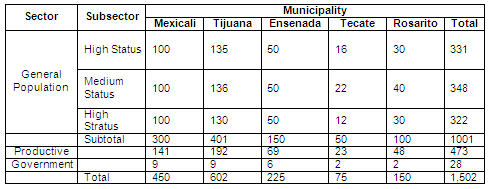
The questionnaire was administered to a sample of 2,857 subjects, 1,355 were
from inside the university, out of the total university population of 27,384.
1,502 subjects were from outside the university out of the total population
of 2,487,367, which represents the general population, the productive and the
government sector.
The size of the sample derived from the 27,384 of the university
population that includes students, faculty, and administrative personnel, and
who constitute the total number of subjects under study of the internal sector
during the period 1999-2.1 The
size of the sample was calculated by proportions, with a risk of incorrect acceptance
of 3.5% and with a confidence level of 99% (Table I).
Table I. Distribution of the sample size in the internal sector
of UABC

In the other hand, based on the 12th General Census of Population and Housing of 2000 (XII Censo General de Población y Vivienda), the external sector, represented by Baja California population of its five municipalities, registered 2,487,367 inhabitants.2 Due to this fact, a sample of 1,503 subjects was obtained, with a risk of error acceptance of 3.3% and a confidence level of 99% (Table II).
Table II. Distribution of the size of the sample for the external
sector
III. Results
University population’s opinions on the institutional perception of UABC
prestige and leadership were divided when it came to how the institution declared
itself publicly about issues that affect the State population. The diffusion
that the University gives to the information related to students’ and
professors’ achievements was considered enough. In the internal questionnaire
as in the external one, participants indicated that UABC
had enough information diffusion on the performance of professors and students
(Figure 3).

Figure 3. Perception of prestige and leadership in the internal questionnaire
The analysis showed that among subjects who belonged to the university population,
the inhabitants of the municipality of Mexicali registered a greater proportion
of answers favoring UABC leadership of opinion (78.5%),
although Tecate registered the greatest number of favorable answers regarding
institutional participation on community issues (72.2%).
On the other hand, regarding academic quality, answers showed that the indicators
of trust in the institution had the greatest proportion in the internal
questionnaire, followed by the pedagogical model that occupied a similar
place in the external questionnaire. The external sector maintained in all cases
a very similar opinion pattern to that of the university population, so it is
safe to affirm that, as far as the academic quality is concerned, there was
agreement between those who are part of UABC and those
who are not (Figure 4).

Figure 4. Perception of the academic quality of UABC
The quality of faculty was present in all municipalities with the
same answer for both questionnaires conducted: a positive evaluation predominated.
The same happened with the opinion about the quality of graduates from the institution.
As far as the factor of institutional identity is concerned,
the resutls described in Figure 5 indicate that the univerisity community was
identified with the objectives of the institution, because 71% of the participants
answered they identified with them.

Figure 5. Perception of the institutional identity
The university anthem had a similar acceptance. It was placed second
in the position of favorable answers, mainly in the municipality of Mexicali.
The answer that varied the most was identification with the university emblem,
which suggests that it is not consolidated among the members of the UABC
community and it indicates the need to systemize and regulate the use of emblems
in order to improve their perception and index of remembrance among receptors.
Liaison perception results are shown according to the operative
variables: community services, diffusion and liaison activities in
the UABC.3
Figure 6 shows that the percentage of satisfied users by municipality were always
better in the internal questionnaire, which indicates a different perception
of those who are from the institution and have been involved in liaison activities.

Figure 6. Perception of liaison with community
services (User satisfaction)
Similarly, the results of community service by sector produced the same behavior
that was previously observed. Institutional liaison activities related to the
agricultural sector received a positive opinion in both questionnaires in the
municipality of Mexicali, specially. In the industrial sector, the university
community of the four municipalities gave the same answer that referred to the
effectiveness of liaison activities. Regarding the opinion on liaison activities
related to the trading and service sectors, as well as the social and government
sectors, it was interesting that the only difference that outstands between
both questionnaires is the perception of effectiveness in the municipality of
Tecate, because the university community showed more favorable answers than
the external community.
There were some noticeable differences on the perception between the internal
and external population of the university, which can affect the image that university
population portray.
Figure 7 shows the differences between the internal and external questionnaires
for the categories related to diffusion and liaison activities, particularly
collaboration with the University raffle. The university population and the
external community reached similar proportions though in an opposite manner
as far as the reading of university publications are concerned: it is affirmative
for the internal questionnaire and negative for the external questionnaire.

Figure 7. Perception of liaison with diffusion and liaison activities
Similarities were found only on the opinion about the role the University plays
as a diffuser and promoter of arts and culture, since the university population’s
opinion was slightly higher (64.7%) than the one from the external community
(58%).
Finally, results were organized with the objective or grouping the variables
of institutional image and liaison, which consist at the same time of the operative
variables of prestige and leadership, academic quality, community service, and
diffusion and liaison programs, with impact in both sectors:
Through a total sample of 2,857 observations, the contingency data was obtained and it is displayed in Table III.
Table III. Contingency table of institutional image and liaison
variables

To calculate the statistics of the test the following formula was used:

Were  , is the observed value
(participant perception) that corresponds to the ith variable category of image
and liaison and the jth column of the contingency table that denotes the type
of perception (positive or negative). The
, is the observed value
(participant perception) that corresponds to the ith variable category of image
and liaison and the jth column of the contingency table that denotes the type
of perception (positive or negative). The  is the expected value that corresponds to the ith category of operative variables
and the jth column that indicates the expected value when compared with every
observed value.
is the expected value that corresponds to the ith category of operative variables
and the jth column that indicates the expected value when compared with every
observed value.
In terms of the statistics test, the null hypothesis is: “Institutional
image perceived by the internal and external sectors, specifically liaison,
does not significantly affect UABC positioning”,
and by exclusion, the alternative hypothesis is: “Institutional image
perceived by the internal and external sector, in particularly liaison, significantly
influence in UABC positioning”.
The results show that the research statistics (470.21) exceeded the critical
value of the chi-square to reject the null hypothesis (11.34). Thus, statistical
evidence is sufficiently enough to reject the null hypothesis and favors the
alternative hypothesis: “Institutional image perceived by the internal
and external sector, in particularly liaison, significantly influence in UABC
positioning”.
By assessing the institutional image of the University and the perception of
its liaison activities of the internal sector, which consists of students, faculty,
and administrative personnel, as well as the external sector, integrated by
the productive sector, general population and government, it was possible to
test the impact of institutional image, and, specifically, liaison activities
in UABC positioning, by contextualizing it as a subject
of study with the holistic method.
This showed the influence that liaison has over institutional positioning from
the perspective of the subjects under study; if it is assumed that general institutional
image is the compendium of the university’s characteristics when these
are known (Parameswaran and Glowacka, 1995).
To summarize, these results show that institutional image is strongly linked
to the University’s communication efforts and, according to Perkins (1986),
a university will gain recognition and support, only when it has gained the
confidence from the different audiences it depends on, so it must accept the
fact that in order to gain recognition, it is essential to keep people informed.
As far as academic quality is concerned, it is important to mention that UABC
had an acceptable opinion by those that answered the questionnaire. On the other
hand, institutional capacity was considered an important weakness to bring academic,
sport, social, artistic cultural events to internal and external audiences.
This fact is relevant due to the recognition that the University should have
as an integrating element of the different sectors of the community in Baja
California.
IV. Conclusions and Recommendations
As a fundamental part of this research study, the hypothesis “Institutional
image perceived by the internal and external sectors, specifically liaison,
significantly influences in UABC positioning” was
proved.
Regarding the institutional image, it is understood that university activities
do not have the desirable impact on the community. This means that the lack
of recognition can also be attributed to inadequate image strategies that influence
the low or unsatisfactory perception level of the institution regarding it leadership
within community environment.
Similarly, due to the fact that the UABC does not have
an institutional image plan that guides and articulates the efforts in this
matter, there is not enough information to contextualize the problem in its
true dimension.
Regarding community liaison, it can be affirmed, according to the results that
range from low to unsatisfactory within the data collected from the different
sectors that answered the questionnaires, that there is a low satisfaction on
liaison activities UABC develops within its environment.
Likewise, the media resources that the institution has are not the ideal ones,
since results from the questionnaires show that UABC does
not have great television and radio audiences within the external and internal
sectors.
The perception of community liaison based on the attention level that the University
gives to the issues present within the community is unequal and with a low level
of favorable answers given by the external community, this is an upsetting fact.
Despite of the fact that assessments within the State, favored in general UABC,
its institutional positioning does not surpass other IES
with regional or national influence, since it is the second or third place when
compared to other universities. This position is not homogenous within internal
and external perceptions, the phenomenon is manifested equally in the municipal
environment. The latter suggests that the presence of the University is different
in the different municipalities and that there is a lack of organized and structured
work concerning state image and positioning.
The UABC has started to change based on self-assessment
and the external certification of its academic and administrative processes.
However, there is the need of more research studies on the variables that affect
the institutional positioning, and focused on the recognition of the differences
between the purposes and operative methods of the institution, regarding its
own needs and those of the community.
It is important to emphasize the need to restructure processes of image and
community liaison that are currently assigned to the coordinators, who are part
of the new university administrative structure, with the purpose of achieving
a true impact in the internal positioning of the institution, and consequently
in the community.
It is essential that the UABC undertakes a more active
role as an opinion leader in problems that affect the community, which will
provide it with a better positioning, by getting a leadership position in the
public’s mind. The university community shall assume the responsibility
of offering solutions to these problems through relevant actions, such as: redirecting
research lines to topics that affect society, fostering discussion forums with
enough academic rigor to have an effect on government and politics decision
making.
Likewise, the University needs to ensure quality through the accreditation of
its academic programs, the certification of its administrative processes with
international level standards, and the scrutiny from recognized entities in
the global community.
It is necessary to establish clear rules for the faculty regarding obligations
and benefits, particularly in liaison projects. On the other hand, it is their
obligation to achieve a more flexible bureaucratic and normative structure in
order to give quality results to the sectors when they expect them.
Constantly, administration must assess its pertinence and its quality levels,
which is possible through internationally recognized systems, such as the managerial
processes certification that can be sustained trough modern procedures and technologies
used as platforms to support the tasks of the University community.
Through this research study, a wide range of elements that support the need
to consider community liaison as a strategy have been demonstrated; these elements
are important so that UABC can fulfill the expectations
of the community that created it, and it can be immerse within the community
as a main actor. As internal and external liaison actions are strengthen, taking
into consideration the improvement of the institutional image and positioning,
the University will continue to be a current driver of national development.
References
Albrighton, F. & Thomas, J. (2001). A Rose by Any Other Name. Brand Management
and Visual Identity. In F. Albrighton & J. Thomas (Eds.), Managing External
Relations (pp. 8-19). Philadelphia, PA: Open University.
Alcántar, V., Arcos, J., & Mungaray, A. (2006). Vinculación
y Posicionamiento de la Universidad Autónoma de Baja California con su
Entorno Social y Productivo. Mexico: Asociación Nacional de Universidades
e Instituciones de Educación Superior-Universidad Autónoma de
Baja California.
Arellano, A. & Ortega, C. (2002). La Investigación Tecnológica
Universitaria y su Vínculo con el Sector Productivo. El Caso de la Universidad
Autónoma del Estado de México. In L. Corona & R. Hernández
(Coords.), Innovación, Universidad e Endustria en el Desarrollo Regional
(pp. 469-484). Mexico: Plaza y Valdés.
Asociación Nacional de Universidades e Instituciones de Educación
Superior. (2000). La Educación Superior en el Siglo XXI. Líneas
Estratégicas de Desarrollo. Mexico: Author.
Álvarez, Y. (2000). Imagen Corporativa. Teoría y Práctica
Desde un Enfoque Psicológico. La Habana, Cuba: Instituto Cubano
del Libro-Editorial de Ciencias Sociales.
Castañeda, M. (1996). Panorama de la Vinculación en México.
In M. Sánchez, J. Claffey, & C. Castañeda (Coords.), Vinculación
entre los Sectores Académico y Productivo en México y Estados
Unidos (pp. 21-26). Mexico: Asociación Nacional de Universidades
e Instituciones de Educación Superior.
Congreso del Estado de Baja California. (February 28, 1957). Ley Orgánica
de la Universidad Autónoma del Estado de Baja California. Periódico
oficial del Estado de Baja California LXVIII, 117.
Costa, J. (1997). Identidad Corporativa. Mexico: Trillas-Sigma.
Covarrubias, J. (1996). Ideas Sobre la Formación de los Ingenieros
para el Futuro. Mexico: Fundación ICA.
Dagnino, R., Thomas, H., & Davyt, A. (2000). Vinculacionismo/ Neovinculacionismo.
Racionalidad de la Interacción Universidad-Empresa en América
Latina (1955-1995). In R. Casas & G. Valenti (Coords.), Dos Ejes en
la Vinculación de las Universidades a la Producción. La Formación
de Recursos Humanos y las Capacidades de Investigación (pp. 25-48).
Mexico: Universidad Nacional Autónoma de México-Universidad Autónoma
Metropolitana.
De Armas, R. (2001, December). Las Estructuras de Enlace en la Vinculación
universidad-sector productivo y de servicios. La unidad docente, una de sus
manifestaciones en la Educación Superior cubana. Almamáter,
5. Retrived Decemeber 2, 2002, from: http://www.utc.edu.ec/Alma_Mater/revista_5/indice_6.htm
Gallo, G. (2000). Posicionamiento: El Caso Latinoamericano. Colombia:
McGraw-Hill.
Grupo Andere, S. C. (2000). Reporte de Reuniones de Focus Group. Unpublished
Manuscript.
Hernández Sampieri, R., Fernández, C., & Baptista, P. (1999).
Metodología de la Investigación (2nd ed.). Mexico: McGraw-Hill.
Hernández Sampieri, R., Fernández, C., & Baptista, P. (2003).
Metodología de la Investigación (3rd ed.). Mexico: McGraw-Hill.
Martínez, F. (2000). Nueve Retos para la Educación Superior.
Funciones, Actores y Estructuras. Mexico: Asociación Nacional de
Universidades e Instituciones de Educación Superior.
Monedero, J. (1998). Bases Teóricas de la Evaluación Educativa.
Mexico: Aljibe.
Pallán, C. (1997). La Pertinencia Social de la Vinculación Universidad-Empresa
en México. In C. Pallán & G. Ávila (Eds.), Estrategias
para el Impulso de la Vinculación Universidad-Empresa (pp. 25-29).
Mexico: Asociación Nacional de Universidades e Instituciones de Educación
Superior.
Parameswaran, R. & Glowacka, A. (1995). University Image: An Information
Processing Perspective. Journal of Marketing for Higher Education,
6 (2), 41-55.
Perkins, D. R. (1986). Interpreting the Institution to External Constituencies.
In A. W. Rowland (Ed.), Handbook of Institutional Advancement (pp.
152-161). San Francisco, CA: Jassey-Bass.
Rowland, H. (1986). Building Effective Internal Relations. In A. Rowland, Handbook
of Institutional Advancement (pp. 139-151). San Francisco, CA:
Jassey-Bass.
Secretaría de Educación Pública (2001). Programa Nacional
de Educación. Mexico: Author.
Stufflebeam, D. L. & Shinkfield, A. J. (1985). Evaluación Sistemática.
Guía Teórica y Práctica. Barcelona: Paidós.
Universidad Autónoma de Baja California (1999). Plan de Desarrollo
Institucional. Mexico: Author.
Universidad Autónoma de Baja California (2001). Departamento de Vinculación
con el Sector Productivo. Retrieved from: http://www.uabc.mx/vinc/
Varela, G. (1999). Los Patrones de Vinculación Universidad-Empresa en
Estados Unidos y Canadá y sus Implicaciones en América Latina.
In R. Casas & M. Luna (Coords.), Gobierno, Academia y Empresas en México:
Hacia una Nueva Configuración de Relaciones (pp. 27-65). Mexico:
Universidad Nacional Autónoma de México.
Villiers, C. (1997). La Experiencia Desarrollada por las Universidades y las
Empresas de Quebec. In C. Pallán & G. Ávila (Eds.), Estrategias
para el Impulso de la
Vinculación Universidad–Empresa (pp. 451-460). Mexico: Asociación
Nacional de Universidades e Instituciones de Educación Superior.
Translators: Eleonora Lozano and María Isabel Ramos
1When this research was conducted, the UABC had no extension in the Municipality of Playas de Rosarito; this is the reason why no participants were registered for the internal sector.
2The greatest number of participants (1,193) was in the municipality of Mexicali, which is the capital of the State and where the university unit with most population is located.
3The concept of university liaison activity is the combination of policies, criteria and promotion strategies of the university (Alcántar, Arcos, & Mungaray, 2006).